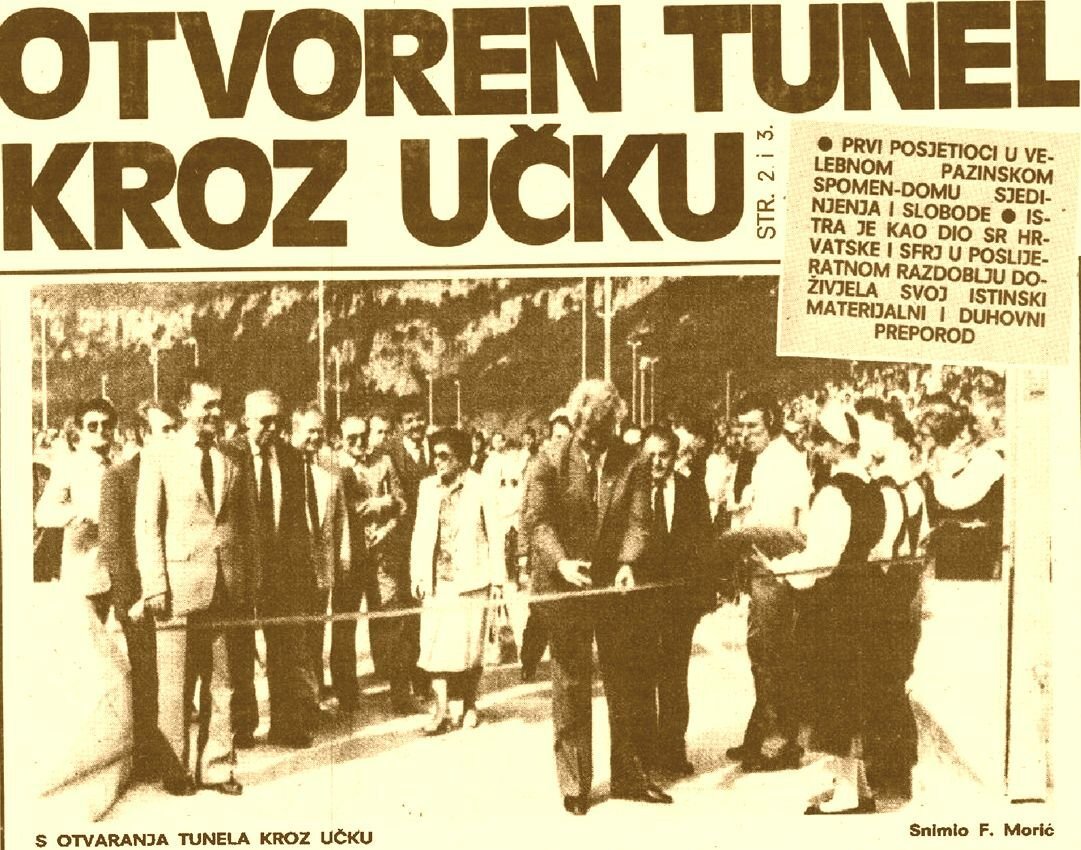
More than 15,000 people gathered on Sunday September 27, 1981, for the opening of the Učka Tunnel, one of the largest traffic projects in Croatia at the time. The 5062-meter-long tunnel was not only a construction feat but also a symbol of traffic connectivity between Istria and the rest of Croatia.
Meeting in the belly of Učka
The entire demanding project was accompanied by a great deal of skepticism. At one point, it was even suggested to abandon the breakthrough of Učka and connect Istria via the so-called island connection, that is, bridges over Krk and Cres.
Construction began in August 1976, with workers from Split’s Konstruktora, who were tunneling from the Kvarner side, and Zagreb’s Hidroelektra, which was advancing from Istria. They greeted each other for the first time when the last mine was activated on May 5, 1978 – at 4:15 AM, it made a hole through which ‘the light at the end of the tunnel’ could finally be seen. The deviation between the two teams tunneling from opposite sides was only five centimeters, which is still considered an extraordinary engineering achievement today.
Traffic connection of Istria with the motherland
The tunnel was opened as part of the celebration of the 38th anniversary of the decision to unite Istria with the motherland, which gives the event an additional symbolic dimension. The tunnel not only shortened the journey between Kvarner and Istria but also enabled a fast, safe, and year-round road connection across the mountain massif that had represented a natural barrier for centuries.
Although Istria is geographically part of Croatian territory, it had long been isolated in terms of traffic. Učka and Ćićarija had hindered connections with the Rijeka and Zagreb areas for centuries. Traveling over the pass was slow, especially in winter, and the development of tourism and the economy constantly faced limitations of the then traffic network.
For this reason, the opening of the tunnel in 1981 was perceived as the beginning of a new era. Istria finally received a fast, safe, and year-round modern road connection with the rest of the country, which was particularly significant for the population, the economy, and the increasingly strong tourism.
The second tube and the end of the traffic bottleneck
Since the end of 1995, the tunnel has been managed by the concessionaire, the Franco-Croatian company BINA-Istra, led by the French group Bouygues, which built the first phase of the Istrian Ypsilon in semi-profile by 2006.