Home / Companies and Markets / From Bicycle to Factory: RIPS Today Produces 4 Million Lanterns

From Bicycle to Factory: RIPS Today Produces 4 Million Lanterns

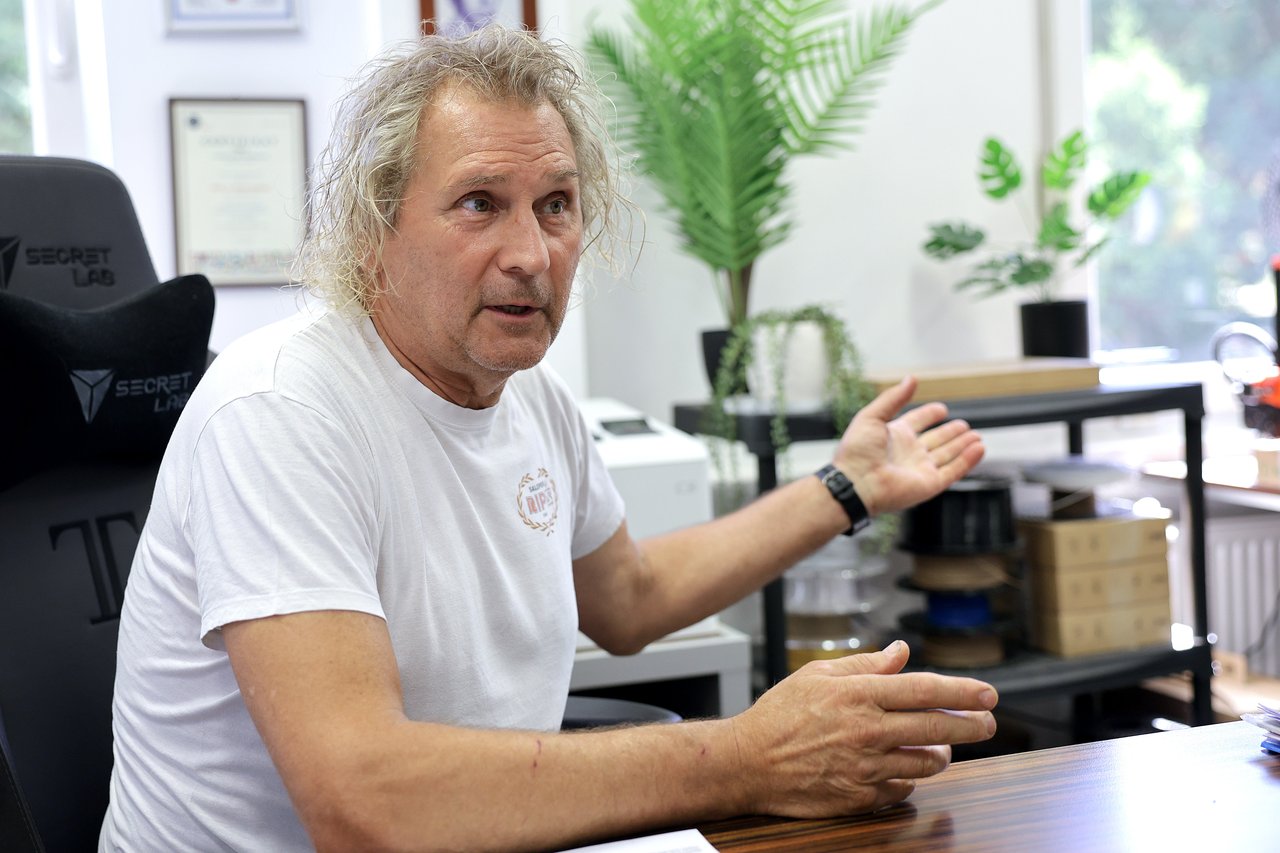
<p>RIPS obrt, Zoran Salopek</p>
RIPS obrt, Zoran Salopek / Image by: foto Ratko Mavar

In RIPS’s facility in Karlovac, candles are produced amidst the sound of dozens of machines, the scent of paraffin, and the constant movement of materials from one production phase to another. On one side of the facility, paraffin is prepared for pouring, on the other, lanterns are filled, and finished products are sent to the packaging area and warehouse. Alongside fully automated lines, products that are still made by hand can also be seen, primarily various figurative and decorative candles. Six decades ago, everything looked quite different. When Nikola Salopek started his own business in 1966, candles were made in a workshop next to the family house in Dubovac, and customers were sought at fairs and in churches. He would even ride his bicycle to Ogulin and Slunj with candles. Today, his son Zoran runs the business with about forty permanent employees, around a hundred machines, and approximately 2,500 square meters of business space. RIPS produces about four million lanterns annually and processes between 800 and 900 tons of paraffin, and for the last four years, it has also been producing PVC lanterns.

Nikola, one of ten children from Ogulin, learned the craft of candle making and wax working in Križevci. After arriving in Karlovac, he worked for his wedding godfather, and in 1966, he started his own craft. Initially, he manually made simple flat candles using a kettle and basic tools, and over time, he expanded the business with a store in Dubovac and new types of candles. His son Zoran grew up in that workshop.

Family Business

– I was born here, next to the workshop, and I helped my father from a young age. I have always been interested in the business. All of this happened alongside my childhood, play, and schooling, and then I gradually realized that I was really interested in this work – he recalls.

Since there was no longer a school for candle makers and wax workers, he finished chemical school. After returning from the army, his father offered him a choice between continuing his education and working in the craft. He chose the job, and thus began the transfer of responsibility to the new generation.

– My father saw that I knew how to work, so he told me: ‘From today, I am your worker, and you are the boss.’ At that time, I did not understand how significant that was. Only later did I realize that he was actually preparing me to run the business independently – says Salopek.

This was in the mid-1980s. With the new generation, larger changes in production began.

Negligible Export

The growth in demand required larger quantities, so Zoran gradually introduced machines, but his father would not compromise on quality. Every new method of production had to undergo the same checks as the hand-made candles.

– I had to return many candles to the kettle and remelt them because my dad did not want them to go out if they were not of the same quality as those made by hand. There was always some struggle between us for proof, for greater and better performance – he notes.

In this process, Zoran Salopek gained knowledge about paraffin, a material that has become the foundation of modern production.

– Paraffin seems simple: you melt it, put in a wick, and think that’s it. But it’s not. You have to know a lot for the candle to look good and burn well. Here, I actually honed all my knowledge about the material and production – he explains.

In 2000, production was moved from Dubovac to the current facility. Today, about 15 percent of production is completely manual, around 35 percent is semi-automatic, and the rest is automated. In one shift, RIPS can produce between 25,000 and 30,000 lanterns. From a few basic models, production has expanded to an assortment of around 400 items. Alongside cemetery lanterns, there are Advent and church candles, seasonal programs, scented candles, and products for various occasions. The sales schedule is strongly influenced by domestic habits and the annual calendar, but in recent years, there has been room for products that are not related to churches and cemeteries.

– We still produce the most lanterns for cemeteries, followed by Advent candles. It is still customary here to go to the cemetery and bring a candle, but we are increasingly developing a home program. Scented and decorative candles are being used more and more for atmosphere at home – says Salopek.

The majority of sales are realized in Croatia. RIPS collaborates with large retail chains, supermarkets, and smaller retailers, including dm, Kaufland, NTL, Plodine, Studenac, and Boso.

– We have been working with dm for about thirty years and are among its oldest suppliers. We have been in that store almost from the beginning, and in that collaboration, we learned what quality means and what the market demands – notes Salopek.

He estimates that RIPS covers about ten percent of Croatian needs for lanterns. There are about ten larger manufacturers in the market, along with several smaller ones, and part of the competition comes from imports. RIPS also relies on products that are not easy to fully automate, especially specific shapes that are in demand in the Croatian market. As for exports, it is almost negligible. Some hand-made products go to Slovenia and Austria, but the share, according to Salopek, is measured only in fractions.
Fire Consumed the Entire Factory

The biggest crisis in RIPS’s history occurred on July 12, 2012, when a fire broke out in the evening due to a power surge.

– Not only materials and goods burned, but the entire facility, all machines, everything we had – he recalls.

Instead of closing, Salopek decided to bring production back into operation. Within a month, a temporary tarpaulin facility of about 200 square meters was set up, used machines were procured, and production of lanterns resumed. Employees worked in three shifts, during the toughest period, up to 12 hours to fulfill the already contracted season.

– I didn’t think at all about stopping. I didn’t lay anyone off; everyone was on salary. I said I wanted to rebuild the company. In a month, we started production and completed the season, and then we continued to build everything else – says Salopek.

The new factory and equipment were ready for operation about a year later, and the total renovation cost between 1.5 and 1.7 million euros. Part was covered by insurance, and the rest was financed with personal funds, including resources left behind by Nikola Salopek, who passed away at the age of 57.

– The money my father created during his life was not spent. It remained and served for the renovation and purchase of new machines. If it weren’t for that, it would have been much harder to rebuild everything – he emphasizes.

Although the renovation burdened the business for several years, he emphasizes that salaries and obligations to suppliers and the state were never late. In the fire, the company lost almost everything, but at the same time, he notes, it gained the opportunity to completely renew its technology.

– If I had only listened to the math back then, I would probably have closed and reopened something else, but I didn’t want to stop the business. It’s good that I didn’t, because we managed to rebuild everything – he notes.

Equal Revenues, Lower Profit

In 2025, RIPS achieved total revenues of 4.32 million euros, the same as the previous year. The net profit amounted to 132,222 euros and was 23.79 percent lower. The result was influenced by rising labor costs, and prices to retailers could not keep pace.

– We had to raise salaries to survive and have better people, but we couldn’t change the prices of the final product that quickly – he explains.

The starting net salary at RIPS is at least a thousand euros, while more experienced workers and managers earn between two thousand and three thousand euros. Additional pressure comes from the price of paraffin, the main raw material in production, which is linked to oil prices. They mainly procure it from Italy, and most other materials are also imported. Despite this, investments continue. At the end of 2025 and the beginning of 2026, a new line for cast lanterns worth 280 thousand euros was set up, of which about 40 percent was covered by non-repayable funds from HAMAG-BICRO. Previously, around 100 thousand euros were invested in a solar power plant, and two new trucks cost about 50 thousand euros. Salopek primarily sees profit as a source for further business development, not as money to be extracted from the company.

– Profit has almost never been extracted from the company. Everything we could, we reinvested in the company: in machines, production, people. The company must constantly renew itself if you want it to last – he emphasizes.

For this year, Salopek expects about a 10 percent increase in production volume, but not necessarily the same growth in profit. The next major investment should be a new machine for plastic production, worth about 200 thousand euros, which is planned to be installed in the next two years.

The Third Generation is Coming

Technology can be bought and set up, but finding new people to take over the knowledge of older employees is a much bigger problem.

– We have people who have been working here for thirty years. On one hand, that’s good because they have vast experience and know the job inside out, but on the other hand, these people will soon retire, and there aren’t enough young people to come and replace them – says Salopek.

A new worker can be trained for simpler jobs in about a month, while more complex tasks are learned with a mentor. More crucial than previous experience, he says, is the willingness to work. Zoran’s son Karlo has already joined the business, taking on some organizational and administrative tasks. Thus, the family business is slowly being passed on to the third generation, just as Zoran took over responsibility from his father Nikola in the mid-1980s.

– I let my son try, just as my father let me. Regardless of the outcome, a person must find themselves in the job. They must try, must make mistakes, and learn something from it – concludes Zoran Salopek.

Thus, RIPS has grown from a small workshop in a family house into a serious industrial production, but a crucial part of the family story has not changed. Nikola passed on the craft and responsibility to Zoran, and Zoran is now doing the same with his son.

Tagged: