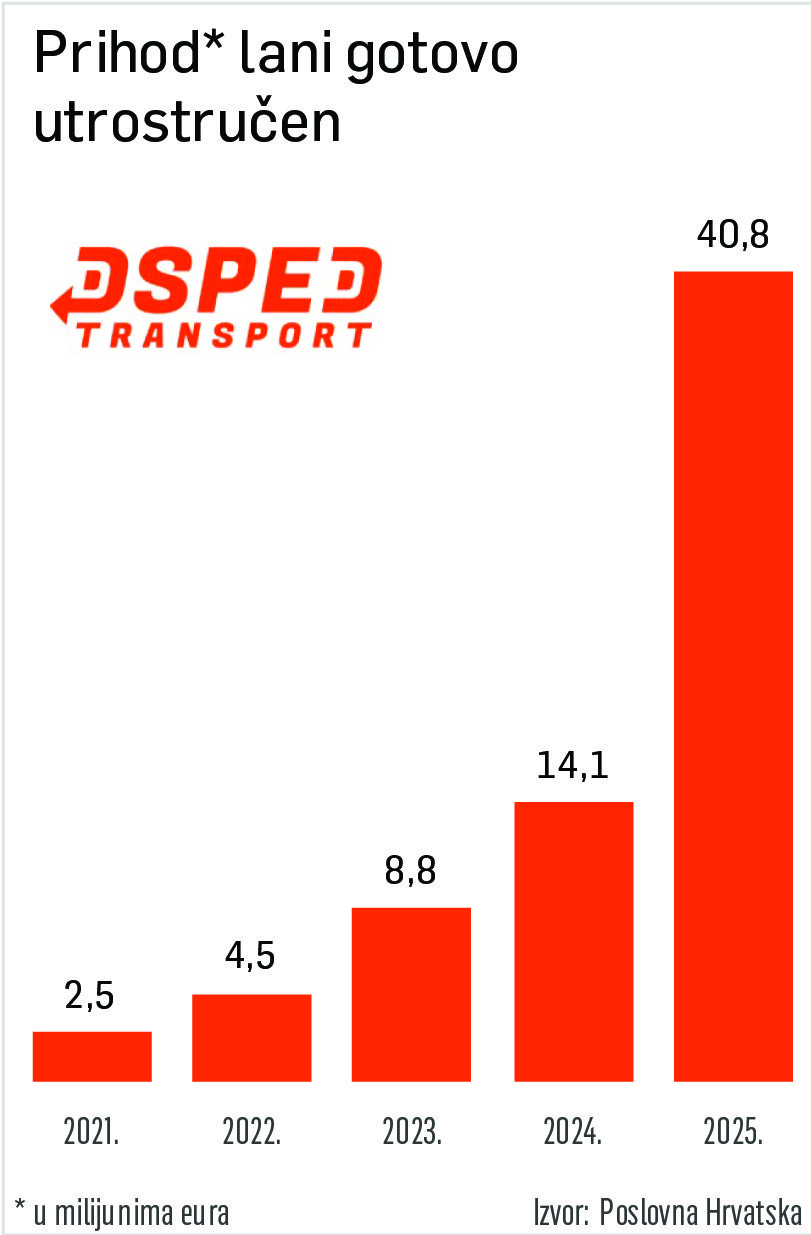
The long-distance transport company D Sped, according to what has been said to Lider, is at a crossroads. Should it continue operations in Croatia or will its owner Mario Gojak shut it down and establish a new one abroad? Last year, it achieved strong growth of 40.8 million euros in revenue (an increase of 189.2 percent compared to 2024), and as things stand now, it will finish this year with a quarter, and perhaps even half, less.
We reached out to Gojak, but he politely declined, stating that he is currently involved in a court dispute at the High Administrative Court against the Ministry of the Interior (having lost at the first-instance court), which denied him 49 applications for the employment of foreigners.
– I could say a lot, but I really can’t because there is an ongoing court procedure in which we are trying to prove that the Ministry of the Interior is wrong. Once everything is over, I will open up – Gojak stated.
Negative Opinion from the Employment Service
He did not even want to confirm or deny the information from our interlocutors from the Karlovac area who told us that he is considering the option of shutting down the company and registering it in another country. The denied resolutions are based on opinions from the Croatian Employment Service (HZZ), which believes that D Sped does not meet the conditions for issuing work permits for foreigners.
Our sources close to Gojak claim that the HZZ cited as reasons for the negative opinion that the company did not have the mandatory minimum monthly income of ten thousand euros (even though its revenue has been drastically increasing in multi-million amounts year after year) and that it is not engaged in registered activities in Croatia. It also mentions tax debt as one of the reasons, as well as the unreliability of the documentation of potential workers and the company.
However, as we can see from Business Croatia, there is no question that the company generates less than ten thousand euros in monthly revenue, is engaged in registered activities (it has 155 trucks) even though it primarily earns revenue from jobs abroad. This was one of the arguments for the HZZ to conclude that the company is not engaged in registered activities in Croatia, even though the revenue is deposited in accounts opened in our country’s banks.
The Administrative Court in Rijeka even sided with the HZZ (dismissed the lawsuit of D Sped) regarding the court procedure related to the non-issuance of a permit for one foreigner who wants to work in Gojak’s company, concluding that it indeed generates revenue abroad, and therefore does not perform registered activities in Croatia?!
Although we do not want to question the Court’s decision, it is a bit strange that a company registered in Croatia with accounts in Croatia does not perform registered activities in that same Croatia just because it is an exporter. As it can be heard, it seems that the High Administrative Court could overturn that ruling, but let’s wait a little longer.
Questionable Tax Debt
It is questionable whether there is also tax debt. Namely, the Tax Administration told us that they cannot speak about a specific company when it comes to tax supervision and potential measures for a tax offender, but when it comes to tax debt, ‘the General Tax Law stipulates that the obligation to maintain tax secrecy is not violated if the Ministry of Finance, the Tax Administration, without the consent of the taxpayer’, publishes on its website how much is owed. Legal entities whose debt exceeds 39,816.84 euros are included in the list. The last list was published at the end of October last year, and D Sped is not on it, which theoretically means it can only have a debt lower than the stated amount.
However, Gojak did give statements to Jutarnji list in May this year (he emphasizes that his lawyer told him he should not have done that while the court procedure is ongoing) when he stated that his workers receive a net salary between three and five thousand euros. However, data from publicly available sources tell a different story, which we will address in the second part of the text.
Our sources claim that he even pays them a privileged work experience, although he is not obliged to. We asked artificial intelligence, and it is indeed legally possible, but Gojak did not mention this to us. He previously claimed that he does not owe the state a cent, meaning he pays his obligations on time. If that is true, then he does not have any debt to the state lower than the minimum for publication on the Tax Administration’s website.
Strange HZZ Stance
Regarding the unreliability of the documentation, our sources are surprised by the HZZ’s stance as it concerns applications for the employment of foreigners who are already working in Croatia. In the aforementioned statement, Gojak accuses employment agencies (not naming them) that allegedly extorted him. ‘At first, we imported labor through agencies, like everyone else, we were forced to. Those agencies do not aim for that worker to stay employed, but to circulate, while they mediate. In a phone conversation, a woman at the HZZ named the agency through which we should import workers, and we would get visas without problems.
Then we call that recommended agency, which asks us for 400 euros, but not for the worker, just for – the phone call! If during that conversation you decide on a worker and sign a contract, you must pay the agency another 4500 euros. For one person and without any guarantees. So, I pay them 45 thousand euros for ten drivers who might run away after two months, and some I never even meet because they escape at the airport. Besides, is it normal for an HZZ official to refer me to a specific private agency?’ Gojak stated in May to Jutarnji list.
The owner of this long-distance company decided to bypass agencies, which is completely legitimate, to go cheaper (not paying a commission), so he offered jobs to foreigners who already work in Croatia. As our sources explain, he ‘fell’ here because the HZZ, with its institute ‘Opinions’, made his life difficult, which is why the Ministry of the Interior began to reject his applications for foreigners. However, it is interesting that applications were also denied for those foreigners who have been legally working in Croatia for several years, and the explanation cites the unreliability of their documentation (as well as the company’s).
– How is it possible that these foreigners could previously obtain all the papers if their documentation is unreliable? – asks one of the sources.
Silence of Institutions
Furthermore, when we talk about the unreliability of the company’s documentation, if everything mentioned is true (not achieving minimum monthly income, not performing registered activities, tax debt), one must ask how it is possible that D Sped always receives a positive resolution from the Ministry of the Interior for the extension of permits for those foreigners who already work in that company!