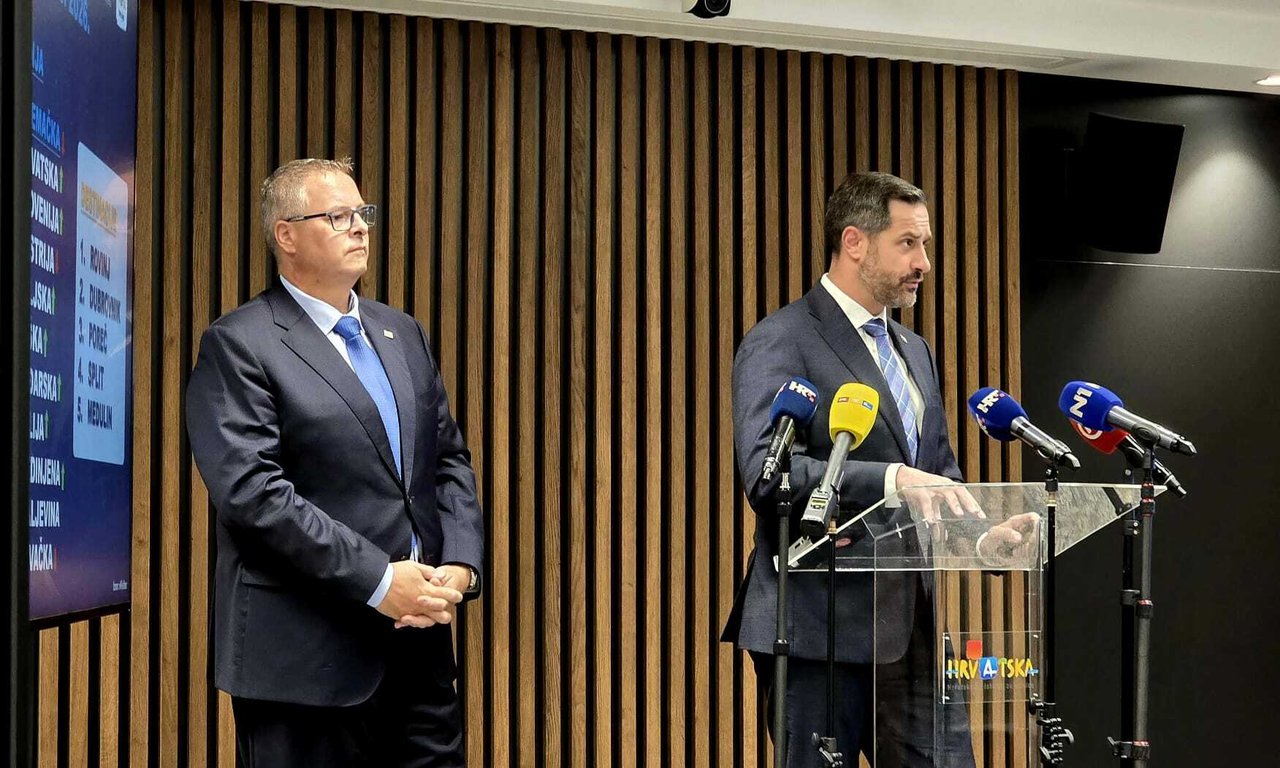
This year’s tourist season will be marked by minimal growth in overnight stays and the fact that guests are staying shorter and spending money more cautiously. These are the key messages behind the latest tourism data from the eVisitor system for the first eight months of this year. Although both the Minister of Tourism Tonči Glavina and the director of the Croatian Tourist Board Kristjan Staničić attempted to present the official figures at today’s press conference as ‘stable results and a slight plus’, a more detailed analysis indicates changes in guest behavior and stagnation in overall tourist traffic.
According to data from the eVisitor system, which includes commercial and non-commercial accommodation as well as nautical charters (eCrew system), Croatia recorded 17.5 million arrivals and 90.5 million overnight stays from January to the end of August, representing a growth of only one percent in both indicators compared to last year.
In the Adriatic, there were 86.7 million overnight stays, which is just 0.5 percent more than last year, while on the continent, including the city of Zagreb, there were 3.8 million overnight stays (a growth of one percent).
A similar pattern is visible in August, when over five million arrivals were recorded (a growth of two percent) and 31.4 million overnight stays (a growth of 0.5 percent).
Despite the fact that this month marked the first time in history that the famous five million arrivals were exceeded, it is evident that guests are staying shorter on average.
The most overnight stays in August were achieved by guests from Germany, Croatia, Slovenia, Poland, Austria, Italy, Hungary, and the Czech Republic, while the most sought-after counties were Istria, Split-Dalmatia, and Kvarner, with destinations including Rovinj, Vir, Poreč, Medulin, Umag, and Dubrovnik.
Minister Glavina interprets the difference between the growth in arrivals and the modest growth in overnight stays as an expected global trend and clearly states that Croatian tourism is competitive.