A market research study on mixed goods retail conducted by the Competition Protection Agency (AZTN) showed that the revenues in mixed goods retail of all retailers in the AZTN sample in 2025 amounted to 8.93 billion euros, representing a nominal growth of 6.2 percent compared to 2024.
The study covered 41 entrepreneurs who, based on revenues generated from mixed goods retail, belong among the most significant retailers in the observed market. The sample remained unchanged compared to the 2024 study.
Retailers in the sample had a total of 5,347 sales outlets in 2025, 81 more than in 2024, representing an increase of 1.5 percent, according to AZTN.
Konzum plus remained the leading retailer
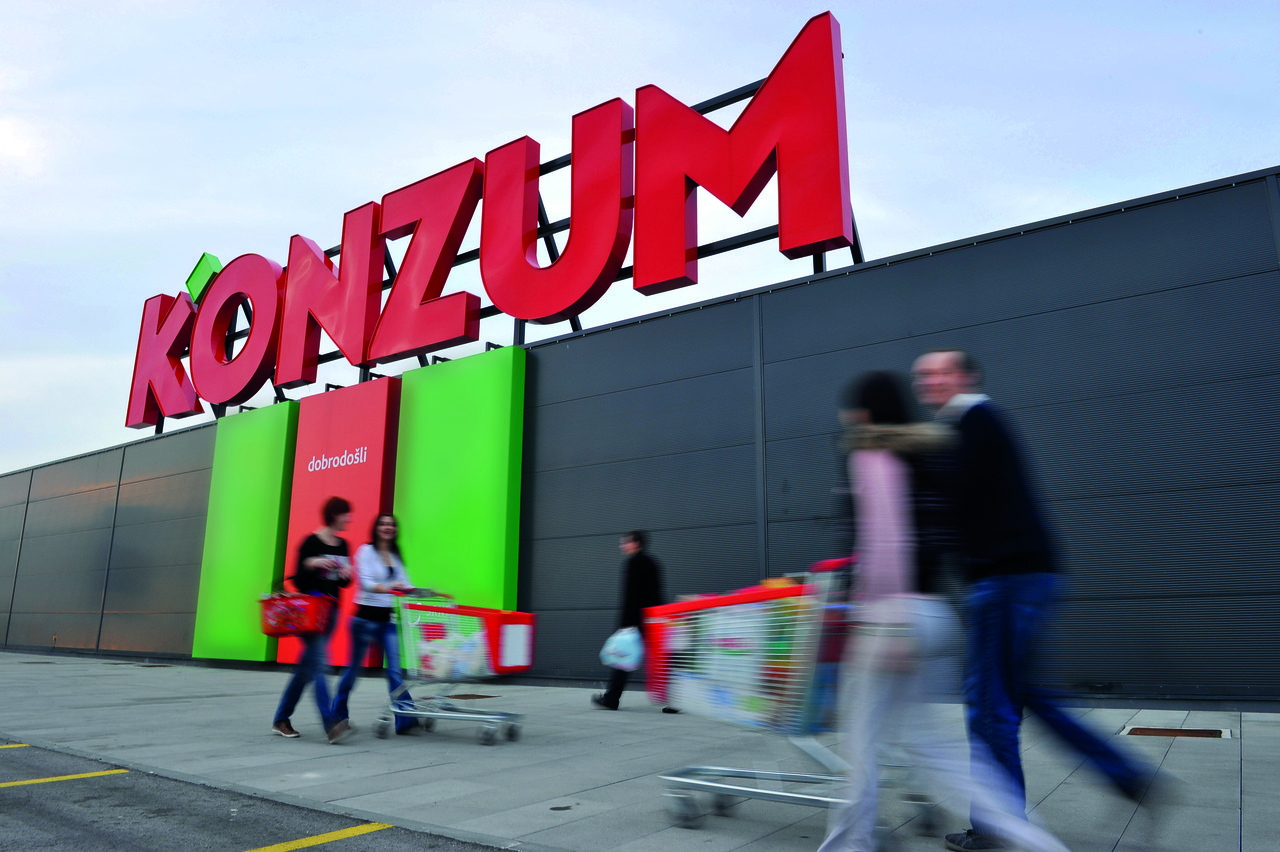
The largest mixed goods retailer in 2025 was Konzum plus, with a market share ranging from 20 to 30 percent. In 2025, it had 630 sales outlets.
Members of the Schwarz Group, Lidl and Kaufland, together had a market share ranging from 20 to 30 percent. Lidl retained second place, while Kaufland held fifth place in terms of revenue generated. Both retailers achieved a slight increase in market share and also recorded the two largest nominal revenue increases among the retailers in the sample.
The market shares of individual entrepreneurs are expressed in ranges as they were calculated based on data that the entrepreneurs marked as business secrets, AZTN states.
They also note that out of the 41 entrepreneurs covered by the research, 31 achieved revenue growth in 2025, while revenues for ten entrepreneurs declined.
The largest nominal revenue growth was again achieved by Lidl, the only retailer whose revenue increase exceeded 100 million euros. Following were Kaufland, Plodine, Spar, and Tommy, with revenue increases ranging between 50 and 100 million euros.
Studenac, Konzum plus, and Eurospin achieved revenue increases between 20 and 30 million euros, while the revenue increases for NTL, Trgovina Krk, and KTC ranged between 10 and 20 million euros.
Among regional retailers, larger nominal revenue increases were achieved by Boso, Ribola, NewMip, and Slavonija-Bošković. For each of these retailers, the revenue increase ranged between five and ten million euros.
Studenac, with a total of 1,487 sales outlets, still had the largest sales network among the retailers in the sample. Its network was predominantly made up of small-format sales outlets.
The list of the top 10 retailers remained unchanged
Compared to 2024, there were no changes in either the composition or the ranking of the top ten retailers. These are Konzum plus, Lidl, Plodine, Spar, Kaufland, Studenac, Tommy, KTC, NTL, and Trgovina Krk.
The top ten retailers, as stated, together achieved 87.7 percent of total revenues in the observed market.
Supermarkets remain the dominant type of retail outlet
The results of the research showed that supermarkets were also the dominant format in 2025 in terms of revenue and net sales area. Supermarkets generated just over 4.7 billion euros in revenue, accounting for 53 percent of total revenues in the observed market. Compared to 2024, supermarket revenues increased by 334.4 million euros, or 7.6 percent.
Hypermarkets generated revenues of 1.75 billion euros, self-service stores 1.7 billion euros, and small shops 748.4 million euros.
Supermarkets and hypermarkets together accounted for 72.6 percent of total revenues, compared to 72 percent in 2024. The share of supermarkets increased from 52.3 to 53 percent, while the share of hypermarkets decreased from 19.7 to 19.6 percent.
In terms of the number of sales outlets, self-service stores had the largest share at 41.6 percent, followed by small shops at 39.3 percent, supermarkets at 16.2 percent, and hypermarkets at 2.9 percent.
No format recorded a decrease in the number of sales outlets in 2025, and the number of small shops remained unchanged, the research states.
Retail margins highest for bakery and confectionery products
The results of the research showed that the average margins for food products last year were highest in the category of bakery and confectionery products, followed by fresh fruits and vegetables, the same as in 2024.
Compared to 2024, a decrease in the average gross trading margin indicator was recorded in seven out of eight observed categories. The decrease ranged from 0.3 percentage points for bakery products to 1.9 percentage points for staple food products. A slight increase of 0.3 percentage points was recorded only in the category of non-alcoholic beverages and water.