‘Launching the European economy is our number one priority.’ This phrase could summarize Ursula von der Leyen’s state of the union speech. Unlike last year’s speech, which focused on security issues and the situation in Ukraine and Gaza in the first block, this year’s speech mentioned the economy almost immediately after the introductory geopolitical framework, with a very unequivocal message about the main priority.
The Economy Takes the Whole Block
Almost the entire first major block was dedicated to what is holding European companies back in the global race: expensive energy, slow permits, bureaucracy, lack of capital, a fragmented single market, Chinese industrial pressure, and dependence on critical raw materials.
Last year, the emphasis was on what could be done to increase competitiveness; this year, the focus is on speed. It is no longer a question of how to help the economy but what can and must be done immediately.
Compared to last year’s speech, the change is even more visible in tone. Last year, the Commission mainly presented the architecture of responses to the problems identified by Mario Draghi: the Single Market Plan, omnibus packages to reduce bureaucracy, the Union of Savings and Investments, the Scaleup Europe fund, AI gigafactories, and the Clean Industry Agreement.
Europe, von der Leyen reminds, has a large market, world-class industry and services, enormous private savings, and one of the leading world currencies. Yet, it continues to fragment capital, infrastructure, and purchasing power.
There is not much new in this. Last year, referring to Draghi’s and Letta’s report, she warned about the obstacles within the single market and announced the Single Market Plan, which is expected to be completed by the end of 2027. What is now most important is speed.
The Burden of State Requirements
Permits, forms, connections to the electricity grid, or financing decisions can determine where a company will invest and where it will create jobs. That is why the Commission announces a new acceleration of permit issuance, and strategic European projects should go through procedures much faster. Subsidies, industrial strategies, and funds are of little value if a company in another part of the world can build a facility while its European competitor is still waiting for a connection or permit, and in this regard, she pointed out a concrete problem – the member states.
The term she used is gold-plating, a practice in which states add their own requirements when transposing European regulations. Therefore, von der Leyen calls for a kind of pact against gold-plating: if the EU simplifies rules, national administrations should not add additional procedures, their own interpretations, and state requirements, thereby recreating the burden that Brussels has tried to eliminate.
What was repeated in last year’s speech and again this year is energy, with this year’s focus on prices, and again for the industry.
– Europe cannot remain an industrial power if its energy prices are structurally too high – von der Leyen warned, which is a clear message that this is no longer a climate issue but the survival of the European industrial base. The reasons are clear: the crisis in the Middle East, the blockade of Hormuz, and dependence on imports.
– Since the beginning of the conflict in the Middle East, imported fossil fuels have cost Europe an additional 90 billion euros – von der Leyen emphasized.
Industrial Policy Begins with Energy
Von der Leyen believes that complete industrial policy begins with the price of energy. Her logic is that Europe will not retain energy-intensive operations or attract new ones if it structurally has more expensive energy than its competitors. Therefore, she no longer presents electrification, renewable sources, nuclear energy, networks, and storage merely as climate policy but as a prerequisite for industrial competitiveness.
The goal is to double the share of electricity by 2040, which, according to estimates from the speech, could reduce the fossil fuel import bill by 260 billion euros annually.
But perhaps an even more interesting fact is about infrastructure. Europe installed more than 80 GW of renewable capacity last year, but six times more capacity is still waiting for connection, which should urgently be brought to the industry.
The biggest change compared to last year was seen in how von der Leyen speaks about China. China was already a major industrial competitor a year ago. The Commission warned that Europe must not cede the market for new technologies to Chinese manufacturers and, among other things, small and affordable electric cars.
The Second Chinese Shock Has Arrived
– The EU’s trade deficit with China has reached about one billion euros daily – von der Leyen stated, sending a strong warning from the podium of the European Parliament that Europe is threatened by a ‘second Chinese shock’ that has already arrived.
All this is already clearly visible in European factories, resulting in the deindustrialization of industrial centers. Such a situation, she concludes, is unsustainable, and the EU will use all the instruments at its disposal to redesign its relationship with China.
An even bigger problem is what Europe buys from China. For many critical raw materials, European dependence is greater than 80 percent, and for some rare earths, it reaches 90 percent. Therefore, she announced the establishment of a new European Corporation for Critical Raw Materials, which should help Europe jointly procure and create stocks of materials needed for electric cars, chips, batteries, clean technologies, and defense.
Saving into the Economy
She also addressed the problem of capital, noting that Europe has enormous private savings but fails to convert them sufficiently into capital for the growth of European companies. The development of the Union of Savings and Investments is underway, von der Leyen acknowledges, although she is aware that access to capital needs to be faster.
– Europe needs a banking system built for growth, not just for stability – von der Leyen emphasized, adding that a Banking Package is being prepared aimed at simplifying and reducing fragmentation, but also increasing the financial system’s capacity to take on risks.
The capital market is not sufficiently developed to finance companies, and Brussels wants to change the relationship between regulatory security and growth financing.
AI in Factories
She did not fail to mention AI. Last year, the emphasis was on building European AI capacities, gigafactories, infrastructure, and technological sovereignty, while this year the Commission poses a more practical question: where will AI produce real economic value and offers the answer – in the economy.
Von der Leyen wants to move AI ‘off the screen’ into factory floors, hospitals, precision agriculture, energy networks, autonomous driving, and defense. Europe sees its potential advantage precisely where it is often declared technologically weaker: in its large existing industrial base and the data it produces.
The Commission highlights five areas with the greatest potential for industrial AI: healthcare, transport, agri-food sector, advanced manufacturing, and defense and space, with more to be known in November when new initiatives will be announced.
Industry Cannot Do Without Alliances
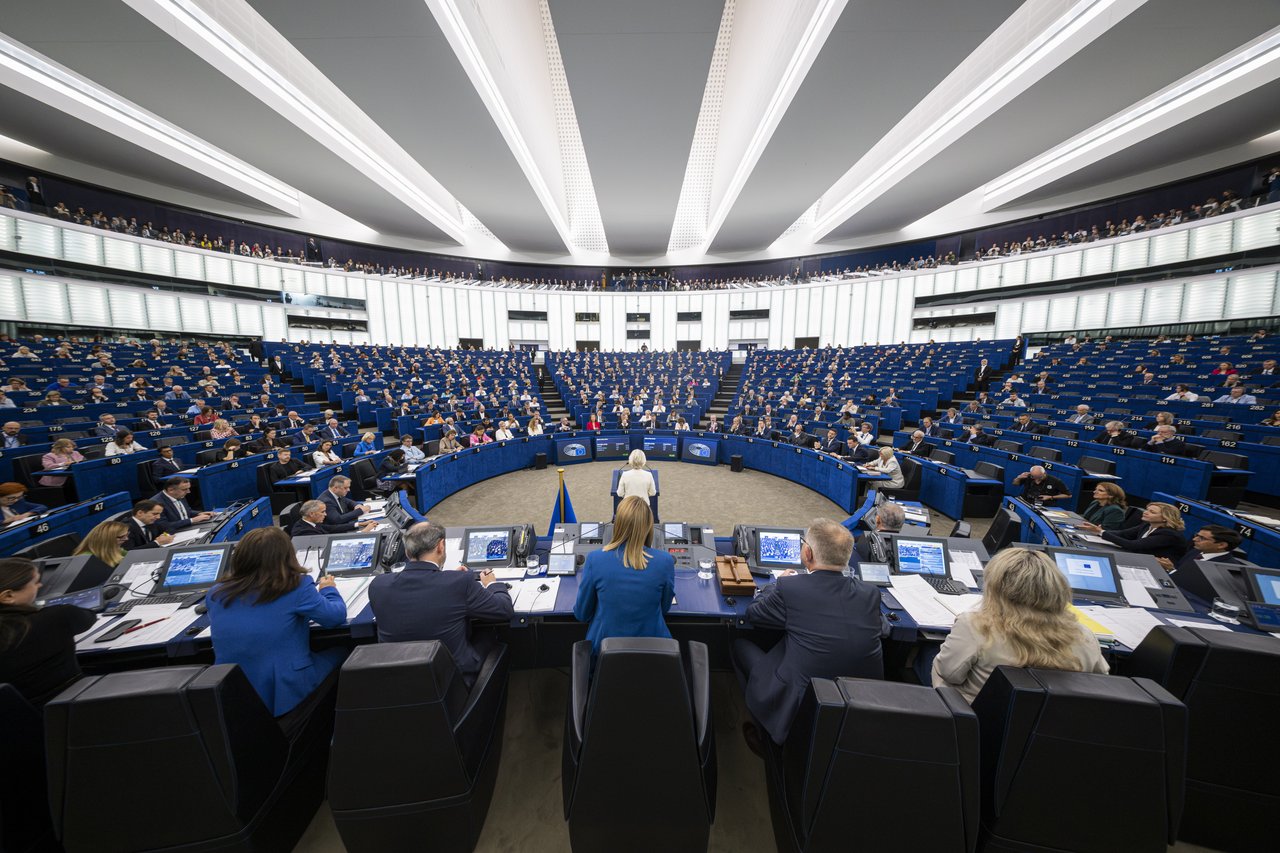
Interestingly, von der Leyen places the new European industrial policy within a broader circle of alliances with countries that think similarly, which is not surprising given that Canadian Prime Minister Mark Carney attended the plenary session where the speech was held.
The existing trade agreement CETA has already, according to the data presented, increased trade between the EU and Canada by 75 percent in less than a decade, but now both sides want to go much further than classic trade liberalization.