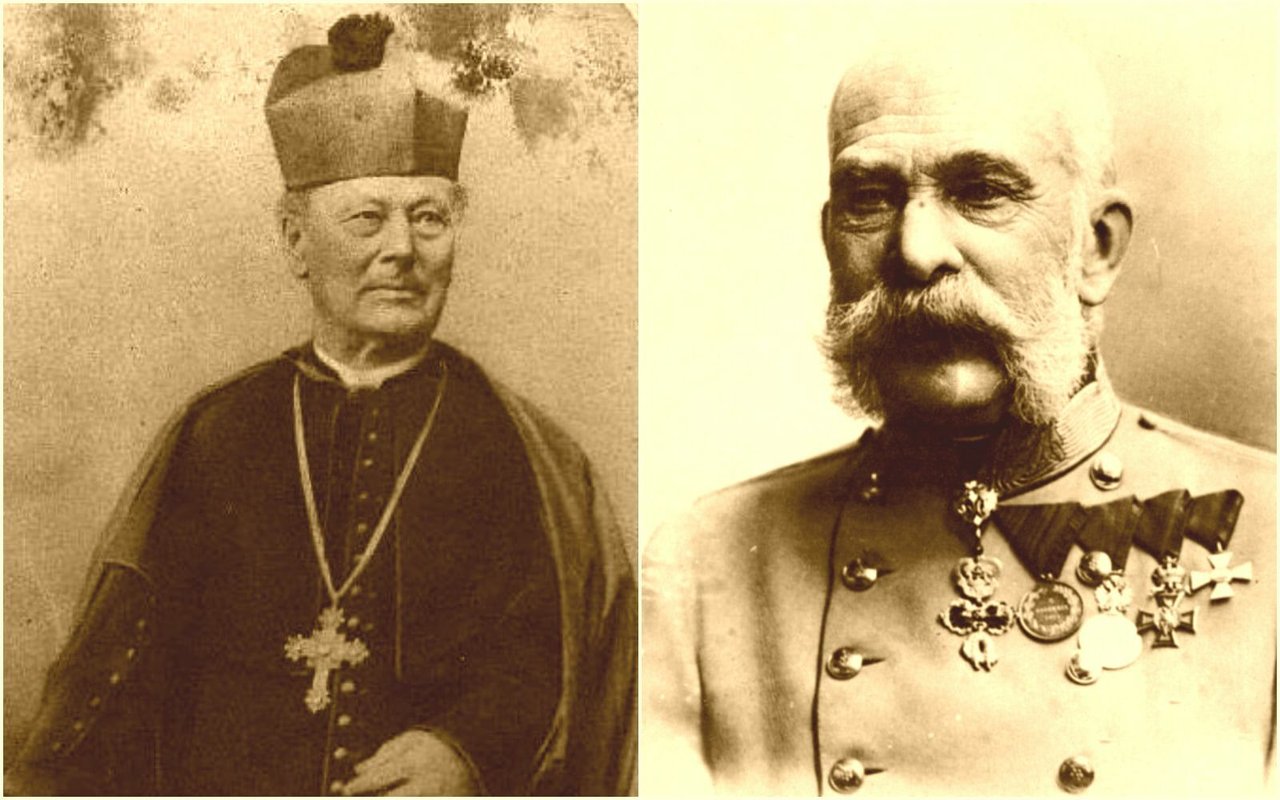
One of the most notable political incidents in Croatian history of the 19th century occurred on September 12, 1888, in Bjelovar, hence it is called ‘Bjelovar Affair’. It was a personal conflict between the Bishop of Đakovo Josip Juraj Strossmayer and Emperor Franz Joseph I, and it is remembered in public for Strossmayer’s demonstrative act of turning his back on the Emperor.
What happened?
Emperor Franz Joseph I was in Bjelovar on September 12, 1888, to observe large military maneuvers taking place in the nearby areas of Rača and Drljanovac. Accompanying him were Crown Prince Rudolf, several Archdukes, and the British Prince of Wales, the future King Edward VII.
In the building of the then city hall (today the City Museum of Bjelovar), the Emperor met with Strossmayer. During their conversation, Franz Joseph sharply reproached the Bishop for a telegram he had previously sent to Kyiv regarding the commemoration of the 900th anniversary of the Christianization of the Russians, or the acceptance of Christianity as the official religion in the territory of the then state of Kievan Rus.
Strossmayer responded with a short sentence:
‘My conscience is clear!’
After that, he distanced himself and turned his back on the Emperor, which, according to the strict rules of the Viennese court, represented an exceptionally severe form of rudeness and practically a public challenge to the authority of the ruler.
Vienna Did Not Like Pan-Slavism
To understand the affair, one must look at the broader political background.
For decades, Strossmayer advocated for the cooperation of Slavic peoples and the rapprochement of the Catholic and Orthodox Churches. For this reason, he welcomed the Kyiv celebration of the 900 years since the Christianization of the Russians, considering it an important Slavic and Christian event that is seen as the origin of the Christian tradition of today’s Russians, Ukrainians, and Belarusians.
However, in Vienna and Budapest, this move was perceived differently. The year was 1888, the Russian Empire was the main geopolitical rival of Austria-Hungary in the Balkans, and any manifestation of pan-Slavism raised suspicions among the authorities. Strossmayer’s telegram was interpreted as a political gesture favoring Russia and the ideas of Slavic unity, which many in the Monarchy considered a threat to its survival.