No one has to be afraid of us! – with these words, Tino Chrupalla, one of the leaders of Alternative for Germany (AfD), addressed the public the morning after the elections that changed the entire political order of the German state of Saxony-Anhalt, causing a tremor whose secondary vibrations will be felt for a long time in Germany and across the continent.
Aware of the chill that has spread through Berlin and Brussels, Chrupalla rushed to convey that after their victory, integrated immigrant families will not face any persecution and that no one will take revenge on children with special needs in schools. AfD is not a threat, but a protector of the ordinary German, at least that is the post-election narrative.
The electoral math in Saxony-Anhalt is more than clear. In the parliamentary elections in the province with 1.7 million voters, AfD achieved a historic victory, winning as much as 43.8 percent of the votes – which is more than double the result compared to 2021. This is the first time since World War II that a far-right party in Germany has achieved such a convincing triumph, shattering the existing political order into pieces.
On the other hand, the ruling Christian Democratic Union (CDU) experienced a real disaster, receiving only 17.2 percent of the votes, while other established options, from the Social Democrats and the Left to the Greens, faced complete collapse. Thus, on Sunday evening, the so-called firewall (German: Brandmauer), a long-standing tacit pact that kept the radical right away from power, also fell apart.
Alliance of Despair
This electoral shock is not just a mere shift of one province to the right – it is a devastating blow to the very foundations of the party of Konrad Adenauer, Helmut Kohl, and Angela Merkel, but above all a direct slap to the current Chancellor Friedrich Merz, for whom German media have already openly questioned since Monday morning whether he is even capable of handling the political tremors shaking the state.
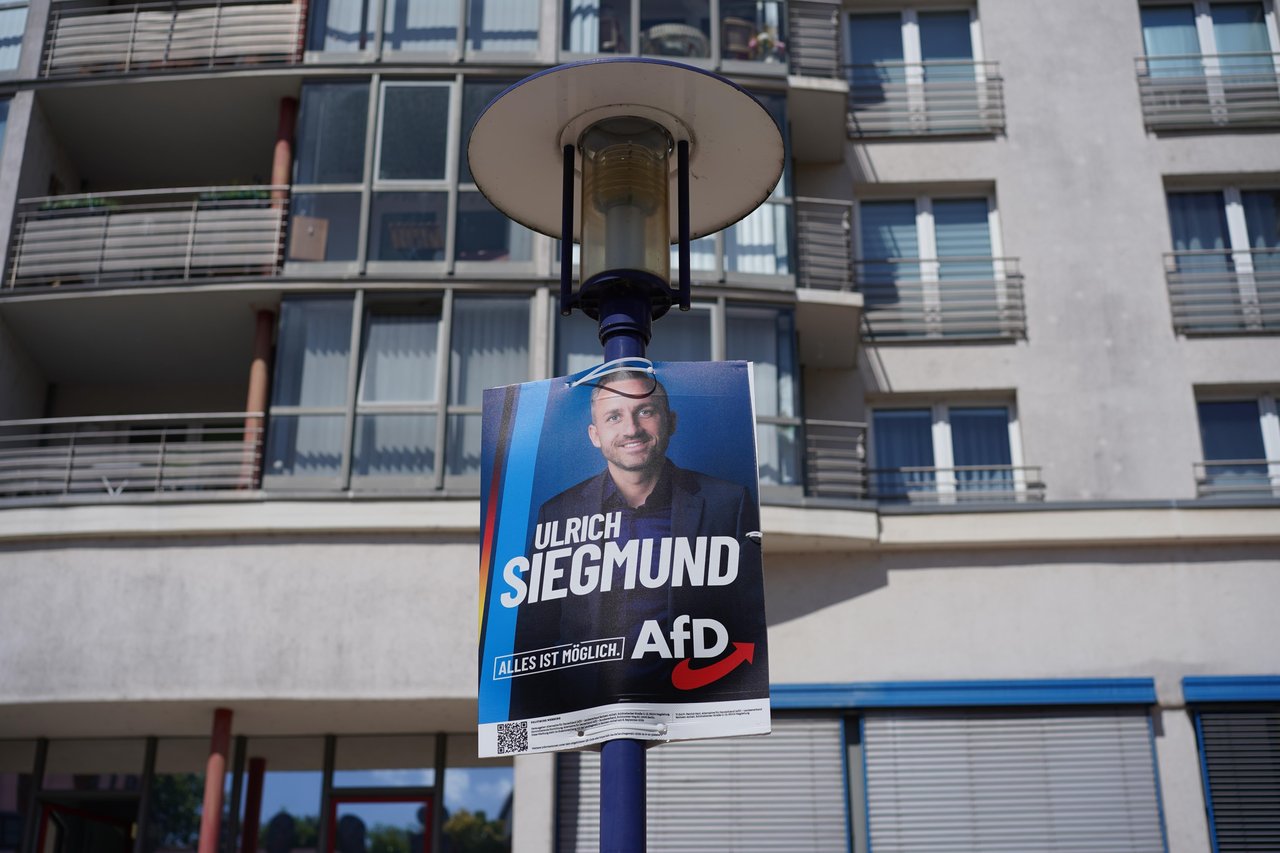
Although AfD celebrates a historic triumph, its victory has a bittersweet taste. With 39 mandates won in a parliament that has 83 representatives, Ulrich Siegmund, the most dangerous man in Germany, as Der Spiegel dubbed him, and a candidate for provincial premier, is exactly three votes short of complete power, which pushes the province into a severe political drama and a complicated mathematical puzzle.
Although all other parties ruled out cooperation with AfD before the elections, a coalition seems impossible, so more and more hope is placed on some political defector who would, it is clear, be under enormous pressure. AfD left the possibility of a coalition open even the day after the electoral triumph, but only with options willing to accept its conditions. The first and foremost is the premiership position exclusively for AfD, the second crucial condition is the acceptance of radical policies regarding migration, energy, and Russia, as well as unconditional loyalty to the new government. In other words, discussions can only happen if all others submit to AfD.
There are prospects for other parties to form a government, but that ‘alliance of despair’ would be unsustainable due to the CDU’s official ban on entering into a coalition with the Left and likely unstable, and voters would directly perceive their political actions as an open disregard for their expressed democratic will.
Constitutional Trap
It seems that the key cards for forming the provincial government are held by the Alliance of Sahra Wagenknecht, which entered parliament with 5.3 percent of the votes, won five mandates, and now acts as an unexpected swing voter. Signals are already coming from BSW that in the decisive round of voting for the provincial premier, they do not intend to support anyone and will remain abstained. However, this is where the most dangerous constitutional trap lies.
Namely, if no one secures an absolute majority of 42 votes in the first two rounds, in the third round, the candidate who collects a simple majority of valid votes wins, which means that Siegmund could directly take the premiership chair with a simple majority of his own AfD votes.
The constitution stipulates that the new provincial parliament must be constituted no later than thirty days, that is, by the beginning of October. Aware of this constitutional advantage and the position of power he has found himself in, Siegmund appeared in Berlin full of confidence, not sparing even his fiercest critics, the media. With a generous dose of irony, he thanked the German media for what he considers very sharp reporting, cynically stating that they owe part of the credit for the victory to them.
– We succeeded thanks to you. You have created an insurmountable chasm between your media bubble and the real everyday life of the ordinary person in this country – he said and announced that he would also reconsider the media subscription policy.
And while champagne was still being drunk in the AfD camp, anxiety reigned in the German business sector. Major business associations warned in open letters that the entry of right-wing radicals into the provincial government and acceptance of Siegmund’s conditions would likely ‘finish off an already ailing regional economy’.
Clear and Unyielding Message
The population in Saxony-Anhalt is the oldest in the demographic structure of all of Germany, and it is already nearly impossible to fill the jobs of those retiring without a constant influx of foreigners.
AfD has also openly announced the abolition of church tax and cutting state support for religious institutions, accusing the clergy of interfering too much in politics, which is why the church leadership of both the Evangelical and Catholic churches is sending messages about the ‘return of the nationalist spirit’ after election night.
Regardless of whether Siegmund will ultimately ascend to the premiership or whether established parties will form some loose pact for survival at the last minute, the message from Magdeburg is clear and unyielding: the German political spectrum is once again causing discomfort. The genie is out of the bottle, and no one in Berlin can put it back.