Home / Business and Politics / Gradec and Kaptol: ‘Two Hills’ United in Zagreb Only on September 7, 1850.

Gradec and Kaptol: ‘Two Hills’ United in Zagreb Only on September 7, 1850.

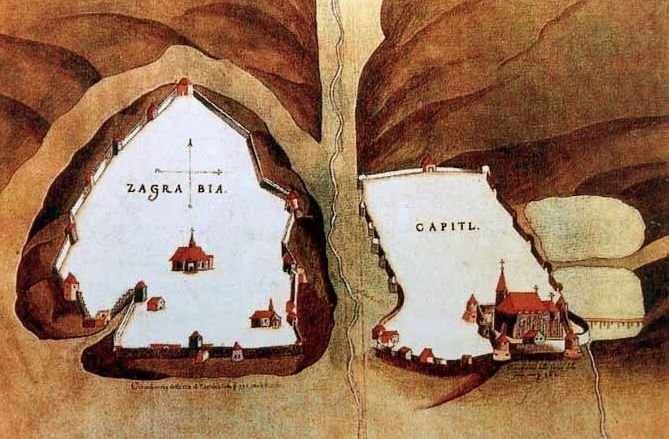
<p>Najstariji prikaz 'dva brega' iz XVI. stoljeća<br>
 </p>
Najstariji prikaz 'dva brega' iz XVI. stoljeća   / Image by: foto

On September 7, 1850, Emperor Franz Joseph I issued a patent by which the previously separated Gradec, Kaptol, and the surrounding settlements of Nova Ves, Vlaška Ves, and Horvati were united into a single city of Zagreb. This occurred at the urging of Ban Jelačić, who, after the 1848 revolution and administrative reforms in the Habsburg Monarchy, advocated for the modernization of Croatian administration and the creation of a stronger capital.

Kamauf the First Mayor

This led to the creation of a modern, administratively unified Zagreb, although the name Zagreb had been in use centuries earlier. At the time of unification, the city had only about 16,000 inhabitants, and the former Gradec judge Janko Kamauf was elected as the first mayor in 1851. In the meantime, Zagreb has grown to nearly 780,000 inhabitants, and Tomislav Tomašević is the 49th mayor.

Although Zagreb is much older in its roots, it is a fact that as a unified city it is relatively young. For centuries, there existed two neighboring but separate entities in its area: Gradec on the western and Kaptol on the eastern hill. Each had its own administration, laws, interests, and fortifications.

Each Hill with Its Walls

Gradec received the Golden Bull from King Bela IV after the Tatar invasion in 1242, which made it a free royal city. Kaptol, on the other hand, was the seat of the Zagreb Diocese and was under ecclesiastical administration. Both settlements were surrounded by their walls and towers, and between them lay a natural boundary formed by the valley of the Medveščak stream.

The conflict between Gradec and Kaptol was not primarily of a religious nature, but rather political and economic. In a small area, there were two authorities trying to preserve and expand their privileges. Gradec defended the rights guaranteed by the royal charter, while Kaptol protected the interests of the diocese and church properties. Disputes over jurisdiction were almost inevitable.

The Stream as a Source of Dispute

An important source of dispute was the Medveščak stream, which flowed along the route of today’s Tkalčićeva Street. Besides separating the two settlements, it was also an important economic resource. Its water powered numerous mills, and the income from grain milling was a significant source of profit.

At the beginning of the 19th century, more than 45 mills operated on the stream. Here, the first manufactories emerged: the cloth factory of Franjo Kušević, a paper factory, and later industrial plants such as a leather factory. Questions regarding water usage, dam construction, and rights to the mills regularly caused conflicts. Control of water also meant control over an important part of the city’s economy.


Disputes over Tariffs and Trade Rights

Additional tensions were created by trade. Gradec enjoyed royal privileges for holding fairs and collecting certain fees, which brought it money and prestige. Kaptol, meanwhile, sought to protect its own economic interests, leading to frequent disputes between the two sides over tariffs, trade rights, and revenue from the movement of goods. Behind many political disputes, there was actually a struggle for economic supremacy.

The question of justice was not simple either. Since Gradec and Kaptol were adjacent to each other, it was often unclear who had the right to judge the residents of border areas or decide on specific disputes. Thus, seemingly minor disputes could easily escalate into serious conflicts, even armed confrontations.

The Bloody Bridge as a Symbol of Conflict

One of the most famous conflicts was recorded in 1667 when a dispute over crossing the Medveščak escalated into an armed confrontation. Due to these and other bloody skirmishes, the crossing became known as the Bloody Bridge, a name it still carries today, although the bridge itself has long since disappeared.

As Zagreb grew, the old division gradually lost its meaning. By the end of the 19th century, the course of the Medveščak was redirected towards the Ribnjak area, and the bed that ran through today’s Tkalčićeva Street was gradually filled in. The natural boundary that had divided Gradec and Kaptol for centuries disappeared.

Both the Bridge and the Stream Have Disappeared

In essence, Zagreb lived for centuries as two neighboring cities: Gradec as a commercial, craft, and administrative center, and Kaptol as a church, educational, and spiritual center. Their mutual dependence was as great as their rivalry.

The former duality is now hardly felt, although the administrative seat of state authority remains in Gradec, and the seat of the Zagreb Diocese in Kaptol. However, secular and ecclesiastical authority are no longer at odds today.

Today, it is almost impossible to feel the boundary that divided Zagreb for centuries. The stream has been redirected from today’s Tkalčićeva to Ribnjak and has disappeared underground, so there is no longer a bridge. From the centuries-old rivalry between Gradec and Kaptol, only the name of a short street between Radićeva and Tkalčićeva remains: the Bloody Bridge. A place that once symbolized divisions is now merely a passage in the heart of a united Zagreb.

Tagged: