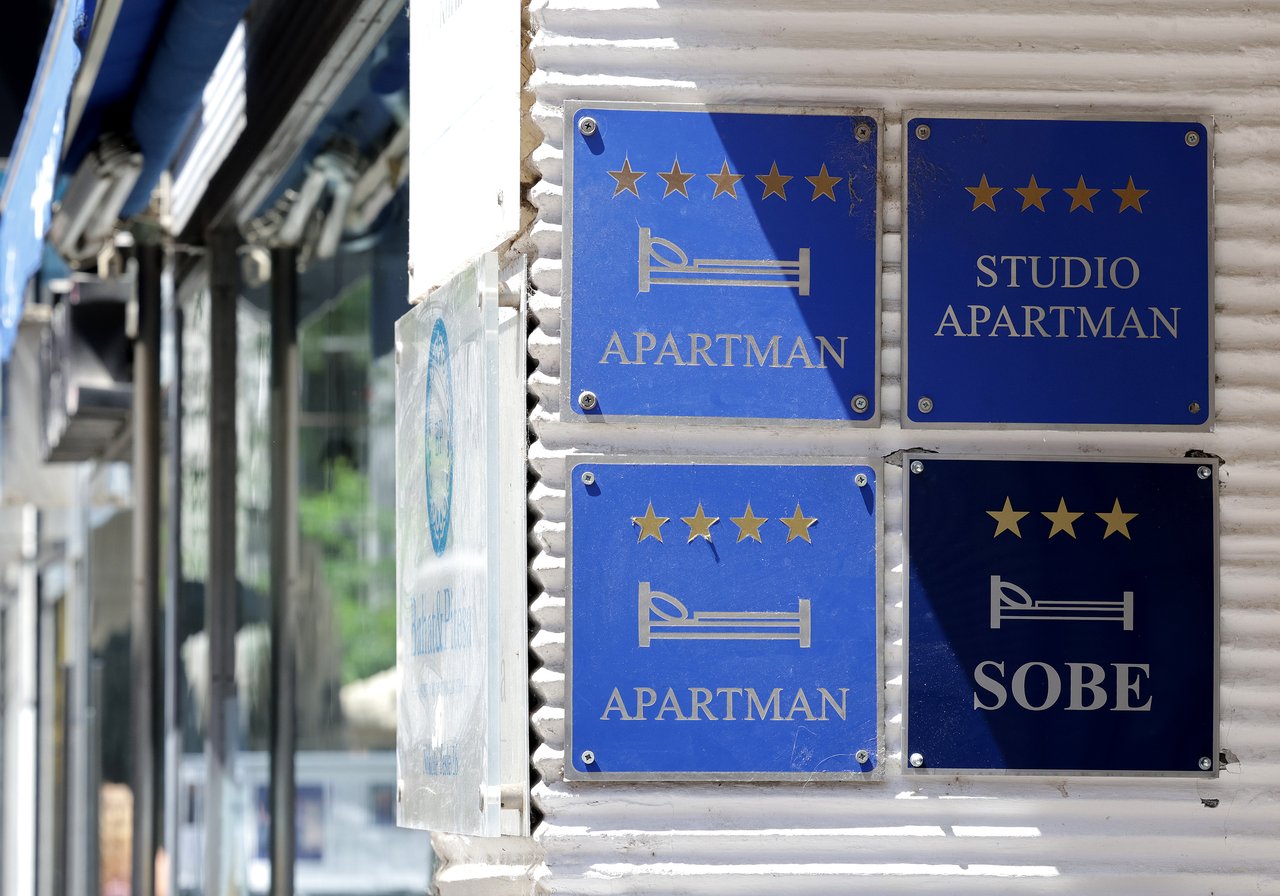
After four years of continuous growth, the number of small private renters and accommodation capacities in Zagreb has declined for the first time since the pandemic. According to data from eVisitor, Zagreb had 2,753 registered renters, 3,183 properties, and 10,458 beds on August 24. Compared to the previous year, the number of renters decreased by 3.7 percent, properties by three percent, and beds by 1.4 percent.
The reversal is even more pronounced in new market entries. Since the beginning of the year, only 111 new properties have opened, which is 70.7 percent less than in the same period last year. At the same time, 136 properties have closed, marking the first time since 2021 that the number of closed properties exceeds the number of newly opened ones. Last year, the situation during the comparable period was completely different: 379 properties were opened, and 158 were closed.
The decline in new entries has certainly been influenced by legal changes that have made it more difficult to open apartments in residential buildings.
After the pandemic contraction, the Zagreb private accommodation market grew for four consecutive years. The number of properties increased by 9.5 percent in 2022, 16 percent in 2023, 7.8 percent in 2024, and another 4.7 percent last year. This year’s decline thus interrupts a four-year post-pandemic growth.
The data on the state of the private accommodation market was provided to Lider by the Zagreb Tourist Board.
Although Zagreb is not experiencing an exodus of existing renters, the greatest slowdown is occurring in new market entries.
– The data indicates a slowdown in the entry of new renters into the market and a change in trend towards stagnation. However, considering that the number of closed properties in 2026 is lower than the previous year, one cannot speak of a pronounced trend of mass exit from short-term rentals – state the Zagreb Tourist Board.
Decline in Arrivals and Overnight Stays
Private accommodation is also recording somewhat weaker tourist results. In the first seven months, household properties recorded 124,572 arrivals, three percent less than in the same period in 2025, and 348,059 overnight stays, which is a one percent decline.
Occupancy during most of the year also hovered close to last year’s levels. In July, it was 26.03 percent, compared to 27.16 percent the previous year, which is a decrease of 1.13 percentage points.
Thompson Influenced Last Year’s July
In July itself, the result was worse. Private accommodation had nine percent fewer arrivals and five percent fewer overnight stays than the previous year.
However, the Tourist Board warns that this year’s result is compared to an exceptionally strong July in 2025. At that time, Zagreb hosted several major events, primarily the concert of Marko Perković Thompson, which, according to the Tourist Board’s data, attracted a large number of guests from other parts of Croatia. The results were also influenced by concerts of Queens of the Stone Age and Skunk Anansie, as well as the ceremonial military parade held on July 31.
– This year’s July is compared to an exceptionally strong base from last year, significantly influenced by major events, primarily the concert of Marko Perković Thompson, which generated an exceptionally large number of arrivals and overnight stays from guests from the rest of Croatia, concerts of international stars such as Queens of the Stone Age and Skunk Anansie, and the ceremonial military parade marking the 30th anniversary of the military-police operation Storm, held on July 31, 2025. Therefore, July should be viewed as a specific month, not as an announcement of a long-term trend – state the Tourist Board.
Fewer Active Listings
An even greater decline than the official data from eVisitor is shown by data from short-term rental platforms. AirDNA recorded 4,214 active listings on Airbnb, Booking, and Vrbo for July, which is 9.3 percent less than the previous year. At the same time, according to eVisitor, the number of registered beds decreased by only 1.4 percent.
The difference between the movement of registered capacities and active listings raises the question of how much formally registered accommodation is truly active in the market. Visitor records registered properties but cannot determine how many are actually receiving guests at any given moment.
The Tourist Board therefore warns that the decline in the number of active listings cannot automatically be equated with the disappearance of the same number of apartments. Some renters may no longer use certain platforms, advertise less intensively, or shift sales to their own websites, agencies, and other channels.
– Such a relationship of data suggests that a reduction in activity on platforms does not necessarily reflect an identical decline in the total registered accommodation capacity – state the Tourist Board.
However, all indicators together confirm a change in direction. The registered fund of private accommodation is decreasing for the first time since the pandemic, the number of closed properties is greater than the number of newly opened ones for the first time since 2021, and the number of new properties is down by as much as 70 percent compared to last year.