The International Medical Center Priora in Čepin near Osijek reached the milestone of 100 surgeries performed with the help of the sophisticated Da Vinci robotic system.
The first surgical procedures using Da Vinci in Croatia were performed at IMC Priora on June 3, 2024, in cases of prostate cancer, and to date, more than a hundred patients have been successfully operated on at the hospital, which recently marked its first two years of operation.
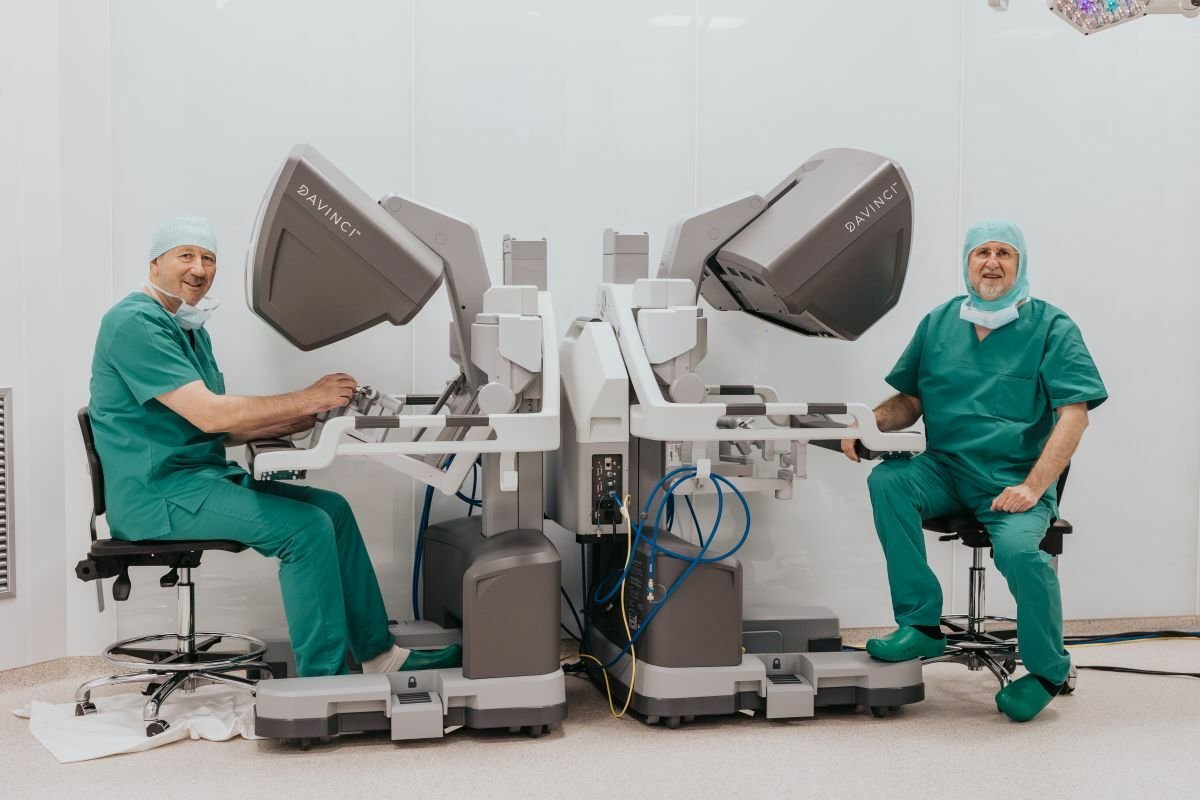
– We have completed more than a hundred successful surgical procedures with the help of the Da Vinci robot, which we are extremely proud of. With Da Vinci, the operator practically has four ‘hands’ to operate simultaneously. The robotic arms have incredible mobility with a range of up to 540 degrees and millimeter precision.
We monitor the procedure at all times in a three-dimensional display on the monitor, and the image is magnified ten times. The technological advantages translate into benefits for the patient – the incision is small, bleeding is minimal, and recovery is much faster than with traditional surgeries. In the case of urological procedures, the patient retains continence and potency – emphasized Mr. Tomislav Kalem, director of IMC Priora and head of the urology department, who also performed the first Da Vinci surgeries in Croatia.
In perfecting the work on the robotic system, the doctors at IMC Priora have been greatly assisted by mentor Dr. Georg Schön from Munich, who has performed over 6000 surgeries on this robot, making him one of the most experienced operators in the world on this system.
In the first hundred surgeries, the majority were prostate procedures, and among the first urological patients was Mirko Blažević from Vinkovci: ‘After the surgery, I felt no pain, and I returned to my daily activities, including work, within ten days. I regularly go for check-ups every three months, and everything is perfectly fine; I no longer think about the surgery, as if I never had cancer.’
Da Vinci has also proven itself in kidney surgeries at Priora, and recently it has been used in gynecology. The first gynecological surgeries on this system, including a very demanding hysterectomy, were successfully performed recently by gynecologist Dr. Dimitrije Milojković, under the mentorship of Dr. Balázs Lintner from Semmelweis University in Budapest.
– Thanks to the high-resolution three-dimensional display and the ability to magnify the image up to ten times, the surgeon is provided with an exceptionally precise view of even the smallest structures of tissues and blood vessels. Such precision increases the safety of the procedure and reduces bleeding, as well as the risk of complications. The duration of the procedure is also shortened, meaning the patient spends less time under anesthesia, resulting in faster and easier recovery – explained Dr. Milojković.
Patient Ivana Čulić from Čepin is the first woman in Croatia to have her uterus removed with the help of the Da Vinci robotic system. ‘The fibroid on my uterus caused me serious problems for three and a half years, and the consequences were anemia, frequent fainting, and general weakness, which significantly impaired my quality of life. Previously, I underwent two gynecological laparoscopic surgeries after which I recovered for a month, but the day after the Da Vinci surgery, I was walking normally and felt no pain.’
The capabilities of Da Vinci are impressive, and at Priora, they announced that they will continue to expand its application – already this month, they plan their first procedure in the field of abdominal surgery, as a third specialty.