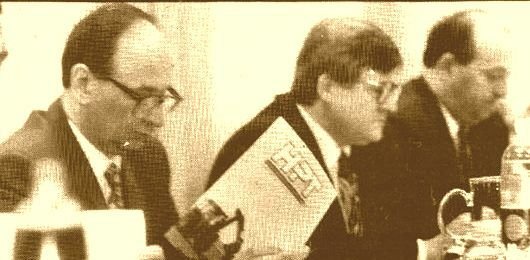
Prime Minister Nikica Valentić announced on April 6, 1994, a great privatization of public enterprises: ‘If we have opted for a market economy and entrepreneurship, we must start thinking about the privatization of large systems.’
Penić tasked with the privatization program
He added that the state, of course, would not allow anyone to have majority ownership, but through partial privatization, it could obtain valuable fresh capital. Valentić made this statement during a visit to HPT and immediately tasked the president of the Privatization Fund, Ivan Penić, to create a general program for the privatization of the public sector.
HPT was only separated into postal and telecommunications parts five years later, the telecom was sold to Deutsche Telekom, and later, Ina came under the management of MOL in a criminal privatization. And that is the epilogue of the entire privatization of mostly state infrastructure companies.
Croatia without a privatization majority
The privatization of strategic public enterprises has never failed because there was no interest from investors, but because there was no political architecture that could carry it out. No government has ever had a majority willing to touch energy, transport infrastructure, forests, water, air, and maritime transport.
However, the ‘Karamarko Government’ ordered in 2016 an assessment of the value of 54 state enterprises (including all strategic companies), but that plan fell together with the shortest-lived government.
Without consensus with the opposition and within HDZ
Neither then, nor before, nor later was there a consensus with the opposition, nor within the ruling party (most often HDZ): every time the idea of ‘opening’ HEP, HAC, Jadrolinija, CA, or ACI appeared, two factions immediately collided in the party — the market faction, which argued that public enterprises should be placed in a market framework, and the political faction, which knew that this would lose levers of power, staffing, and directing investments.
Privatization as a question of power
Too much money was at stake: forests, water, energy, and transport generate billions through procurements, concessions, and investments, so every idea about privatization initially had too few friends and too many opponents.
It is also true that many of these activities do not have to be public by definition: sailors do not need a state marina, air transport can be private, the same goes for maritime transport and numerous communal areas. But privatization in Croatia has never been a market issue — it has been a question of power.
Who knows why that is good
Therefore, today, 32 years after the first serious announcement, the balance is simple: the state has privatized only what it could (HT), sold what it should not have (Ina), and retained everything else.
But who knows why that is good. Through the privatization of strategic enterprises, we might have lost key infrastructural levers just as we lost a number of ‘ordinary’ manufacturing firms, which were driven into bankruptcy after privatization just to monetize real estate at all costs.
Below we provide a reminder of privatization attempts.
How public enterprises were (not) privatized.
• HPT
separated in 1999 into Croatian Post and Hrvatski Telekom. Croatian Post remains 100 percent state-owned.
• HT
The state sold 35 percent to Deutsche Telekom for 850 million dollars in 1999, and an additional 16 percent for 500 million euros in 2001 — DT acquires majority ownership (51 percent). Citizens acquired 25 percent ownership through a public offering in 2007, and DT subsequently increased its stake to the current 54.56 percent.
• Ina
MOL purchased 25 percent + 1 share from the state in 2003, and an additional 22.15 percent in 2008, becoming the largest shareholder with 49.08 percent ownership. The state remains at 44.84 percent and in 2009 transferred complete management rights to MOL. The court later definitively sentenced then Prime Minister Sanader to six years in prison for accepting a bribe for that decision.
• HEP
Privatization was only timidly mentioned on a few occasions. The most serious was a combination in 2017, according to which the state would offer 25 percent ownership in HEP in an IPO, to use that money to pay off MOL’s ownership stake in Ina. None of this was realized, and the announcement of partial privatization of HEP was soon decisively denied.
• Hrvatske šume
There was never serious consideration of privatization under the aegis of forests as state property. On the other hand, it is too lucrative a business that the authorities want to keep under control. It is no coincidence that all three presidents of the management boards from 2012 to 2025 left those positions after major scandals.
• Hrvatske vode
There was never serious discussion about privatization. However, ’roundabout privatization’ was conducted — through companies that are concessionaires of certain sources of drinking water, and through the privatization of water management companies.
• Hrvatske željeznice
They were separated into three companies (passenger, freight, infrastructure), but without privatization. A partner was sought for HŽ Cargo — unsuccessfully, and the possibility of privatizing passenger transport was also timidly mentioned. Now there is again talk of merging Passenger Transport, Infrastructure, and Cargo.
• Hrvatske autoceste
The most serious attempt to grant highways in concession in 2014 was prevented by the civic initiative ‘We Will Not Give Our Highways’. It collected 530 thousand signatures for a referendum against monetization, i.e., privatization. The referendum was judicially banned, but the privatization of HAC became a politically dead topic.
• Hrvatske ceste
The investment company, responsible for construction and planning, has never been the subject of more serious discussions about privatization.
• Janaf
Various models were considered, from selling part of the shares to a public offering, to increase efficiency and secure funds for investments. However, after the shock in the energy market after 2022, Janaf is strategically more significant for the state than ever, and will certainly not be privatized.
• Croatia Airlines
Regularly in search of a strategic partner that has never been found. The company would be insolvent without the state and survives with the help of the state.
• Jadrolinija
The most serious proposal for privatization is a study commissioned in 2005 from the Faculty of Economics, according to which the state would retain a controlling stake (25 percent + one share), while 50 percent of the shares would go to an IPO. The story quickly died down. In the meantime, maritime transport has been liberalized, but Jadrolinija remains the dominant carrier, although burdened by a series of scandals.
• ACI Club
The largest marina system is potentially the most attractive to investors. Privatization has been announced at least three times. Alleged secret negotiations with Turkish investors were mentioned in 2014, but Prime Minister Milanović responded that privatization and recapitalization would not pass without complete public oversight. ACI remains state-owned.