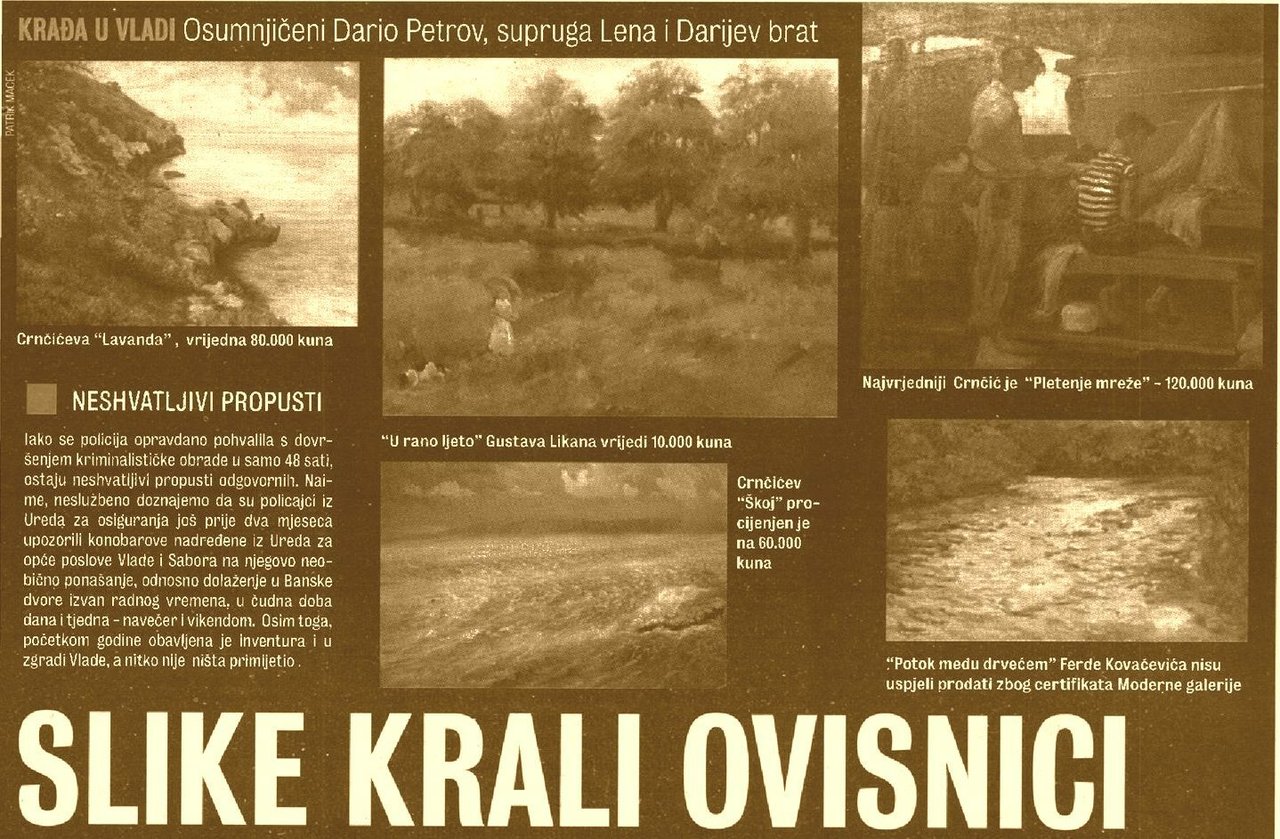
On April 4, 2003, one of the most bizarre thefts in contemporary Croatian art history was uncovered.
Two Bizarre Thefts on the Same Day
On that ‘black Friday’, the police arrested suspects for the theft of several paintings Mencija Clement Crnčića from the Banski Dvori. And that’s not all! On the same day, the Klovićevi Dvori Gallery reported that 61 artworks were missing from the depot.
These were not committed by international gangs specialized in art heists. The perpetrators were from the milieu of drug addicts and alcoholics, and the method of execution was almost unbelievable.
From the Government to Klovićevi Dvori
The paintings were taken from the Government through the window, without anyone noticing. The actors were Crnčić’s great-granddaughter – who had previously sold some works from the painter’s estate, and her husband – a waiter in the Government.
While it was still being counted what exactly was missing from the Government, it was discovered in Klovićevi Dvori that 61 artworks — paintings and graphics by various authors — were missing from the depot. It is shocking that no one knew that the artworks had disappeared, when they disappeared, who had access to the keys of the depot, whether the works had ever been properly cataloged, or how long all of this lasted.
Domestic Thieves – Petty Criminals
The two thefts on the same day revealed a system in which artworks were — an accidental nuisance in the hallway.
While professional groups that monitor security protocols for years sometimes rob world museums, in Croatia, some of the largest thefts were committed by drug addicts and alcoholics with access to a window or a key.
This is not just a social anecdote — but an important diagnosis of the state and its institutions that were not prepared to protect their heritage.
Louvre’s Password for Royal Jewels
However, last year in the Paris Louvre, in one of the most famous thefts of royal jewels, the password for the Louvre’s video surveillance was – ‘louvre’. This is a universal lesson that security systems are not as strong as the equipment is, but — as strong as the weakest person using it.
The Croatian version of that weak point had its ‘password’ – an open window.
The Theft of a Million Dollar Vase
This model was applied in the theft of a million dollar vase from the Ming dynasty, which was stolen by three amateurs from the Mimar exhibition, then still in the Upper Town, in the five seconds that the camera was not recording.
The story received an equally bizarre media echo, it all turned out to be activism – a warning about shortcomings in the security system. The vase was anonymously returned and there were no consequences.
A Statue Over Two Meters Tall Also Disappeared
Stolen artworks are most often lost on the black market, and that is where they are most often found. However, ‘Antun Mihanović’ was never found. The bronze statue by Kuzma Kovačić, 220 centimeters tall with a stone pedestal of 170 centimeters, disappeared from a park in Omiš, and has never been found.