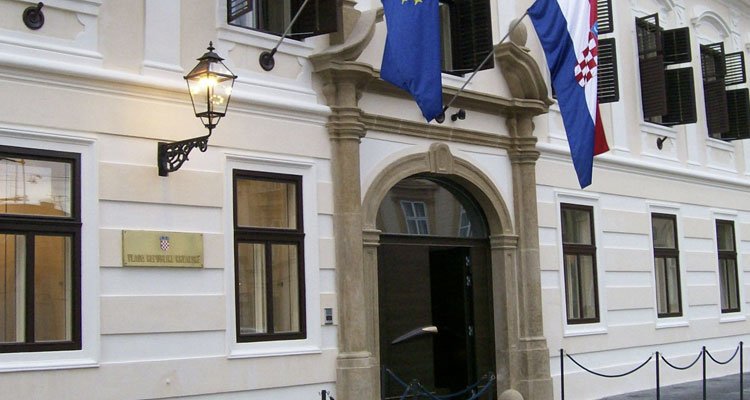
The National Reform Program defines three main goals: strengthening the competitiveness of the economy, increasing employability, and linking education with the labor market, as well as the sustainability of public finances, which should contribute to achieving long-term sustainable economic growth, increasing employment, creating new jobs, and reducing macroeconomic imbalances.
>>> Plenković Requested the Dismissal of Three Ministers from Most
These three goals, said Prime Minister Plenković, are fully compatible with the fundamental tasks of the government, and he expects the national reform program to be a guide for the work of all ministries and to be fundamentally used in the implementation of reforms.
Deputy Prime Minister and Minister of Economy, Entrepreneurship, and Crafts Martina Dalić stated that the National Reform Program represents a crucial step towards addressing the problems that plague the economy and slow down its growth capacity.
The achievement of these main goals will be supported by the implementation of 53 reform measures in 12 reform areas.
Consolidation of Inspections, Cutting All Administrative Fees
Strengthening the competitiveness of the economy is planned to be achieved through improving the business environment, enhancing the management and disposal of state property, effective human resource management, and providing services in public administration, eliminating institutional, structural, and functional fragmentation in public administration, and improving the efficiency of the judicial system.
Among other things, one of the measures mentioned is the consolidation of inspection services in the economy. Dalić noted that there are currently 50 inspections in Croatia employing over 2,200 people. An analysis showed that, for example, a small entrepreneur in the retail sector can encounter more than 10 inspections on a daily basis, Dalić illustrated.
It also mentions further reductions in administrative costs and non-tax levies, which will further relieve entrepreneurs and craftsmen. Under this reform measure, administrative relief will be implemented at an average of 30 percent by the end of 2017, and para-fiscal relief of at least 20 percent during the period 2017-2019.
The abolition of all administrative fees that constitute direct revenue for the central state budget is also planned, and in partnership with the business sector, the Ministry of Economy will launch an interactive web portal in 2017 through which entrepreneurs and citizens can report administrative costs, obstacles, and levies.
>>> Tax Authority Clarified Age Coefficient, Calculation of New Property Tax
Activities will also be undertaken to increase the efficiency of institutions, which includes simplifying rules and speeding up the work of administration and courts, while the increase in the efficiency of public administration will primarily be achieved through effective human resource management along with revising the salary determination system that will encourage expertise and ensure rewards based on the performance of each employee.
Thus, the government plans to implement comprehensive normative regulation of the organization and performance of state administration tasks and rationalization of the system of legal entities with public authority of an agency type, as well as the rationalization of first-instance bodies and regional units of state administration bodies (TDU).
Increasing Employability and Linking Education with the Labor Market is planned to be achieved through the implementation of education program reforms, lifelong learning, and integration into the labor market; aligning educational programs with labor market needs at the level of vocational and higher education, and implementing education reform.
Amendments to the State Audit Act
The sustainability of public finances, on the other hand, is planned to be achieved by strengthening the framework for public finance management and implementing fiscal consolidation, i.e., further reducing the budget deficit, which will result in lowering the share of public debt in GDP, thereby improving the country’s credit rating and reducing borrowing costs for both the state and the private sector.
>>> Dalić: The Register of Non-Tax Levies is a Step Towards Reducing Business Costs
As part of this, stricter implementation of state audit recommendations will be ensured. Adjustments to the legislative framework related to sanctioning non-compliance with the recommendations of the State Audit Office (DUR) will be made with the aim of increasing the sustainability of public debt and strengthening public finance management. The proposed State Audit Act intends to introduce sanctions for audit subjects and responsible persons for non-compliance with given orders and recommendations and for failing to submit reports within the prescribed time; to clearly define who the audit subjects are and what the audit process entails; to extend the deadline for submitting reports on the audit of the annual report on the execution of the state budget; to introduce the possibility of engaging special experts as external collaborators to address specific issues; and to clarify the obligations of employees in DUR.
Furthermore, it also mentions reducing debts in healthcare and the sustainability of the healthcare system; improving the social benefits system and ensuring the long-term sustainability of the pension system.
Encouraging Longer Work Through Penalizing Early Retirement
A key measure for improving the efficiency of the pension system is, as emphasized, encouraging longer stays in the labor market, which is intended to be achieved by discouraging early retirement, i.e., increasing the so-called penalty for early old-age pensions. Instead of the current reductions that depend on the length of pensionable service (the starting factor for determining early old-age pension ranges from 0.10 percent to 0.34 percent per month of early retirement), it is proposed to introduce a uniform starting factor for each month before the insured person’s prescribed age for acquiring the right to an old-age pension, regardless of the years of pensionable service completed.
For example, in Austria, early old-age pensions are reduced by 4.2 percent per year of early retirement up to a maximum of 15 percent, in Slovenia by 0.3 percent per month up to a maximum of 18 percent, in Germany by 0.3 percent per month of early retirement, and in Lithuania by 0.4 percent per month, but the pension is recalculated after meeting the conditions for old-age pension.
>>> Fina: Only a Quarter of Obligors Submitted the Annual Financial Report
It is also stated that the adoption of the National Hospital Development Plan will improve the quality of healthcare services and enhance hospital healthcare as a whole. Measures will be developed to stimulate the retention of young doctors in Croatia and ensure faster and easier access to specializations, while continuous professional development of doctors will be financed from EU funds. Rationalization of expenditure will be ensured through control of the scope and quality of services provided by all healthcare entities.
The National Reform Program defines the state and plans for the implementation of key structural policies of the state, while the convergence program determines the key characteristics of the macroeconomic and fiscal policy framework.
These activities are part of the mandatory reporting process and alignment of the economic policies of EU member states with the jointly defined goals and provisions of the Union, and non-compliance results in sanctions that include the “freezing” of EU funds for the member state.
Convergence Program – Slowdown of GDP Growth
In the convergence program, which all EU member states are obliged to adopt and align their economic policy with the jointly defined goals and provisions of the EU, it is stated that the government expects economic growth of 3.2 percent this year.
In 2018, GDP growth is projected to slow down to 2.8 percent, a year later to 2.6 percent, and in 2020 to 2.5 percent. “The mentioned slowdown in the projection period is the result of the convergence of GDP growth towards the growth of potential GDP in the medium term,” the convergence program states.
Economic growth will, it is added, throughout the entire period be based solely on the contribution of domestic demand.
It is also emphasized that the stability of public finances is the foundation of sustainable economic growth, so one of the key determinants of government policy is fiscal consolidation based on reducing the budget deficit and stimulating economic growth, which contributes, among other things, to a significant reduction in the share of public debt in GDP.
“Therefore, the key emphasis of fiscal policy is on strict control of budget expenditure and utilizing every surplus revenue compared to planned for further reduction of the budget deficit,” the program states.
Last year, the share of the budget deficit in GDP fell to only 0.8 percent, which is its lowest level since these data have been recorded under the current methodology. This year, however, an increase in the deficit to 1.3 percent of GDP is expected, which will again fall to 0.8 percent in 2018.
The convergence program also states that a continuation of the decline in public debt is expected in the upcoming period, after it was nominally reduced last year, as well as its share in GDP.
Thus, after it slipped to 84.2 percent of GDP last year, public debt is expected to fall to 81.2 percent in 2017, and a year later below 80 percent of GDP.
“All these efforts also enable the fulfillment of the EU Council Recommendations regarding addressing the excessive budget deficit and the subsequent exit of the Republic of Croatia from the excessive budget deficit procedure in the next few months,” the convergence program states.