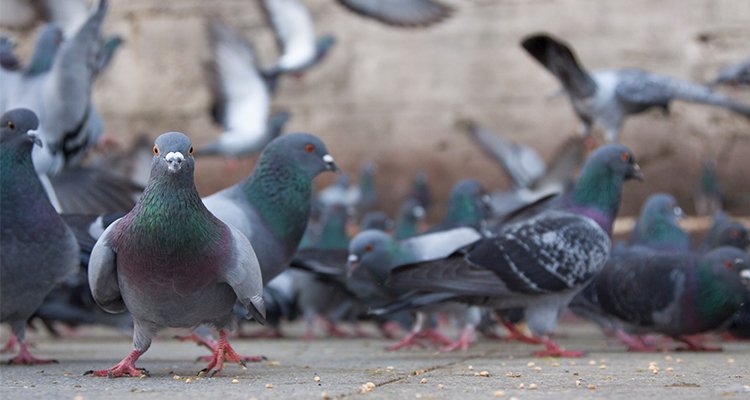
Takao Sasaki and Dora Biro, scientists at the Department of Zoology at the University of Oxford, conducted research on the flight paths of homing pigeons to discover whether the efficiency of the process increases over time, and whether collective intelligence is generationally transmitted, writes Nature.
>>>Research: Mice moved in as soon as we started building houses 15,000 years ago
The experiment was conducted on ten birds, some of which were familiar with the flight route, while others flew it for the first time for the first time.
The result was published in the journal Nature Communications, proving the thesis that over time, students indeed become teachers.
The research showed that flight performance consistently improved from generation to generation, as each subsequent generation flew a more direct route. Groups of later generations eventually surpassed individuals flying alone or in groups whose members were always the same individuals. The routes of different pigeons resembled each other more closely in successive generations of the same pair of pigeons than those across pairs, indicating generational knowledge transfer.
– At one point, scientists believed that only humans possessed the cognitive abilities to accumulate knowledge in society. Our research shows that pigeons possess the same abilities as humans, at least to the extent that they can improve behavioral solutions over time. However, we do not believe they achieved this through the same processes, said Sasaki.
>>>Research: Scientists discovered where babies cry the most and the least
When humans share knowledge across generations, culture becomes more complex over time, as confirmed by many examples from production and engineering. On the other hand, in the process occurring in homing pigeons, the end result is an increase in efficiency, in this case navigational, but not necessarily an increase in behavioral complexity.
– Our results show that pigeons can accumulate knowledge and gradually improve their performance, meeting the criteria for nurturing cumulative culture. The results further indicate that cumulative culture does not require sophisticated cognitive abilities as previously thought, explained Sasaki.
This study also shows that collective intelligence, which typically focuses on one-time performance, can arise from the accumulation of knowledge over time.
– We believe that one of the key novelties is that the gradual improvement we see is not due to new ‘ideas’ about how individual birds increase the efficiency of routes. Instead, the necessary innovations in each generation are formed from a form of collective intelligence that occurs among pairs of birds that can solve problems together. In other words, two heads are smarter than one, explained coauthor of the research Dora Biro.