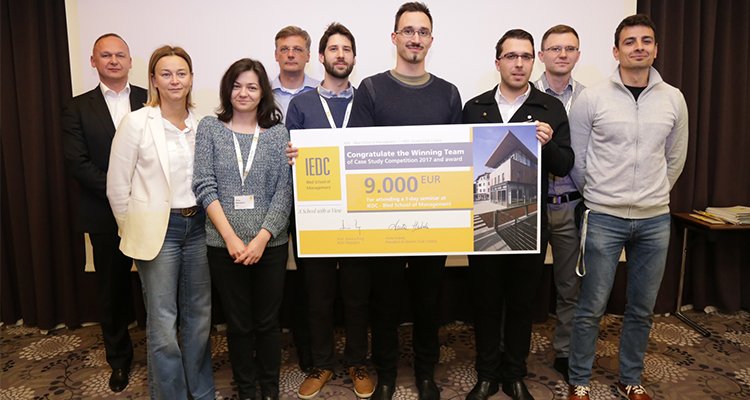
HEP is the winner of the jubilee tenth competition in solving business cases, the Case Study Competition (CSC), which took place on Wednesday and Thursday at the DoubleTree Hilton hotel in Zagreb. With a business model that utilizes existing infrastructure, is energy-efficient, and allows savings for owners of commercial buildings – the HEP team secured victory over teams from Alarm automatika, Cemex, Franck, HPE, IN2, JGL, Styria, and Vipnet.
>>> Electricity Exchange
– There is no exact solution. The same problem can be viewed in many different ways. Each of the solutions you offered has room for improvement, but we concluded that the winning case was very well and clearly resolved – said the jury president Dr. Brane Kalpič, a strategy and business model expert and lecturer at the IEDC Business School Bled and Saïd Business School at the University of Oxford, during the announcement of the winner, praising the focus and clear logic of the business strategy offered by the HEP team. He explained that some teams, in wanting to cover as much as possible, lost focus, which is a very common case in real business situations that leads to failure.
All nine teams received the same task on Wednesday to design a service that would allow them to enter the new e-mobility market and had 24 hours to come up with the best solutions through teamwork. – It’s great team building, emphasized Manca Debeljak, head of the Alumni office of the Bled IEDC school.
– It was interesting. The case study was very demanding with a lot of information that needed to be studied, understood, framed, and a solution that is grounded in reality, feasible, and has some profit for us as a company and users, said Matej Gržeta from the winning team.
>>> Moody’s Upgraded HEP’s Long-Term Credit Rating from Negative to Stable
His teammate Vedran Prpić reflected on the reactions of other teams who interpreted the fact that the task was related to the energy sector, and among the competitors were representatives of the national electricity company, as their advantage.
Prpić disagrees with this because the e-mobility and e-vehicle market is still new to HEP as well. – Most of us work in different parts of HEP and are not necessarily directly connected to the e-vehicle market. At certain moments, knowledge about our company and electricity even made it harder for us to make a decision to go in a certain direction because we were aware of all the shortcomings. So I wouldn’t say we had an advantage over the others from the start, said this member of the winning team who will participate in a one-day seminar at the Bled IEDC business school in September and compete with the winners from the other five countries where the CSC is held.
The competition is organized by the Croatian IEDC Alumni Club with the aim of promoting additional business education and lifelong learning among young managers and leaders of Croatian companies. Initiated by the Croatian IEDC Alumni Club, the CSC competition is now also held in Slovenia, Bulgaria, Romania, Serbia, and North Macedonia.
– Finding solutions in such an analytical and systematic way is a method that schools like IEDC use every day. Similar tasks in IEDC’s MBA program are also solved in groups because that team dynamic is extremely important. That’s how it’s done in business as well. Everyone was surprisingly good considering they do not have an MBA and the tools acquired there for solving such cases. In the end, the consistency of the HEP team’s business model was decisive, concluded Anita Hukelj, president of the Alumni Club Croatia and a member of the CSC competition jury.