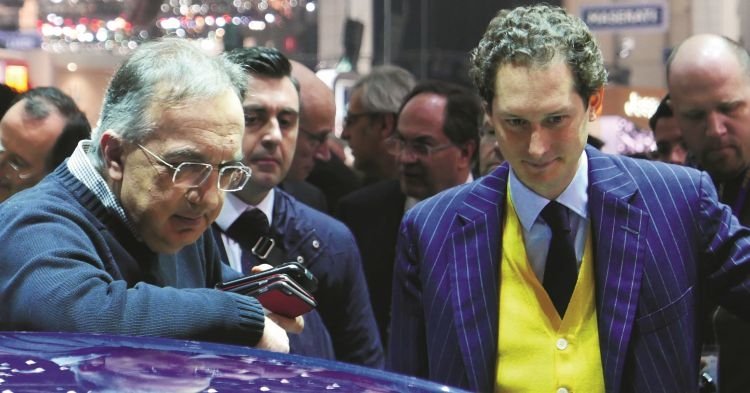
Fiat – Fabbrica Italiana Automobili Torino – the factory founded in 1899 in Piedmont by Giovanni Agnelli – is one of the most important symbols of industrial Italy in the last century. When the Agnelli family gathered in 2013 for a memorial mass on the tenth anniversary of the death of the founder’s grandson Gianni Agnelli, tributes were paid not only by representatives of the business world but also by the President of Italy Giorgio Napolitano, and the Archbishop of Turin Cesare Nosiglia read a message from Pope Benedict XVI. However, the man who inherited the Agnelli empire and miraculously revived it, Gianni’s grandson John Phillip Jacob Elkann, decided last year to move the headquarters of the holding company Exor to the Netherlands. He plans to strengthen Exor’s connection to Italy by investing in smaller Italian family businesses that have managed to grow into national or continental brands over the past decades. All this is happening at a time when it was announced that FCA (Fiat Chrysler Automobiles) would lose Sergio Marchionne, Elkann’s long-time right-hand man and one of Fiat’s most successful managers in 2019.
Good Opportunity
The character of Exor and Fiat itself provide quite convincing reasons for relocating the headquarters of the holding company. After Chrysler’s bankruptcy, John Elkann decided in 2009 to take a stronger ownership stake in the American automotive giant. Although he did not think so at the time, that decision proved crucial in bringing Fiat and Exor back to the paths of former glory. Acquiring a majority stake in Chrysler brought the Agnelli automotive group a net profit of $1.86 billion in 2012, and without Chrysler’s revenue, the loss would have amounted to $1.38 billion.
John Elkann, the man who inherited the Agnelli empire and miraculously revived it, decided last year to move the headquarters of the holding company Exor to the Netherlands. He plans to strengthen Exor’s connection to Italy by investing in smaller Italian family businesses.
– I felt it was a good opportunity, but I didn’t feel it would be crucial – John Elkann later said about entering Chrysler.
With the merger into FCA, Fiat’s headquarters is already in the Netherlands, and its fiscal residence is in the United Kingdom. Therefore, the shareholders’ decision regarding Exor’s departure from Italy is understandable, as is Elkann’s effort to internationally expand Exor’s portfolio. Exor no longer holds only Italian and Italy-related companies and symbols, such as La Stampa, Ferrari, Iveco, Alfa Romeo, and the football club Juventus, but by acquiring PartnerRe, it entered the international reinsurance market, and through The Economist, into international media. However, the words Italian and Turin are still hidden in Fiat’s part of the FCA merger, and Elkann today plans Exor’s return with financial investments in more successful Italian businesses.
From Drama to Profit
Elkann began formal preparations for ‘capa’ exactly twenty years ago. He incognito visited the headlight factory in Birmingham, the production line in Poland, and a car dealership in France, and until his grandfather’s death in 2003, he worked in corporate auditing at General Electric. When he took over IFIL, today’s Exor, in 2003, the family business was not doing well. Fiat’s European market share had fallen below six percent, but Elkann quickly began making successful business decisions. One of the most important was undoubtedly bringing Sergio Marchionne on as Fiat’s CEO.
To Elkann, Marchionne meant what Cesare Romiti, known as Il Duro, meant to his grandfather Gianni Agnelli. Thus, an operational figure capable of managing all the details of the most important resource of the Exor holding and leading it from drama to profit, even running the company if necessary. When Elkann offered him the position of Fiat’s CEO, Marchionne told him he sincerely hoped he wouldn’t need him because until then he had experience with toasters and children’s toys, not vehicles. However, the fear proved unfounded, and Elkann’s choice was excellent. Elkann’s and Marchionne’s collaboration transformed Fiat into a successful company that acquired a controlling stake in Chrysler and then merged with it, now making up a quarter of Exor’s portfolio and the largest part of Exor’s revenue. And when they just started in 2004, Fiat had a cost of two million dollars a day, three billion in credit obligations, a falling stock, and the entire IFIL (Exor) was being dragged down.
Negotiations with GM
Acquiring Chrysler, merging with it, and quality joint development, as well as bringing Sergio Marchionne on board, were certainly the most important moves by John Elkann in Fiat and Exor. There wasn’t much trust at the beginning; even some family members were skeptical about Marchionne’s selection and Elkann’s youth, especially since Fiat’s blood count was desperate and it was on the brink of Chrysler’s fate. Elkann’s decision to enter Chrysler and Marchionne’s consolidation strategy, which he had recently offered to the much larger General Motors, benefited both companies. However, misunderstandings arose between Marchionne and Elkann, particularly due to communication with GM. When it was revealed that GM was courting a merger in 2015, Marchionne downplayed the importance of the whole story, stating that he sent many emails, so he didn’t want to confirm it. But Elkann himself confirmed it.
Acquiring the American Chrysler and bringing Sergio Marchionne on as Fiat’s CEO were the most important moves by John Elkann in Fiat and Exor. Marchionne, however, is leaving in 2019 and, it seems, to mutual joy, is retiring at 62.
– It wasn’t just one email; it wasn’t the only conversation – Elkann told reporters when asked in May 2015 about the New York Times’ revelation regarding Marchionne’s offer to GM. At the moment that business communication was revealed, Marchionne was already planning to leave FCA in 2019. But did that solidify Elkann’s support for that decision? Marchionne’s consolidation strategy is based on the thesis that too much capital is scattered among too many vehicle manufacturers and that significant savings could be achieved through mergers. However, merging with a larger player like GM would dilute Exor’s 30 percent stake in Fiat to 7.5 percent, although it would still be the largest single shareholder. This would mean further distancing from the Italian nature of the company, although perhaps the strategy has sound logic since FCA, as the seventh largest car manufacturer, is more indebted than its competitors. Did Elkann and Marchionne stick to a common plan? Or did Marchionne go solo and will retire at 62, while his counterpart Cesare Romiti became the chairman of Fiat at 73? The answer to that question ultimately isn’t very important. John Elkann, as befits new generations, has successfully changed Exor’s philosophy and directed it globally rather than nationally. However, this also carries some other consequences. At the height of its economic power, Fiat employed 300,000 people in Italy, of which 100,000 in Turin, and today it has 62,000 employees in Italy, with only five thousand working in the Turin plants.
Plans for Italianization
Regardless of Exor’s global significance, which Italy can be proud of, the move to the Netherlands is an additional blow. Exor is not fully owned by the Agnelli family but is in a majority stake. With the recent acquisition of the international reinsurance company PartnerRe, FCA and Fiat ceased to be Exor’s largest resource. Where, actually, is Elkann leading Exor? Perhaps he realized that he must connect as strongly as possible with Italy, or perhaps he was forced to do so by business decisions that increasingly give Exor a global character. In any case, he has plans for a stronger ‘Italianization’ of Exor. For example, among the 62,000 employees in Italy, 950 are in Maserati, where he plans to revive the production of luxury cars intended for export. By turning Exor towards smaller investments in successful Italian businesses, John Elkann has likely found a way to maintain a strong connection with his family’s homeland, expand the portfolio, achieve profit, and help continental and national brands reach a global level. His targets include Moncler, Eataly, and Technogym, companies that are among the fastest-growing in the last ten years.
Exor does not only hold Italian and Italy-related companies and symbols, such as La Stampa, Ferrari, Iveco, Alfa Romeo, and the football club Juventus, but by acquiring PartnerRe, it entered the international reinsurance market, and through The Economist, into international media.
– We believe there is a market where entrepreneurs or family businesses are looking for partners for many reasons. And in partnerships, we seek investment opportunities – Elkann recently told the Financial Times. Will he succeed in his intention? Time will tell, but the prospects for success are not bad, among other things due to the well-known current problems of the Italian banking system, which give a private investor of Exor’s size unprecedented opportunities. If he successfully leads Exor and establishes strong ties with Italy through investments, John Elkann could become as successful and respected as his predecessors who led the Agnelli family. And those are shoes that are hard to fill for anyone, including John Elkann.
Grandfather’s Decision
Although he was born in New York and grew up in Brazil, the United Kingdom, and France, John Phillip Jacob Elkann chose to study in Turin because he felt Italy, due to the Agnelli family, was most like home. Grandfather Gianni Agnelli tried to persuade him to study economics; however, he opted for an engineering degree at the Polytechnic because he considered it more challenging. The oldest son of Margherita Agnelli, Gianni Agnelli’s only daughter, was unexpectedly chosen as the heir at just 21 years old. The original heir Giovanni Alberto Agnelli suddenly passed away from cancer in 1997, and grandfather and long-time ‘capo’ of the family saw the future in John Elkann. – That day after lunch, he told me he was thinking about an appointment to the board and that he thought it should be me. I didn’t expect that. I asked him if he thought it made sense – Elkann recounted his grandfather’s decision.