
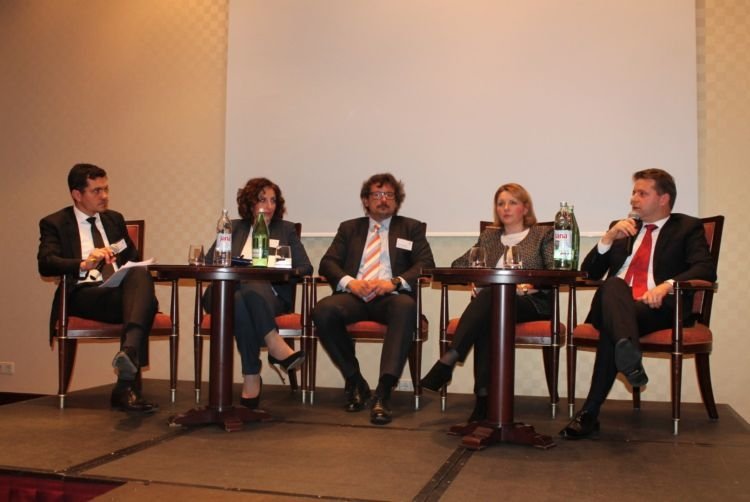
The consulting and auditing firm EY Croatia held a conference in Zagreb titled Maximizing Value through Capital Optimization, during which eminent experts from the banking sector, as well as lawyers and other professionals involved in corporate restructuring processes, discussed the key determinants of these processes. The conference reflected on “best in class” restructurings that create value for all parties involved in the process – creditors, companies, shareholders, and employees.
The gathered participants were welcomed by Lena Habuš, Executive Director and Head of the Transaction Advisory Services Department for Croatia, and Raj Apte, Partner and Head of the Restructuring Department for Central and Southeastern Europe. On this occasion, Apte emphasized that “restructuring is something that interests many, but it is important to understand that the Southeast European region is still in a transition process. Therefore, it is crucial to use tools that create revenue and new jobs, relying on best practices from around the world. Croatia is one of the countries that has the opportunity to capitalize on its potential, from natural resources to beauty. Restructuring should be one of the tools that supports development in any form; in other words, it is about creating a quality foundation for development.”
Following the opening address, the first panel discussion was held, led by Luka Vesnaver, EY Partner for Restructuring, featuring Vesna Ciganek-Vuković, Member of the Management Board of Raiffeisenbank Austria d.d., Vedrana Jelušić Kašić, Director of EBRD in Croatia, Slovenia, Hungary, and Slovakia, Dubravko-Ante Mlikotić, Member of the Management Board of Addiko Bank d.d., and Dinko Novoselec, President of the Management Board of AZ d.o.o., a company managing mandatory pension funds. Ciganek-Vuković pointed out: “We learned a lot from the last crisis; problems were recognized too late, initially we had unrealistic expectations regarding the possibilities of collection, and the necessity for better cooperation and compromise.” Building on this, Mlikotić emphasized that during a crisis, it is most important to avoid losses in a timely manner. “Thanks to this, banks in Croatia are now much more proactive and approach clients with restructuring proposals,” he concluded.
“Money exists, but its path is long. Financial restructuring is not possible without operational restructuring, where we come to the leadership problem, i.e., the top layer that needs to lead this process,” Novoselec emphasized. The conclusion of the panel was summarized by Jelušić Kašić, highlighting that “restructuring is certainly possible without involving the courts (out-of-court settlements). In this process, it is extremely important to adapt the legal framework, including segments that regulate the write-offs of uncollectible receivables, labor legislation, as well as coordination between banks and the debtor company, and the inclusion of an independent body that has a certain influence over banks, which, for example, in the United Kingdom was the Bank of England, their central bank.”


