
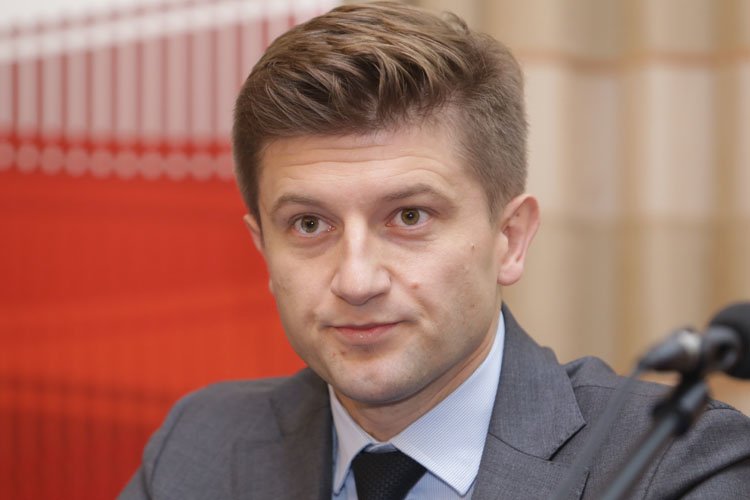
Finance Minister Zdravko Marić announced in an interview with Mediaservis on Monday that a “short technical budget revision for 2016” related to the restructuring of the Government will be presented on Thursday, and next week the macroeconomic projections and the revenue side of the budget for 2017.
In response to a journalist’s question, Marić stated that the budget revenues for 2017 are not yet fully prepared and will depend, among other things, on two key elements – macroeconomic projections for the next year and tax reform.
“All of these are interconnected, everything affects each other, and we will finalize this by the end of the week. In some time frame, you can expect a short technical budget revision for 2016 this Thursday, which concerns exclusively the restructuring of the Government. Redistributions between ministries will be within the framework and there will be no breach of the expenditure side of the budget. That is very clear,” said Marić.
He announced a shortened version of the guidelines for economic and fiscal policy for next week, in which he will present macroeconomic projections, the revenue side of the budget, and the limits he sends to ministries, state administration bodies, and budget users.
“The following weeks will involve fitting in relation to those limits, a lot of bilateral talks with ministers. Those are the ‘interesting conversations’,” said Minister Marić among other things.
He emphasized that controlling the expenditures of the state budget will be crucial. “He believes that the problem of Croatian public finances is primarily on the expenditure side of the budget, then the revenue side of the budget, stimulative, through encouraging the economy by relieving citizens, and on the other hand, all excess revenue will go towards reducing the deficit and decreasing public debt. This will be the idea, intention, and foundation for working on next year’s budget,” emphasized the finance minister.
“There are certain categories of expenditures, especially items for retirees, where we will foresee two indexations for next year, which automatically means an increase in that expenditure side, then our participation in terms of co-financing EU funds, but in other categories, we will try to seek certain savings, rationalizations so that this expenditure side does not, as in previous years, I would say explode, and then ultimately create negative feedback effects,” said Marić, reiterating that it is certain that the targeted deficit will be at most at the level of 2 percent of GDP.
If salaries for officials are not increased, savings of three to four million kuna annually
In response to questions about tax reform and explaining why he considers the announced amendment by Most, i.e., changes to the law to prevent salary increases for officials, to be populist, Minister Marić stated that one of the key problems of state administration is, among other things, the simultaneous existence of shortages and surpluses of people.
“You have a shortage of good people and at the same time, I will say, a surplus of not-so-good people. And that is the responsibility of those who manage, namely ministers, the Government, to make a quality reform of state administration. But there are a whole range of segments and other elements in which really strong structural steps need to be made,” said the finance minister.


