
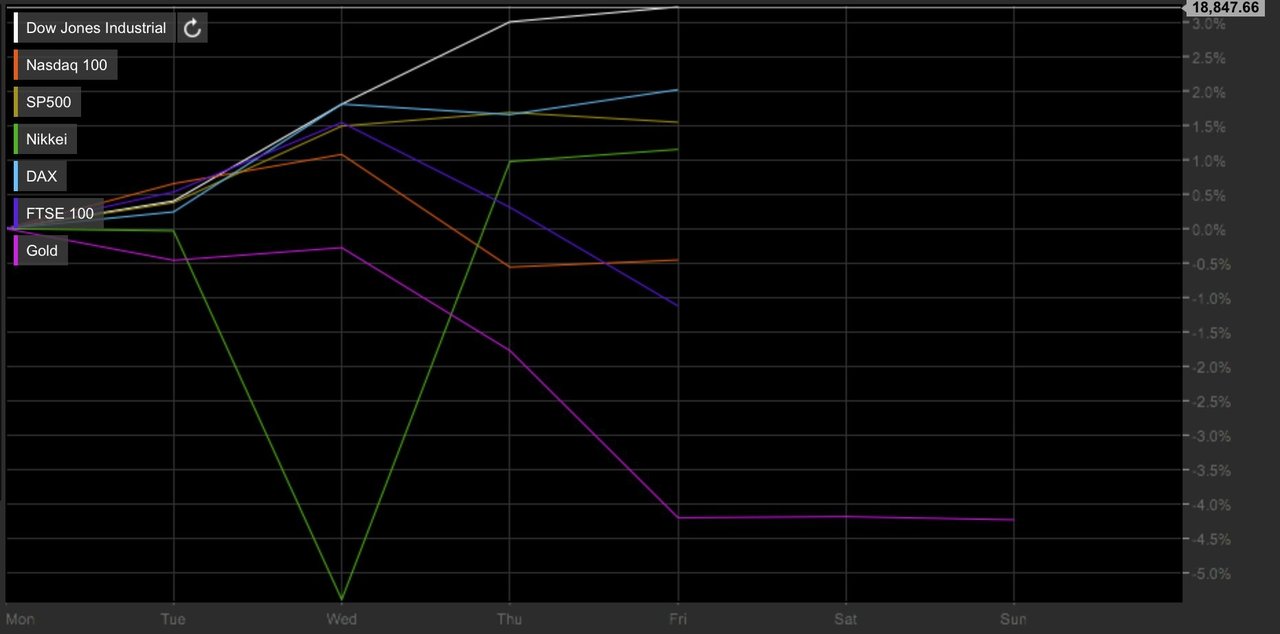
We have just completed a week marked by significant volatility in the financial market. In response to the election of a new American president, the market initially reacted too dramatically, and on Wednesday morning, the main American stock indices were down over 5%, only to recover during the day and finish in the positive. It is evident that the election winner was unexpected, and the markets reacted only to the uncertainty surrounding everything, but not to the outcome, as they quickly recovered after the initial shock. Just like in the case of Brexit at the end of June. All those who predicted a market catastrophe, and there were quite a few, were once again left with incorrect forecasts.
Let’s take a look at how the most well-known global stock indices finished the week. All listed indices ended the week in the positive, with the largest weekly growth on an annual basis: S&P 500 3.79%, DJIA 5.36%, NASDAQ 100 1.96%, Nikkei 225 2.78%, DAX 3.98%, and FTSE 100 0.56%. Although gold is considered a safe haven in uncertain market conditions, it recorded the only weekly decline among all significant asset classes, at -5.86%. So much for (in)security. Perhaps it will one day become clear to everyone that the capital market (stocks) is the only asset class that consistently provides higher returns than all other asset classes, and that corrections should be viewed as opportunities, not as catastrophes and market collapses, because in the end, new peaks are constantly being reached.
Chart 1 – Major Global Stock Indices

One of the first stock indices in the world, the DJIA (Dow Jones Industrial Average), which includes 30 of the most significant industrial corporations in the U.S., had its best weekly performance since December 2011. With a weekly growth of 5.36%, it reached a new all-time high of 18,873.66 points on Thursday, continuing the upward market trend since 2009. New peaks will continue to be reached in the future, with or without doomsayers. The only certainty is that their number will decrease as their participation in the capital market increases.


