
The “Nonfarm Payroll” is a regular monthly report from the labor market of the largest world economy – the USA. It is published on the first Friday of the month at 14:30 Central European Time (CET). Why is this report so important for financial markets and how does the publication of the report affect the mood of investors and traders?
The content that the report brings us will not be elaborated too much in this text. We will deal with the published numbers, and the consequences (reactions) at the moment of publication, as well as how to technically position oneself in very complex market conditions.
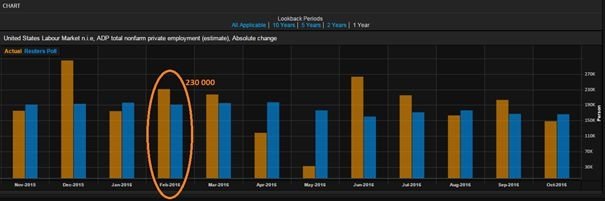
We will take the currency pair EUR/USD as an example and the market reaction to the report published on February 5, 2016. In Table 1, we see that the figure of 230,000 new jobs on a monthly basis was significantly better than the expected figure of 190,000. It is important to note that for long-term stability in the US labor market, a “good” average number of 100,000–150,000 new jobs each month is necessary. This means that a healthy economy should generate between 1.2 – 1.8 million new jobs annually.
Any figure on average greater than 150,000 new jobs represents a very good result. At the moment of publication, the short-term market reaction was directed towards the weakening of the dollar, and half an hour after the publication, the dollar had already set a daily “high” against the euro, completely erasing the initial negative reaction. Given my years of experience in monitoring and trading on the payroll release, I would like to draw your attention to several important details:
1. There is a pronounced high volatility at the moment of publication, so if a trader lacks experience, they can incur significant losses in a short time.
2. At the moment of publication, on currency pairs that contain the dollar in the quotation, the spread (the difference between the buying and selling rate) can be several times larger than usual.
3. A good figure from the labor market does not necessarily provoke a positive reaction, i.e., an increase in the value of the dollar – be cautious, as analysts always find some explanation for the market’s reaction to the report, but with a delay.
4. I recommend that in the first half hour from the moment of publication, do not expose yourself to unnecessary risks, only when the market calms down should you take a certain position.
5. I do not recommend beginners to trade at all in complex market conditions.


