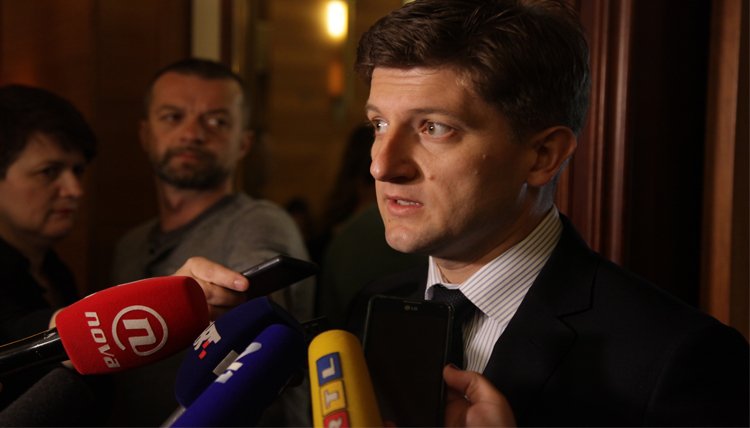
The impact of the proposed tax reform in the first year of implementation will amount to approximately 1.8 to 2 billion kuna, but the reduction of the tax share in GDP will have a positive effect on the long-term potential growth rate, and the system will become simpler, more transparent, and fairer, emphasized Finance Minister Zdravko Marić on Thursday.
Presenting the details of the proposed tax reform, which will require amendments to a total of 15 laws, of which 7 will be completely revised, Marić stated that these legislative proposals should be before the Government at the beginning of November, in order to meet the targeted date for implementation, starting from January 1, 2017.
– If this targeted deadline is missed, we lose a year, and therefore we will try to expedite procedures both before the Government and the Parliament, said Marić, adding that he expects some resistance to the proposed changes, but that the majority of citizens should be satisfied.
Income Tax
From the beginning of next year, according to the proposed reform, income will be taxed at a rate of 24 percent up to an amount of 17,500 kuna, after which the rate will increase to 36 percent. This changes the current rates of 25 and 40 percent and abolishes the lowest rate of 12 percent, which Marić explained by the fact that the personal deduction is increased, which will now amount to 3,800 kuna for all taxpayers. This change, he added, excludes another 550 – 560 thousand citizens from the ‘tax scissors’ of income tax, in addition to the existing 915 thousand citizens. For another 330 thousand, the tax burden on income is reduced by 95 percent.
The amendments also raise the personal deduction for children (for the first child, the factor increases from 0.5 to 0.7, for the second from 0.7 to 1, for the third from 1 to 1.4, etc.) and other dependents, and foresee an additional reduction of the tax obligation by 50 percent for pensioners, people in assisted areas, and the city of Vukovar. For example, a person with one child living in a city with a surtax of 12 percent will no longer pay tax on income of nearly 5,520 kuna net, and if they have two children, that amount increases to 8,000 kuna.
Lovrinčević on Tax Reform: Entrepreneurs Have Room to Operate, It Is Up to Them to Utilize It
The reduction of the highest tax rate, on the other hand, was explained by the desire to facilitate individuals who are in demand throughout the EU, such as experts from the ICT and IT sectors, doctors, engineers, etc. A rate of 12 percent will only apply to income from property, capital, and interest from savings and insurance. Synthetic taxation of secondary income is also introduced, along with the obligation to pay contributions on that income, but at reduced rates – for healthcare from 20 to 10 percent, and for the pension system from 15 to 7.5 percent.
Corporate Tax
The proposed amendments will reduce the general corporate tax rate from 20 to 18 percent, and to 12 percent for small farmers, entrepreneurs with annual income up to 3 million kuna, etc. At the same time, the incentives for reinvested profits are abolished, as only 1 to 2 percent of entrepreneurs utilized them, according to Marić, but incentives for research and development, assisted areas, the city of Vukovar, as well as those provided by the investment promotion law remain. The recognized expense for representation is increased from 30 to 50 percent, and incentives for cars are reinstated.
VAT
Regarding VAT, it is proposed that the general rate be reduced to 24 percent, and the reduced rate to 12 percent from the beginning of 2018. From next year, VAT for agricultural raw materials, electricity supply, child seats, and certain funeral services would be reduced from 25 to 13 percent. VAT on hospitality services and sugar would increase from 13 to 25 percent, while VAT on cinema tickets would rise from 5 to 13 percent. The lower VAT on electricity supply, Marić explained, will reduce bills for citizens, and this will also compensate for the higher costs due to increased fees for renewable energy sources, which the Government will consider separately. Since it is planned to abolish the lowest VAT rate in 2018, this means that products currently taxed at 5 percent, such as books, orthopedic aids, food, etc., will be taxed at a rate of 13 percent from then on.
Property Taxation
New proposals have also been made regarding property taxation. It is proposed to abolish incentives for the purchase of the first used property and to reduce the general property transfer tax rate from 5 to 4 percent. Additionally, Marić emphasized that this tax is proposed to become entirely the income of local government units, likely in a ratio of 80 percent to cities and municipalities, and 20 percent to counties. Furthermore, it will no longer be earmarked but will be general budget revenue.
From 2018, instead of the utility fee, a simple property tax would be introduced, and in its calculation, along with the current coefficients, which are the area of the property, zone, and purpose of use (residential or commercial), two new criteria would be introduced – age and actual condition of the property. Marić points out that the majority of citizens will not feel this change, meaning it will represent a greater burden only for those who have newer properties that are in better condition. He also advised local government units to account for this income when preparing their budgets for the next year, and if the reform is not successfully implemented by the beginning of 2017, this income will be compensated directly from the state budget.
The exact impact of these measures will be seen when proposing the state budget for 2017, but it is estimated that in the first year it will amount to 1.8 to 2 billion kuna, said the finance minister, emphasizing that significantly greater positive effects are expected through increased consumption, employment, and more.