
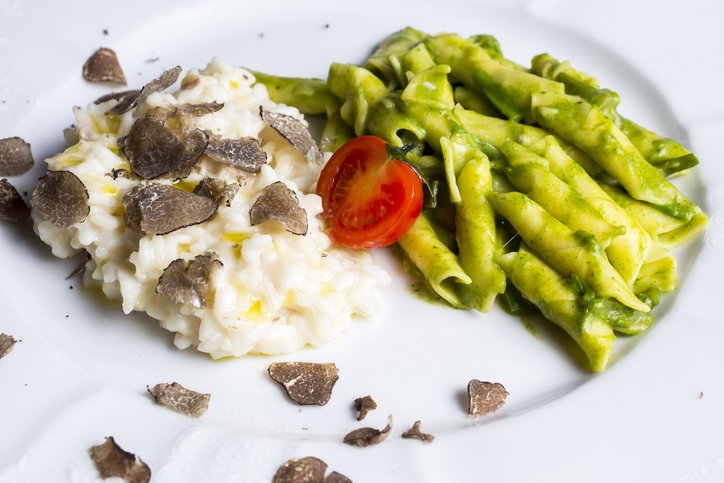
The Romans believed that they were created by Jupiter throwing a thunderbolt near an oak tree. Since this god was known for his pronounced sexual drive, they immediately attributed aphrodisiac properties to them. They called them the sons of the earth and a wonder of nature. In the Middle Ages, it was believed that witches ate them, and even today there are people who claim that they are easiest to find with the help of specially trained pigs.
These are some of the myths about truffles, the most expensive and highly valued mushrooms in gastronomy, to the extent that the production of butter, olive oil, salami, cheeses, honey, and sea salt with truffle aromas, as well as truffle paste, a mixture of mushrooms, truffles, olive oil, salt, citric acid, and garlic, has become a more lucrative business than the uncertain search for real truffles. In most of these products, the aroma is synthetic. Therefore, anyone who wants to enjoy the true smell and taste of truffles should seek the real mushroom, not its substitutes. And for that, one does not need to go to the vicinity of Motovun – truffles can be found throughout Croatia, in the forests of pedunculate and swamp oaks where they grow near their roots.
Nothing without a dog
Agronomist and mushroom expert Prof. Dr. Romano Božac digs them up in Maksimir, near the Faculty of Agriculture, and has repeatedly stated that besides along the rivers of Istria, Mirna, Dragonja, Pazinčica, and Raša, white truffles also grow along the banks of the Sava, Una, Bosut, and Spačva. In Podravina, there are black truffles, and the story about the whites from a few years ago turned out to be inaccurate. A woman found two mushrooms resembling white truffles peeking out of the ground in a forest near Koprivnica; they weighed a total of 145 grams. She tried to sell them, potential buyers confirmed that they were indeed white truffles, but they did not offer a price that would satisfy her. Later, it became clear why. Dr. Božac revealed that it was a similar mushroom, the tuber, which is a wavy fleshy fungus that grows half-buried in the ground, unlike truffles which are entirely below the surface, at depths of 10 to 30 centimeters. Because of this, it is almost impossible to search for them without dogs, and not just any dogs. They need to be trained from the moment they can walk, and the best are those of the Lagotto Romagnolo breed. It is a common belief that the dog searches for truffles because they are tasty, but the real reward for them is the treat they will receive from their owner. And when they find them, they must not damage them, so it is not surprising that truffle hunters pay for a well-trained tracker with dry gold, or thousands of euros. That is why pigs love truffles, and they are no longer used, if they ever were – they would eat most of the found truffles themselves. In the vicinity of Obrovac, goats dig the ground in search of truffles. Goat herders mostly leave this delicacy to them because they say that truffle buyers offer them too little. The story of better organization in the harvesting and marketing of Dalmatian truffles has also gained momentum, especially after Dr. Božac discovered white truffles with his dogs.
Taste Madness
In the last century, it was said that there were about ten species of truffles in the world, but by 2009, the number had exceeded 60. Of these, 25 grew in Istria and Italy, and nine were edible. Today, more than 80 species are mentioned. Average consumers, however, only divide them into white and black, and the difference, as evident as in color, is also clear in price. White truffles in Europe are sold for several thousand euros per kilogram, while black ones are ‘only’ a few hundred. In gastronomy, white truffles are used exclusively raw, as a seasoning. They have an extremely intense flavor, so the dishes they are served with must be simpler and more neutral. They are most often thinly sliced and placed on fine homemade pasta or fritaja.
The basic ingredient that white truffles season must not be aromatic. They pair very well with, for example, monkfish fillet, but connoisseurs have also experimented with stronger flavored meats. The former chef of the Esplanade Hotel in Zagreb, Maltese Jeffrey Vella, excellently incorporated them into tortellini filled with blood sausage and served with artichoke cream. White truffles are also used in desserts. They are a perfect addition to chocolate soufflé.


