
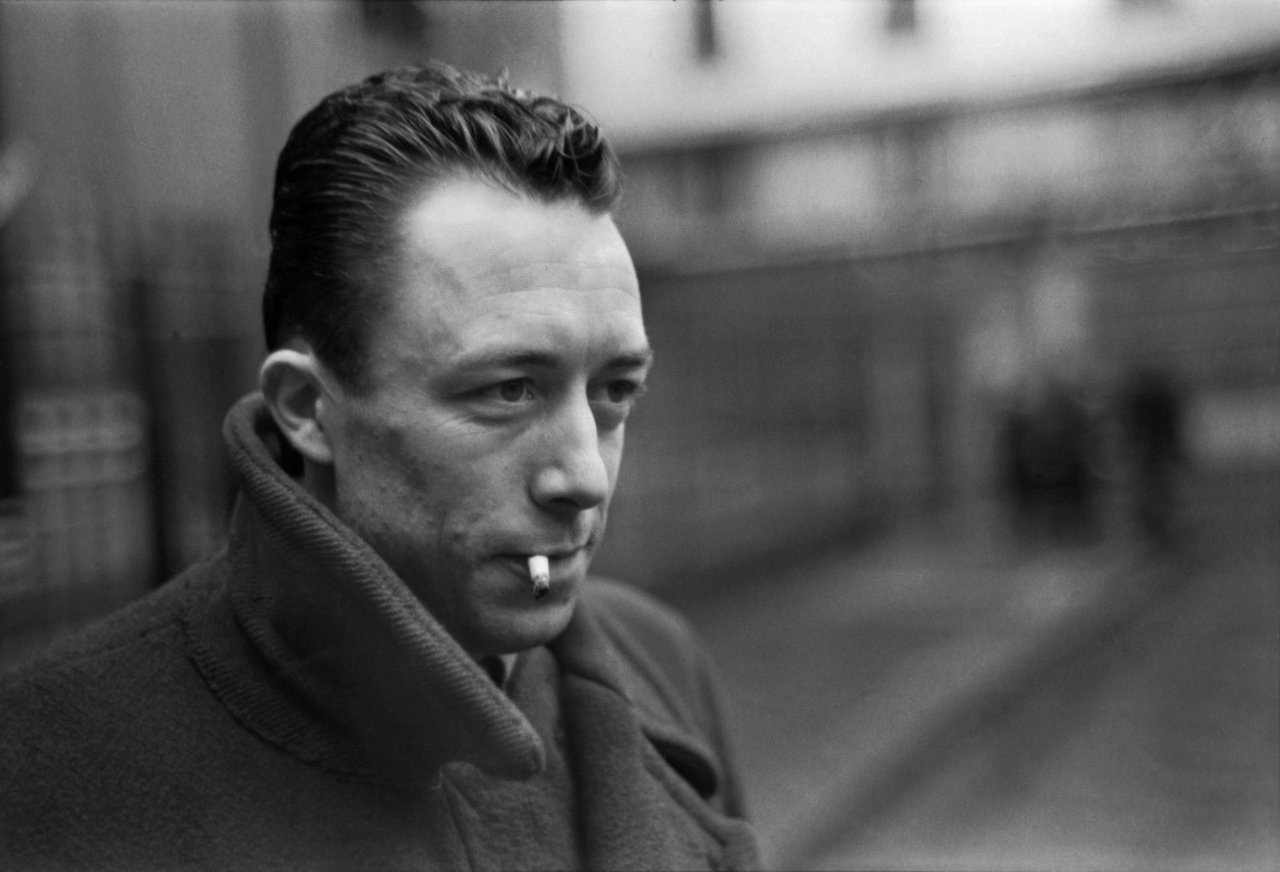
As the son of a semi-deaf illiterate mother and a father who died prematurely (killed in the Battle of the Marne when little Albert was only one year old), Camus was born in the impoverished district of the Algerian city of Mondove a hundred years ago (November 7, 1913). He realized early on that only through education could one escape poverty. As a scholarship student, he completed high school and studied philosophy in Algeria, while also seriously engaging in philosophy and literature (Kierkegaard and Nietzsche were his philosophical models, while Proust, Gide, and Malraux were his literary influences) and additionally earned money as a private tutor, car parts salesman, meteorologist, and passionate football fan. In 1930, he fell ill with tuberculosis, which marked the end of his football career, but his tireless spirit founded the theater troupe ‘Workers’ Theater’ where he wrote, directed, and even acted. In 1935, he joined the French Communist Party and advocated for Algerian independence, and with such fervor did he rise against every (including Russian) totalitarianism that he was declared a Trotskyist and expelled from the PCF. Camus then aligned himself with the French anarchist movement and published in anarchist magazines.
The Paradox of the Absurd
During World War II (in which he could not participate due to poor health), he became a member of the resistance movement ‘Combat’ which illegally printed the magazine of the same name, in which Camus wrote, worked as an editor, and later as the chief editor. Although left-leaning, his sharp critiques of the totalitarianism of communism did not earn him sympathy among communists and ultimately decided his great friendship with Sartre, with whom he was a regular guest in the famous Café de Flore on Boulevard St. Germain in the post-war years, the site of passionate and heated debates among the radical left currents of the time. Camus placed pacifism and peace above ideals, while Sartre held on to his communist and revolutionary ideals. The idea of communism represented the perfection of human society for Sartre, regardless of how it was implemented, while Camus was so disappointed in this ideology that by rejecting it, he also rejected all ideologies, both from the left and the right.
Camus first mentions the absurd in ‘The Myth of Sisyphus’, in which he states that people strive for clarity and meaning in a world that offers neither. By renouncing ideologies, he also renounced allegiance to any philosophical current, although critics still consider him a theorist of the absurd and an existentialist. However, Camus could not tolerate either party or religious affiliation, did not kneel before any altar, and wanted to be the ‘happy Sisyphus’, aware of the absurdity, but also of the fact that life is the only thing we possess, so it is worth fighting for freedom, which is the only meaning in a meaningless world. Many writers have written about the absurd, but Camus’s absurdity differed in many ways, so it is often referred to as the ‘Paradox of the Absurd’. Camus’s ideas about the absurd are, in fact, much more sophisticated; he does not provide a philosophical statement, not even a definition of the absurd, but speaks about the experience of the absurd. ‘The absurd is an essential concept and the first truth,’ he says. ‘I rebel, therefore I exist,’ he asserts.
The Paradox of Life
Camus wrote prose works, short stories, plays, philosophical works, essays, and was also intensely involved in journalism (most of his works have fortunately been translated into our language). In 1957, he received the Nobel Prize for Literature for his novel ‘The Fall’. Many compare Camus’s bitter struggle against all forms of totalitarianism with George Orwell, and what Big Brother is in Orwell’s famous novel ‘1984’, that is the plague in Camus’s novel of the same title.
Camus confronts the reader with dualism – happiness and sadness, darkness and light, life and death – but not with the desire to be morbid, but to teach people to appreciate happiness and life more. We greatly value life, while at the same time knowing that we are mortal. In this lies the paradox. We live, indeed, in an indifferent and absurd world, we are mortal beings, but we can achieve meaning through our own decisions and interpretations. Camus’s work encourages us to think about the absurd and contribute our own to key values, which are: cooperation, friendship, joint effort, and solidarity, because nihilism is not an acceptable answer. ‘The Plague’ is an undeniable part of life, and as the ‘epidemic’ develops, people do not surrender indifferently to the disease they cannot control, they fight against it, that is, against death, and thus in a wave of despair, optimism is born. Here is what the author tells us: ‘If nothing made sense, you would be right. But there is something that still makes sense.’
Camus died on January 4, 1960, in a car accident near Sens, in the village of Villeblevin, in a Facel Vega car driven by his friend and publisher Michel Gallimard. His friend persuaded him to travel with him to Paris by car, only to die in that accident along with his two children. An unused train ticket was found in the pocket of Camus’s coat…
Women Loved Him
Despite the grim realization of absurdity, Camus was a great lover of life, and of course, of women, and many of them (often at the same time). His romantic (and marital!) ‘career’ involved a double, triple, and even at one point a quadruple parallel life. His first childhood love was his grandmother and mother, whom he always imagined with hunched backs tirelessly cleaning other people’s floors and in hard labor. He greatly respected them. His first wife was Simone Hie, a morphine addict, but the marriage quickly ended due to infidelity on both sides. He then lived for years and eventually married Francine Faure, a pianist and mathematician, with whom he had twins Catherine and Jean. He was strongly opposed to the institution of marriage, considering it unnatural. Poor Francine suffered greatly for years due to his multiple extramarital affairs, which also cost her her mental health.


