
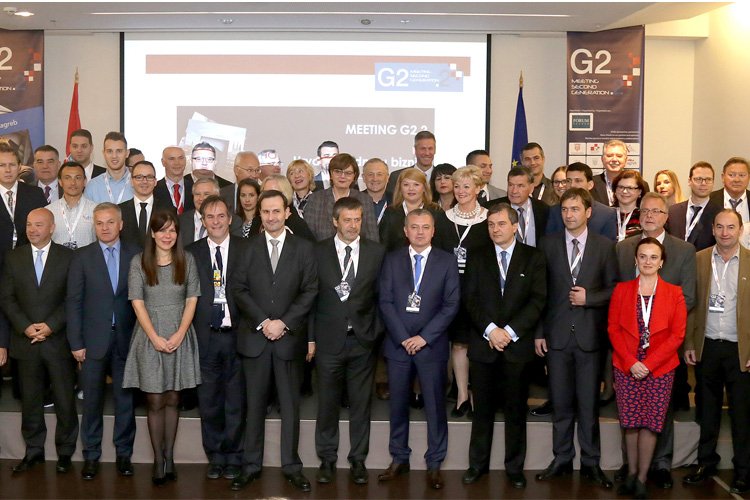
The Meeting G2.2 concluded with a business trip to Rijeka on Thursday, aimed at networking and strengthening economic cooperation between Croats in the diaspora and the homeland. This meeting, under the slogan Croats Together in Business, began on Monday, October 10, with a cultural and entertainment program, followed by two days of lectures and panel discussions featuring successful entrepreneurs of Croatian descent and representatives from relevant political and economic institutions in Croatia.
After the introductory speech by the project director of G2, Josip Hrgetić, the technical minister of foreign and European affairs, Miro Kovač, and the technical minister of entrepreneurship and crafts, Darko Horvat, spoke about the importance of connectivity and the main guidelines for Croatia’s economic progress.
Kovač: Croatia as the EU Presidency will further motivate the diaspora to invest
The director of the Agency for Investments and Competitiveness, Damir Novinić, emphasized that his agency is working to eliminate the negative and inaccurate perception that there are no investors in Croatia, but he also pointed out what he considers to be the weakest point of investment in the country, which is the mechanism for inviting investors. Novinić also stated that the structure of investments has changed and warned of good indicators in every segment.
– Croatia has not four, but eight million inhabitants. We are one nation even though we live on different continents, said Mara Hrgetić, director of the Meeting G2 program. – It is our responsibility to stop the brain drain, but also to promote Croatian products beyond our borders. We will submit the conclusions of this conference to the Government and demand answers, added Hrgetić.
 Mara Hrgetić, director of the Meeting G2 program
Aco Momčilović, a member of the G2 team and director of human resources at Rimac Automobili, presented the G2 project and the portal Business-G2.com, which they launched with the aim of exchanging information and connecting entrepreneurs throughout the year.
G2 Business, a portal that unites business Croatia, wherever it may be
Croatian Innovations – Myth or Reality
At the first panel discussion “Croatian Innovations – Myth or Reality” moderated by Doris Vukšić from the HAMAG-BICRO agency, Sven Maričić, Vjeran Vrbanec, Dubravko Kičić, Đuro Horvat, and Monika Mikac participated. With representatives from some of the most innovative companies at both the domestic and global levels, innovations cannot be described as a myth, but if business obstacles were removed and business processes simplified, many more companies could shift their focus from operational management to creative and innovative projects.
Foreign investments and state support in this segment are urgently needed, which was emphasized by Monika Mikac from Rimac Automobili, stating that the biggest challenge at the beginning of this globally recognized company’s operations was financing. – If it weren’t for the HBOR loans and the support of the business angel network – CRANE, we would have relocated the company to Germany. The state’s task is to recognize projects and support them through the company’s growth. Other countries do this very well, said Mikac.
The president of the management board of the HAMAG-BICRO agency, Vjeran Vrbanec, emphasized that Croatia has a long-standing trend of innovation, and that this trend should continue, announcing that a venture capital fund could emerge in Croatia at the beginning of next year.
Đuro Horvat: The last 5 minutes for the state to get organized!
Đuro Horvat, president of the management board of Tehnix, emphasizes the need to develop teamwork, and Sven Maričić from the Faculty of Engineering in Rijeka believes that Croatian innovators urgently need to network and create synergistically. The executive director and president of the BIO Center, Dubravko Kičić, based on his experience and education in Finland, believes that people are key to innovations and that they need to be educated much more effectively because educated people ensure economic growth.
How to Succeed in Business in Croatia
The second panel discussion, moderated by Stjepan Lović from the law firm Grubišić&Lović&Lalić, addressed this seemingly simple question. Their answers and considerations regarding the biggest obstacles faced by those doing business in Croatia were offered by Danko Sučević, Davor Huić, Davor Tudorović, Don Markušić, Matt Sertić, and Lidija Horvatić.
Davor Huić, one of the founders of the Lipa Association and advisor to Prime Minister Orešković, emphasized that private companies are much more efficient than public ones and stated that a country where 70% of the economy is controlled by the state, as is the case in Croatia, cannot be considered a successful economic country. Huić expressed concern over the European Commission’s report indicating that Croatia’s long-term economic growth potential is less than one percent and explained that there is no growth if the country loses up to 60,000 people annually due to the mass exodus of youth.
Matt Darko Sertić, director of Applied Ceramics, cited examples of how the state directs investors to operate under its not-so-subtle dictates. – The excessive cost of communal contributions forces you to place your business in an existing building. Tax policy directs investors to invest in tourism rather than agriculture. The state directly affects the structure of workers through taxes, as higher taxes for highly educated individuals discourage employers from hiring them. A reorganization of the tax system is needed, believes Sertić.
Matt Darko Sertić: I don’t see any changes in the investment climate in Croatia
The Croatian market is disorganized, but business cannot rely on expectations from the state. – We can think about what the state could do to solve the problem of non-payers and similar issues, but for us, it is like thinking about weather conditions that we cannot actually influence. Therefore, unpredictable circumstances must also be taken into account in business, said Danko Sučević, founder and partner of Infokorpa and executive director of the business weekly Lider, who sees the solution either in the absolute orientation of the company towards exports or in doing business with the state, which regulates 70 to 80% of the domestic market, as many large Croatian IT companies do.
 Second panel discussion How to Succeed in Business in Croatia
Lidija Horvatić, director of the EU and international affairs department at HUP, agreed with David Tudurović, a member of the Supervisory Board of Ilirija, that one should not rely too much on the state, but should influence it to function better as much as possible. – The secret to success in Croatia is perseverance! It takes a lot of time. The diaspora can also succeed with its experience and help Croatia, concluded legal advisor and vice president of Transparency International, Don Markušić.
Exports – New Opportunities
In the third panel discussion “Exports – New Opportunities,” moderated by Gordana Gelenčer, Joseph Gene Petrić, Želimir Kramarić, Hrvoje Galičić, Zvonimir Viduka, and Vjekoslav Majetić participated. Velimir Majetić from Dok-Ing stated that for something to be exported, something must also be produced. Something that others do not have must be offered. The goal is to encourage every initiative for creating new products and to break into the global market. Joseph Gene Petrić, as assistant minister of foreign and European affairs, calls on people to cooperate and to report existing problems and ideas to their embassies. Želimir Kramarić from the Croatian Chamber of Commerce believes that the problem is that Croatian emigration is viewed as a burden rather than as part of Croatia and adds: – Croats are everywhere in the world, and the potential lies in connecting and internationalization. Zvonimir Viduka concluded that exports must be the main topic because the state cannot survive solely by borrowing money. It is necessary for offices abroad to become the main actors in business.
Privatizations – Successful Examples
At the fourth panel discussion, successful examples of privatization in Croatia were presented, moderated by Krešimir Profaca, with participation from Tomislav Boban, Mario Dužić, and Siniša Žanetić. Tomislav Boban from DUUDI believes that the privatization plan must continue, but that restructuring of the company is necessary before privatization. Mario Duzich, a Croat who lived in America for many years, shared his recipe for success in Croatia: fall in love with the company and invest a lot of energy. Siniša Žanetić explains that the company Lola Ribar survived due to resources, workforce, and high professionalism, even though they were on the brink of bankruptcy. He believes that it is necessary to create a plan and then realize your dream.

 Mark Begich, former senator of Alaska of Croatian descent

 Organizers Josip and Mara Hrgetić pose with Croatian emigrants from Paraguay


