
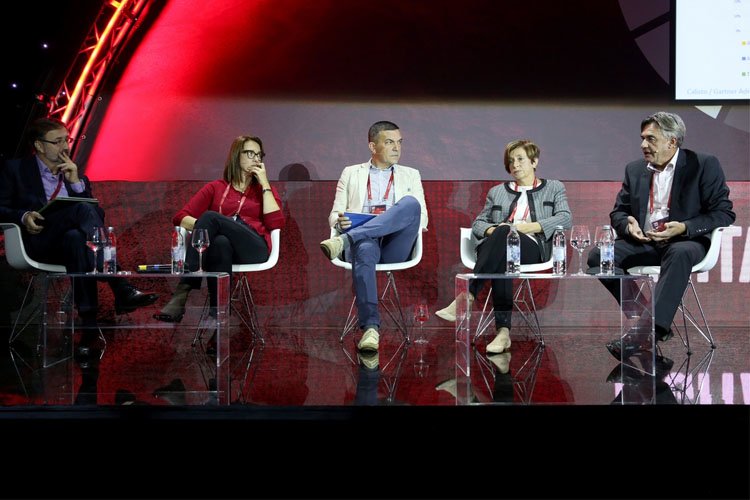
On the second day of the jubilee 10th Combis conference in Umag, a panel discussion titled ‘Digital Era in the Financial Industry’ was held, featuring representatives from leading banks in Croatia. The panelists addressed the direction of digital transformation in banks and how technology can ensure greater competitiveness in the financial industry.
Ivan Maglić from Gartner Adriatic/Calisto, who also served as the moderator of the panel discussion, emphasized at the outset that the digital transformation of banks has three evolutionary phases – the first phase involved the creation of electronic money, followed by a transition phase from analog to digital business processes and the introduction of online banking, culminating in the third phase, where a strong digital business model connects systems and people, places and things, and is able to drive change with the help of technology.
– In the EU, over 90 percent of all types of financial transactions are still conducted in cash (the volume is, of course, much smaller, only 8 percent). The Germans have precisely calculated that the circulation of cash costs taxpayers 150 euros annually. This data should open the eyes of everyone, from government institutions, regulators, financial service providers, merchants, and consumers, that it is high time for digital transformation, emphasized Igor Strejček, Director of the Digital Channels Sector at Erste Bank.
Mobile technology is more affordable and accessible than ever, and EU regulations will open wide doors for all interested providers of digital financial services to easily connect with existing financial institutions starting from 2018, pointed out Strejček.
Vesna Valić, IT Director at Raiffeisenbank Austria, highlighted that they perceive and live digital banking far beyond client interaction and service offerings.
– We continuously improve and transform backend processes with the aim of achieving greater efficiency and quality. I believe that the ultimate success of digitalization depends on the quality of the business model and the organizational culture. For this reason, we are intensively working on recognizing changes in the way of thinking and behavior of people within the organization and jointly finding ways to overcome the challenges we face in the context of digitalization outside the organization, i.e., towards clients, and within the organization in terms of process optimization, innovative ways of working, systematizing and sharing knowledge and best practices, and a more flexible organizational structure, said Valić.


