
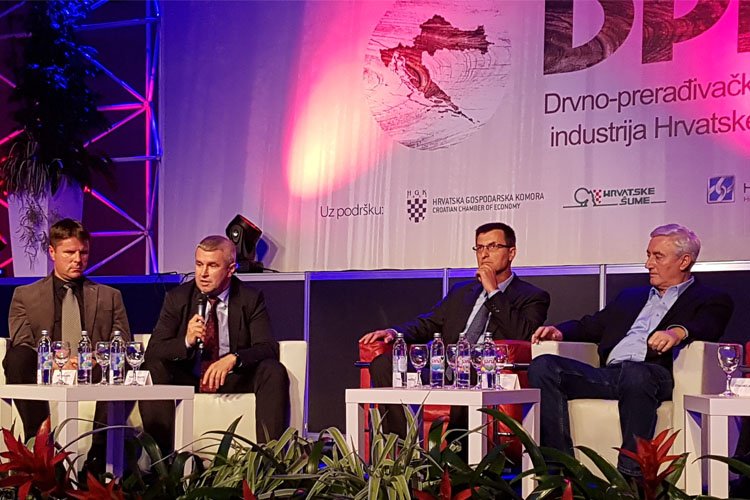
‘Let’s build the brown highway’ was the name of the conference held on the first day of Ambiente, the 43rd international furniture, interior design, and related industries fair at the Zagreb Fair.
The conference was divided into three panel discussions, and in the first, there was a heated debate about the small quotas that cogeneration from biomass received for selling electricity from this renewable source. All panel participants were united in the view that the quotas should be larger and that the current wood processing industry has the right (quota) to sell 13.2 megawatts of electricity from biomass. As the president of the HGK’s Association of the Wood Processing Sector, Ivić Pašalić, somewhat angrily stated, it is unacceptable that wind farms receive a quota of 750 megawatts.
– Wind farms have a very small number of employees, and those are the ones who issue invoices. Moreover, they are not Croatian products, so no new value is created, while our sector employs a total of 50,000 people, including Croatian forests – said Pašalić.
Željko Lovrak from the Pellet project added to Pašalić’s words by stating that in this sector, unlike wind farms, every megawatt produced employs 20 new people. The CEO of Spačva, Dario Puljiz, said that encouraging the wood processing sector could have a significant impact on regional development and demographic renewal in Croatia. He added that it is sad that a large amount of heat is lost because cogeneration cannot convert it into electricity.
– We are practically heating the air – said Puljiz.
Is Vrdoljak to blame?
During the discussion, former HNS Minister of Economy Ivan Vrdoljak was called out several times, with claims that he is the main culprit for the current state because he changed the Regulation on quota allocation and the Tariff System for electricity production from renewable sources, adapting it to other activities. The participants stated that it is precisely the wood processing activity that has the greatest potential in resources. Thus, Lovrak from the Pellet project stated that the annual Croatian biomass potential for electricity is 3.75 million cubic meters, while the annual growth of forests in Croatia is 10.5 million cubic meters. He sees an opportunity for utilizing this resource and called on the future Government and the Ministry of Agriculture to revise all previous projects.
When it comes to legal regulations and other normative acts, Vedrana Pulić from the Energy Institute Hrvoje Požar stated that cooperation with the Croatian government is poor and that the Institute collaborates better with countries from our region, as well as some African countries, indirectly suggesting to the attendees that the disputed regulation and tariff system were written in ‘a very strange way,’ as Pašalić expressed, without consulting the profession. Furthermore, it was stated that many who received quotas did not fulfill all the conditions they accepted when obtaining the right to produce energy from renewable sources after a certain period, even though they sent certified statements to the Ministry of Economy that they were working according to the assumed obligations. One of the biggest problems, it could be heard, is that the oversight of companies that received the right to produce electricity is not effective, and it could be concluded from their words that this is also an indicative sign that the quotas were distributed ‘in a strange way.’
The conclusion of this panel was that all granted permits should be revised as soon as possible and that the wood processing sector should be granted more rights for energy production from cogeneration, as this not only helps one of the most dynamic sectors in Croatia but also achieves other goals, such as regional development and stopping the emigration of the population.
The topic of the second panel was also interesting, but it seems to be somewhat poorer in content as participants occasionally strayed from the main idea, which is to improve the efficiency of raw material use through strategic measures over raw material bases.
Ban on log exports
Branko Liker from the Faculty of Agriculture stated that we do not use resources purposefully, in this case, the forests that nature has bestowed upon us. Participants often repeated that a state strategy for forests is needed, to which the still-current Deputy Minister of Agriculture, Tugomir Majdak, responded that this will be one of the main tasks for the new government. Majdak is also one of the candidates for Minister of Agriculture, but to that question, he only diplomatically replied that ‘mandator Andrej Plenković will surely choose the best ministers.’
The CEO of Spin Valis, Zdravko Jelčić, warned that no strategy will help if we do not commit to producing higher value, i.e., final production. He also stated that the exchange rate policy is what it is, but he also noted that the negative effects of the exchange rate policy can be compensated by interest and rebate policies. Additionally, regarding sales, he said that the solution lies in direct sales to customers by opening showrooms, as producers depend too much on large retail chains. Jelčić spoke about this in response to a question about the possibility of a joint appearance of Croatian furniture producers in showrooms.


