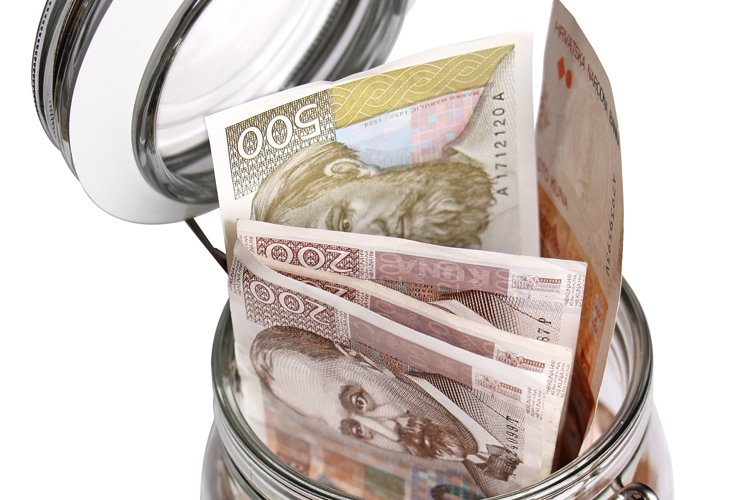
Renowned Croatian investor Nenad Bakić today published an interesting analysis of the domestic banking sector on his blog Eclectica. His thesis is that banks should start taking rational risks and lend more to the economy, where there is still significant potential for economic growth. We present Bakić’s analysis in full:
Banks can significantly improve their policies and thereby create greater value for their shareholders and society, but they need ‘help’ from the state; this is a great potential for increasing economic growth
Practically unbelievable developments in the banking sector. Let’s look at some things.
1. Starting point. Banks are full of money primarily due to citizens’ deposits. I have already published this: net savings of citizens are rising sharply, even though interest rates on deposits have plummeted to nearly 0. Although the growth of savings is slower than before (mostly because of the lower interest rates that are ‘credited’), it is even more evident that citizens are deleveraging (mostly by repaying loans, and taking out fewer new ones):

- Net savings of citizens

- Savings and loans

- Interest rates on loans
2. What did I mean by ‘full of money’? Let’s first look at the liabilities of banks (= ‘how banks are financed’).
These are the main items of liabilities (about 95%). As you can see, the most important item, citizens’ deposits, is growing significantly. But recently, deposits from companies in the real sector are also increasing (contrary to the distorted and vulgar usage here, ‘real sector’ does not mean ‘private sector’, but companies that are not in the financial sector):

Here are the shares of liabilities:

Notice a very important thing, which is the reduction of foreign liabilities. This means that banks are returning money abroad, presumably mostly to their parent companies, and under all this, I mean ‘banks are full of money’.
3. Let’s look at the assets (= ‘what banks do with money’). These are the main items (about 98%). Notice the most important thing: the increase in placements to the state (I summed up central and local government, including social funds). Notice that lending to the state is still exceptionally growing, while lending to the real sector is declining!

And as shares in liabilities:

Minor things here are: – increase in foreign assets: I think this is the prescribed part of foreign currency savings that must be kept abroad for security – part of the decline in loans to companies has fallen due to the sale of bad receivables, but this is a negligible part in this trend.
4. The question is why are loans to the real sector declining? Let’s first notice the following. Net loans (= loans minus deposits) to the real sector are falling and much faster (because the real sector is significantly increasing deposits):

And these are the interest rates on new loans to the real sector:

Notice that these are already quite good (low) interest rates, and they have fallen even more than the interest rates on household deposits. In my opinion, there is only one explanation for this. That is that banks are actually ‘chasing’ better clients by lowering interest rates, and they are still not significantly expanding the loan base, not taking risks. And they don’t need to: they are doing great living off lending to the state. How great?
Let’s look for illustration at their ‘special unit’, the company managing forced pension funds.
As is known, during the previous government, they increased their exposure to government bonds from 25 to 55 billion kuna, reaching almost 75% of the entire fund’s assets, and I believe that this was the key element of the financial patching of that government, which enabled the perpetuation of its anti-reform stance. The ridiculous excuses we heard from some managers of those funds for why they increased their exposure to government bonds so much show that the truth lies somewhere else than they said, and significant are the statements from some bankers that banks have reached their limits in lending to the state.
This is the income from fund management, for the largest company, in millions of kuna:

This is the profit of the company which was record-breaking last year:

And this is a shocking chart of the cumulative profit of that company (I remind you, in millions of kuna):

As you can see, a very comfortable, profitable business, especially because it has increasingly boiled down to stuffing government bonds. There are many holes in the narrative that some state leaders tell us, and one of them concerns high yields. Well, those yields are mostly from the interest that the same savers in the funds pay on government bonds (minus these huge fees, many investment failures such as Nexe, Ingra, Magma, etc.)
5. The question is whether the main problem lies with the banks? I would say it does not. They behave opportunistically according to the state of the country, and to a lesser extent, their ‘guilt’ is the depressive and anti-risk mentality.
The state of the country is such that ‘fat mama’ demands and can take more and more. We have a fat, not a slender state, its deficit is large and is the main cause of such opportunistic behavior of banks that directly repackaged citizens’ savings into loans to the state, and their companies managing forced pension funds indirectly.

So, the main generator of this state is the state deficit, which besides consuming our resources, distorts the financial sector (as we see above, then also the real one) and adds fuel to our ‘Dutch disease’, by the mechanism I described here: Croatian tourism: a great season in 2016, Dutch disease.
(By the way, regarding the HNB. The Dutch disease we already have means that the HNB is barely struggling to contain the growth of the kuna, and not that it is ‘deliberately strengthening the kuna to favor importers’, that is elementary.)
Here is very good news that our deficit is falling (fewer opportunities for banks to place loans), moreover, we already have a primary surplus! And even better news seems to be a very serious and credible approach (this one, and we hope future ones), especially from the Minister of Finance regarding curbing the deficit. Just remember how he rightly refused to issue bonds at a high rate in London (amid the panic and catastrophism of our media, the only realistic portrayal you had here: Bond issuance: don’t panic!
And what is the problem with banks? It is absolutely incomprehensible to me how pessimistic-depressive banking macroanalysts have all massively missed the turnaround and strength of economic growth last year, and those guys are very well paid, unlike me who am an amateur and ‘got it right’. If they are so closed in their gloomy ivory towers, we can imagine how their colleagues in risk management behave! Probably, the ‘state of siege’ psychosis with Swiss francs contributed to this.
Banks are by nature conservative institutions, and it is good that it is so. However, it is also true that banks have fared far better through the crisis than the real sector and citizens, how is it possible if the game is not a little tilted in their favor? But that relatively comfortable success has lulled them, and they have now become too focused on risk defense instead of quality risk taking. I know it may not sound like it to you, but one of the main (or the main) functions of banks is to take, process, and transform risks.
Banks have not yet realized that economic growth is quite large and robust. They should be helped to understand this and start taking rational risks, lending more to the economy. There is still significant potential for economic growth hidden in this.
Note: I own shares in banks, but only HPB, moreover, I was the only individual who subscribed to those shares in the recent issuance.
Nenad Bakić