
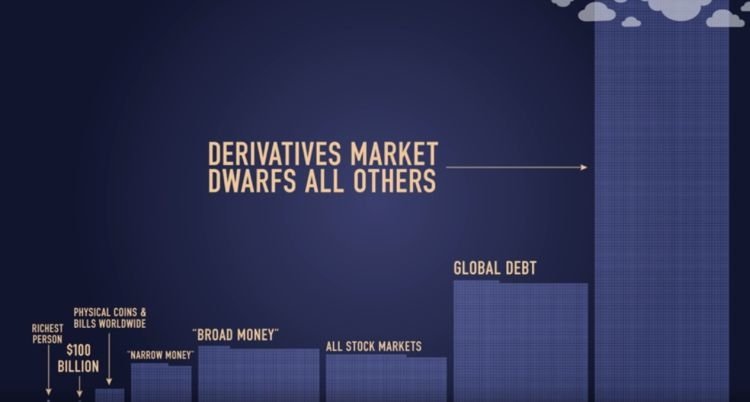
The Money Project uses intuitive visualizations to explore money as a concept. Established in 2015, the project studies the evolution and application of money in an effort to answer difficult questions that, as the founders say, hinder the understanding of its nature and role in finance, investments, or capital accumulation.
In the latest visualization published at the end of September, researchers play with the amount of money created, initially using the average household income in America and then gradually scaling it up to billions, trillions, quadrillions…
The visualization is factually convenient, as it uses data from Forbes’ list of the richest to frame the context and then compares it to the “incomprehensible” amount of money on Wall Street.
– The total of global physical currencies, all coins and banknotes in dollars, euros, yen, and other currencies amounts to about $5 trillion. At the same time, if bank accounts are added to the equation, the amount of money in the world rises to $28.6 trillion according to CIA World Factbook data. This is referred to as “narrow (readily available) money.” If you add capital markets, savings, time deposits…, the figure jumps to $80.9 trillion, which is defined by economists as “broad money” – the authors write in the accompanying text of the visualization, emphasizing that this total is “nothing” compared to the world of derivatives and Wall Street.
Time Bombs
Enticing in the context of current uncertainty or open fear regarding the fate of Germany’s largest bank, Deutsche Bank, the visualization also offers insight into the magnitude of derivatives, financial instruments whose value fluctuates depending on a range of underlying variables, and most often involves some form of speculation, essentially betting, on the future movement of assets, stocks, or other exotic financial instruments. For example, one of the more popular and notorious forms of financial derivatives are mortgage-backed securities, which, along with unsecured loans, led to the collapse of the American real estate market, the bankruptcy of Lehman Brothers, and the Great Recession.


