Home / Business and Politics / HUZUPP: Croatia Necessarily Needs Women’s Quotas in Economy and Politics

HUZUPP: Croatia Necessarily Needs Women’s Quotas in Economy and Politics

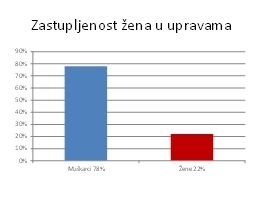
The number of female representatives in the 9th term of the Croatian Parliament will be the lowest since the 1990s. A similar trend of increasingly unfavorable positions for women is also observed in the economy. According to a study conducted by the Croatian Association of Women in the Legal Profession (HUZUPP) in collaboration with Zenlab, in Croatia, there are generally 78% men and 22% women in management boards, and 74% men and 26% women in supervisory boards. When looking at the indicators for joint-stock companies, which have the highest concentration of business power and influence, the ratio is even more unfavorable, with 80.6% men and 19.4% women in supervisory boards. In the supervisory boards of state-owned companies, there are 73.4% men and 26.6% women.

Zastupljenost žena u upravamaZastupljenost žena u NO

Zastupljenost žena u NO listanih društavaZastupljenost žena u NO društava u državnom vlasništvu

In Croatia, according to the valid Gender Equality Act from 2008, legal entities that are predominantly state-owned, state administration bodies, and other legal entities and craftsmen employing more than 20 workers are required to adopt anti-discrimination legal provisions and measures to establish gender equality. The law also stipulates that by adopting and implementing special measures, equal participation of women and men in legislative, executive, and judicial bodies should be promoted. These special measures will be introduced whenever the representation of one gender is significantly unbalanced. Significant imbalance means that the representation of one gender in political and public decision-making bodies is below 40%.

Women’s quotas in the economy and politics were the topic of a conference held by the Croatian Association of Women in the Legal Profession (HUZUPP) on Saturday, with institutional support from the European Bank for Reconstruction and Development (EBRD) and the Croatian Employers’ Association (HUP). A panel discussion titled “Application of Women’s Quotas in Politics – Lessons for Women’s Quotas in the Economy” was also held, featuring participants from politics and the economy – Gordana Sobol, candidate for the president of the SDP and president of the SDP Women’s Forum, Sanja Putica, from the Women’s Community of HDZ “Katarina Zrinski”, Gordana Deranja, president of HUP, and Vedrana Jelušić Kašić, director of the EBRD for Croatia, Slovenia, Hungary, and Slovakia.

– Considering the issue from the perspective of a woman with long-standing experience in a political party, I believe that the problem must be addressed on multiple levels – intra-party through statutory changes that ensure equal representation of men and women in all party bodies and through legislation that mandates equal gender representation on electoral lists while respecting the so-called ZIP system so that women do not end up in marginal positions. Financial penalties alone will not solve anything, at least regarding the large parties that are willing to pay the fine. A woman at the helm of the SDP, as one of the leading political parties, would certainly contribute to solving this problem as she would be a good model for others and new generations, said Gordana Sobol.

Regarding the situation in the economy, Vedrana Jelušić Kašić from the EBRD stated: – In Croatia, we are faced with the underrepresentation of women in key positions both in politics and in the economy. It is important to persist in making changes and continuously work on talent development, but also to consider the possibility of introducing mandatory quotas for companies listed on the Zagreb Stock Exchange to contribute to the quality of corporate governance. Only those societies that include their underrepresented groups can be sustainable and competitive in the long term. The aversion to quotas is unjustified for a number of reasons, primarily because within the EU, there is a proven direct correlation between a company’s prosperity and gender-balanced supervisory boards.

The president of HUZUPP Tarja Krehić expressed satisfaction with the conference and the turnout.

– We believe that today, through examples of good practice from other countries and through the experience and recommendations of our panelists, we have managed to show that the introduction of quotas in the economy is a necessity, not a need. Following the example of our female lawyer colleagues from other EU countries, we will continue to actively work on changing and applying existing laws to be a real support for the implementation of women’s quotas in the economy and politics as a proven good measure for achieving gender balance in high positions.