
It can be predicted with great certainty that with August, this year’s period of seasonal employment growth and declining unemployment has ended – no year has recorded such a trend extending into September. Namely, more intensive employment ends with the conclusion of the main tourist season or more intensive employment in tourism and related activities: in August, the number of employees in legal entities in the “Accommodation and Food Service Activities” increased by 2,600, which is more than half less than in the previous three months.
The last month of favorable trends in the labor market was somewhat better than the same month last year – the number of employed increased (it fell in August last year), while the number of unemployed decreased three times more. However, this mismatch in the dynamics of employment and unemployment also produces a stronger reduction in the working-age population and confirms that the influences on unemployment are also found outside the sphere of employment, such as negative demographic trends and increased economic emigration. In such a context, data on the dynamic reduction of unemployment become less relevant as an indicator of the quality of labor market recovery.
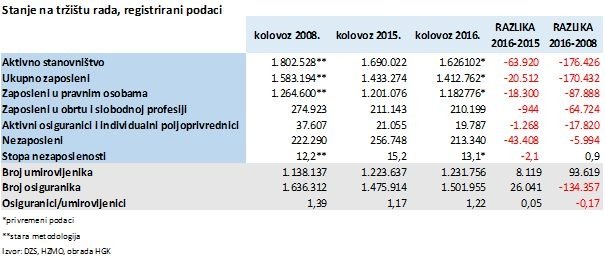
When we compare the current state of certain contingents in the labor market with their state in August 2008, a certain shift is visible. Namely, it is evident that in August 2008, a lower unemployment rate was achieved with a higher number of unemployed persons because there was also far more working-age population. There were significantly fewer retirees and significantly more insured persons, and their ratio was considerably more favorable: now 17 fewer insured persons pay pension insurance for every 100 retirees.


