
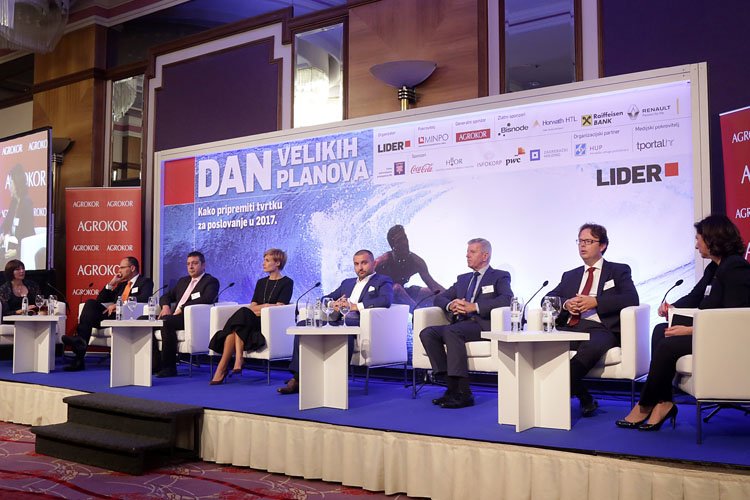
During the conference Day of Great Plans, a round table was held – Forecasts for 2017 – opportunities and dangers. In the last few quarters, positive shifts can be seen in Croatia, indicating a period of economic growth, including banking and loan placements.
– I expect that in the coming years, these positive trends will be visible. Croatia has great potential that has not been sufficiently utilized so far. Much more can be leveraged from the European Union, but the first years of membership are always slower. However, it is accelerating, and this is already evident. Inflows of money from the EU will increase. All events in the economy in recent months indicate that a period of optimism is ahead, even our chief economist Hrvoje Stojić, who I find a bit unrealistic, has changed his forecasts – said the head of Addiko Bank, Mario Žižek.
When asked where he, as a banker, will make money in a time of low interest rates, he responds that banks earn similarly in all markets. Interest rates on deposits were high, now they are falling. Bank margins are almost always the same.
– Personally, I expect that interest rates will remain at these low levels for some time, and now is the time to invest – said Mario Žižek, CEO of Addiko Bank.
The time has come when we all must accept continuous change as a normal part of business. The bank’s credit policies are now changing twice a month, rather than twice a year as was done until recently.
– The market demands it. It must adapt to market conditions and become better for clients. Another important element is sentiment. Indicators are a real basis for decision-making. However, sentiment, a positive approach to investments carries enormous weight. If sentiment turns, everything else will go well. Then you can ride a positive wave that can last a long time and can be in the interest of all involved – says Žižek.
Žižek’s colleague from Raiffeisen Bank, Ivan Žižić, also shares the optimism.
– We have noticed the beginning of an investment cycle in companies. Not only is credit activity increasing, but interest rates are falling. They will continue to fall. Banks are also reducing margins, which gives an impulse to companies – emphasized Žižič.
When asked how entrepreneurs can count on stability when everything is changing rapidly, he responds that this primarily works to their advantage, rates are falling and are expected to remain low for a long time, not only in foreign currencies but also in domestic ones.
– Clients have become aware of both interest rate risk and currency risk. Housing loans are increasingly being placed in kunas. Entrepreneurs have adapted quite a bit to the situation. They are more cautious and conscientious. This is evident from the credit applications. We see fewer high-risk projects, and we are receiving more well-developed projects – says Ivan Žižić from RBA.
After the bankers, who are key to the economy, entrepreneurs explained their views and perspectives on the situation in the coming year. When asked if they have felt cheaper interest rates, whether banks behave differently, and if they offer better conditions, Denis Matijević from Agrofructus said that sentiment is very important.


