
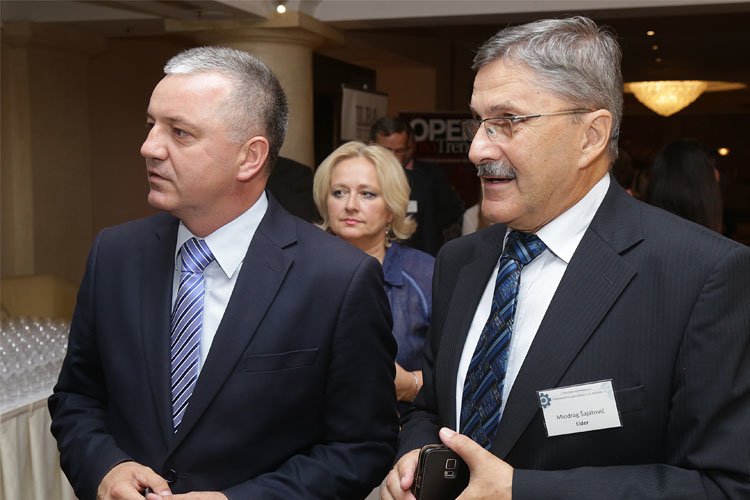
Representatives of the best joint-stock companies who received awards for excellence in corporate governance today at the conference Corporate Governance in the 21st Century shared their experiences in this important segment of business.
The editor-in-chief of Lider, Miodrag Šajatović, who, along with Darko Tipurić, moderated this discussion, started the conversation with a “sticky” question about earnings, to which Neven Vranković, a member of the Management Board of Atlantic Group, which was awarded for best corporate governance practices in Croatia today, readily replied that it is the worst for him when he has to explain to his mother how much money he earns.
– That question is indeed uncomfortable for those of us who earn above the Croatian average. However, if transparency were present in all companies, the answer to that question would not represent something unusual, said Vranković.
He emphasized that it is most desirable for members of supervisory boards to be independent because as soon as a member has an interest, it leads to conflict within the company.
Corporate governance is not a new concept in Croatia; it has a long tradition, and it is precisely on this foundation that the success of Končar rests, where the management approach has been developing for years.
– Corporate governance has not developed during my or my predecessor’s tenure, which means it has existed for over 25 years, stated Darinko Bago, the CEO of Končar.
Continuous education of employees is also responsible, which, in addition to various seminars, is conducted in their business school, and the principles of governance are continuously adapted to new market conditions. Končar also has something that even the state does not have, which is a 20-year strategic work plan. Bago also reflected on the problem of relations with owners, as it is sometimes difficult to reconcile the different interests of shareholders. Unlike employee-shareholders who are interested in the stability of the company and the preservation of jobs, small shareholders are interested in profit. However, the government has also been unable to articulate its interest in this regard, commented Bago, saying that on one hand, they wanted a higher dividend, while on the other, they wanted as many people as possible to work.
– Companies where the predominant owner is the state function poorly because every party wants to protect its interests, and good companies can easily become bad, said Darinko Bago, who is a member of as many as ten supervisory boards.
The high level of corporate governance at Hrvatski Telekom sometimes deviates from the practices that exist in the Croatian market, especially regarding adherence to clearly defined anti-corruption rules.
– We are a sort of island in Croatia, and it is not easy to apply such rules and do business given the underdeveloped business ethics in the country. You are often looked at strangely when you do not want to apply unethical practices that are, unfortunately, common, said Siniša Đuranović, Senior Vice President and Chief Legal Counsel of Hrvatski Telekom, adding that sales representatives claimed before these rules were introduced, about five years ago, that sales would drop if they could not take business partners to lunch or give them appropriate gifts.


