They say that for a bull in the capital market, if it wants to earn, it is essential to be positive and live in the belief of a better tomorrow. Who knows, maybe this is one of the many reasons why we have an underdeveloped capital market. There are too many pessimists and we do not have short selling to be able to come into our own and even get the chance to be right. Although our capital market is quite young and underdeveloped compared to more developed markets where it is quite normal for younger people to plan their financial future because there is no state mother to take care of all needs in old age, there has been noticeable interest in investments lately. Despite the fact that foreign financial markets abound with everything that is lacking at home, which is a much larger selection of financial instruments for trading, ETFs (exchange-traded funds), short selling, options, and the like, stock indices have shown signs of recovery and an upward trend since the beginning of the year (Chart 2).
Many still perceive the stock exchange through the IPO (initial public offering) of HT in which many citizens participated, and the popularity of the stock exchange was at a high level. Many citizens became owners of shares, through public offerings, or before that, through the privatization of companies. Due to the rapid growth of the market that lasted until around mid-2007, many viewed investing in shares as a way to make easy and quick profits. And then came the end of the ballad and the financial crisis of 2008, which, by the way, has long ended where it started, and in the minds of ‘our’ media, it is still (unfortunately) a current topic with which they (un)intentionally entertain the public. The sudden and severe market decline led to the creation of a negative image of the capital market, which is why most characterized investing in shares as a gamble equivalent to gambling in a casino. Many realized what has long been known in foreign financial markets: ‘There is no tree that grows to the sky.’ ‘But all that was, will be again,’ wrote the Preacher long ago.
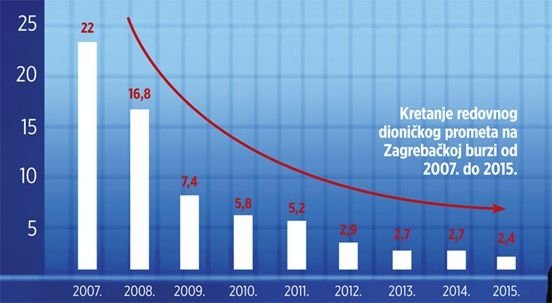
The current state of the Zagreb Stock Exchange (ZSE) is by no means cheerful. The continuous decline in turnover over the last few years (Table 1) has accompanied a tremendous drop in the index and its scraping along the bottom (Chart 1), a chronic lack of liquidity, capital outflow from equity investment funds, the disinterest of pension funds in Croatian shares (not that there are no opportunities), and the introduction of capital gains tax at the beginning of this year have stamped the current state of the stock exchange. Among positive developments, we can highlight the acquisition of the Ljubljana Stock Exchange (LJSE) at the end of last year, which can be interpreted as a positive step towards expanding the offer to investors in the domestic and regional scene.
Table 1 – Regular equity turnover of the Zagreb Stock Exchange in the period 2007-2015.

In the tables below (taken from the presentation Capital Market in Croatia, from the conference on the Croatian money market in May in Opatija), the reasons for the current state can be found. There are fewer and fewer shares on the regulated market that can be traded (Table 2). Consequently, if the number of available trading instruments is declining year by year, the turnovers will also be smaller, as is evident from Table 1. Therefore, it is necessary to increase the number of joint-stock companies (offerings of shares of state-owned enterprises on the stock exchange and/or new successful companies from the private sector) whose shares can be traded as well as the level of transparency.
Table 2 – Shares on the regulated market of the Zagreb Stock Exchange

The decline in the number of available companies whose shares can be traded has also contributed to a smaller number of investors in the domestic capital market, who have stopped investing due to incurred losses and/or poor conditions, and have largely positioned themselves in the global financial market primarily due to the wide selection of financial instruments available for trading. The question arises as to how to bring investors back to the domestic capital market? A better and higher quality offer of financial instruments that can be traded transparently may be just one of many answers to the previous question.
Table 3 – Number of small investors in the capital market in Croatia

The current state of the capital market has also been influenced by institutional investors with their (non)investments. Primarily, we think of mandatory pension funds whose portfolios are mainly adorned with government bonds (about 72% of the portfolio), which have incurred colossal losses on shares in the construction sector whose shares have lost value by over 95%, and a complete failure of investments in the tourism sector (CROBEX tourist from 21.03.2013 to today has made a return of about 200%). Table 4 shows a rather low exposure to both domestic and foreign equity markets. If it is known that, for example, the S&P 500 index (which contains the 500 largest companies in America measured by market capitalization) has an average annual return of about 9% (which is significantly higher than the returns of government bonds and also significantly safer), we can rightly question the motives of such an investment strategy (if it can even be called a strategy). It will be necessary for institutional investors to become more actively involved in the equity market in order to (re)activate the capital market and raise it to a higher quality level.
Table 4 – Institutional investors in securities in Croatia