On Friday, there was volatility in the global financial market. All relevant stock indices were in the red that day, ending the week with a decline of over 2%. We announced that September would be challenging for the stock market, which is supported by statistics – Is the worst month for stocks coming?
Let’s see what awaits us this week. Asian stock markets started the week with a decline, which is just a continuation of the trend from the previous week. The main catalyst for price changes during this and next week will be the Fed. Markets are adjusting, and thus the bond market ended last week with a drop in prices, leading to an increase in yields and raising expectations for interest rate hikes.
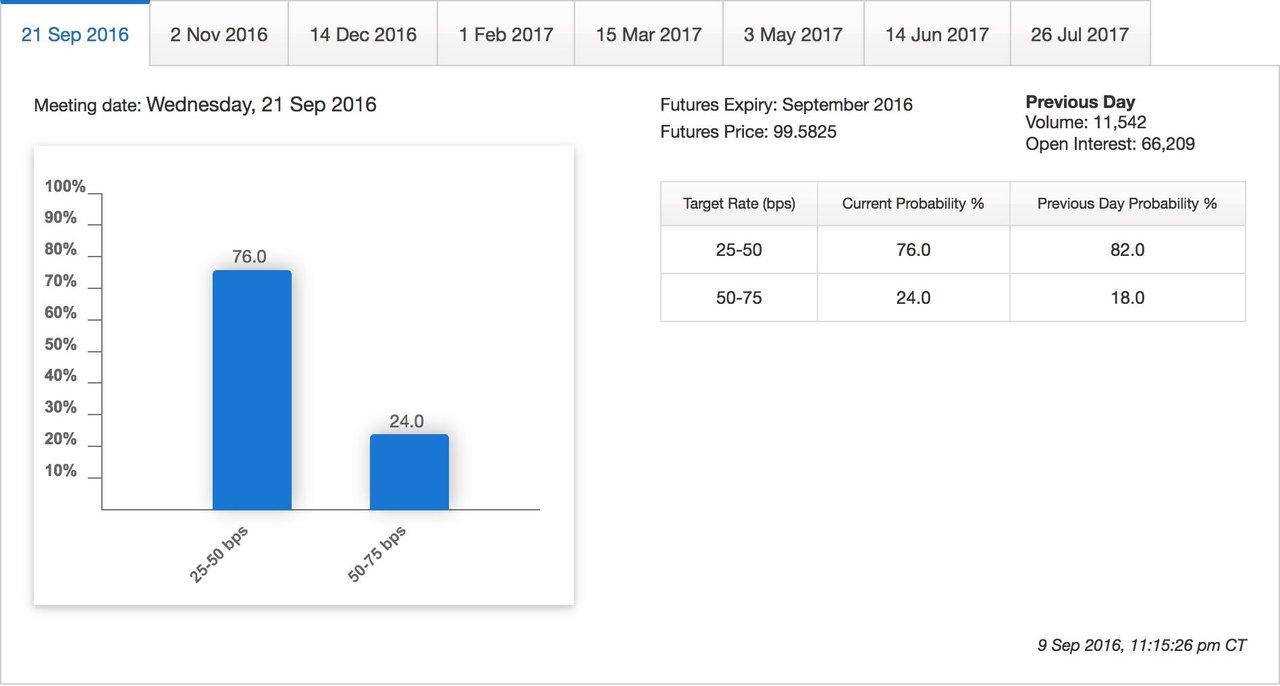
The table shows expectations for interest rates, which are scheduled for next week. The probability of a hike is quite low but still creates some uncertainty in the markets. It can be expected that prices in the bond market will remain under pressure until the final decision. As for the indices in the stock market, a rate hike is not positive for them as investors will allocate part of their funds to the money market to achieve a safer return. In the event of a decline in indices, this will positively reflect on the dividend yield as it will increase, which will lead to a certain balance in the long run.
Table 1 – Probability of interest rate changes

Macroeconomic announcements
During the week, we expect significant announcements of key macroeconomic data. The week starts quite calmly, while on Tuesday we expect data on industrial production from China. From the European market, data on consumer and producer prices from the UK will arrive, and the day will be marked by the ECB and Draghi’s speech, which could impact currency pairs with the euro. From Germany, a survey on the expectations of institutional investors and analysts is coming.
On Wednesdays, data on oil inventories in the US market is traditionally released, which could affect the price of WTI Crude Oil. From the UK market, data on wages and employment will come, reflecting the current state of the economy.
Thursday begins with announcements about employment and changes in the labor market in Australia. In the European market, the day will be marked by the Swiss National Bank (SNB) with a decision on interest rate policy, which is currently in negative territory at -0.75%. The rest of the day will be marked by data from the UK market, including sales data, voting on interest rates, and likely a decision to continue implementing an expansionary monetary policy. From the US market, data on sales and producer prices, unemployment, and a survey on producer expectations published by the Fed Philadelphia branch will arrive.
Friday ends with several important announcements from the US (inflation data and a survey on the current economic situation and consumer expectations) and the Canadian market (total sales value of the manufacturing sector).
The eyes of the world will be on the Fed in anticipation of a decision (on Wednesday, September 21) regarding the hike in key interest rates. One thing is certain: this week we can expect high volatility in the financial market as markets do not like uncertainty, and all of this has turned into one big circus.
Follow us on our Facebook page
DISCLAIMER:
The content of the article does not represent investment advice nor should it be interpreted as a recommendation for trading in the capital market and other financial markets. The author disclaims responsibility and distances themselves from any potential loss incurred from trading based on this analysis. The ideas expressed in this analysis are solely the opinion of the Author and not the company they work for. Everything presented in the article is written solely for educational purposes. Before starting to trade, it is important to understand the risks associated with trading financial instruments and financial products. Trading in stocks, ETFs, futures contracts, currencies (FX), CFDs, options, leveraged financial instruments, and other financial instruments involves high risk, so there is a possibility of losing the entire deposit and even more. You and only you are responsible for your investment decisions. The only recommendation we give is to consult with a licensed investment advisor.