Home / Information / Maruška Vizek: We Need the Depoliticization of the Economy, Political Parties Do Not Understand What the Economy Needs

Maruška Vizek: We Need the Depoliticization of the Economy, Political Parties Do Not Understand What the Economy Needs

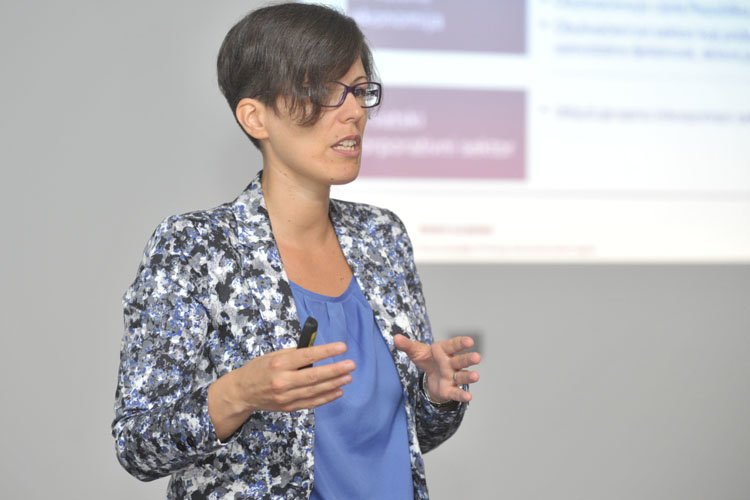
The new director of the Economic Institute of Zagreb (appointed by the decision of the EIZ Management Board on September 9 for a four-year term) Maruška Vizek estimates that economic growth is expected to slow down in the second half of the year, as indicated by some indicators, while for stronger growth, it is necessary for political processes to withdraw from the economy and allow market forces to do their job.

Economic growth in the second quarter was surprisingly high at 2.8 percent compared to the same period last year, but Vizek notes that the CEIZ index, produced by the EIZ, had already indicated a slight slowdown in GDP growth in the first quarter of this year. As she adds, according to DZS data, this did not happen, but growth was slightly higher than in the first quarter, when it was 2.7 percent.

– “The figures regarding GDP growth in the second quarter are illogical and strange, as the growth of total gross added value (GAV), which constitutes the largest part of GDP, has definitely slowed down compared to the first quarter and amounted to 2.5 percent,” comments Vizek.

This, according to her, means that the source of GDP growth in the second quarter must have come either from higher VAT revenues or it is very likely that subsidy payments boosted growth, which could be subsidies to farmers, as they are among the largest.

The EIZ announced on Friday that the value of the CEIZ index in the third quarter is slightly lower compared to the previous quarter, indicating a slowdown in business activity. It also published an estimate that the real GDP growth rate in the third quarter compared to the same period last year could be 2.2 percent.

– “The GDP in the second half of the year will certainly continue to be influenced, as in the first, by the enormous uncertainty that the political crisis brings to the economy,” says Vizek, assessing that relatively good business indicators of companies, as well as GDP in the last few quarters, are partly a result of less political interference in the economy.

– “The Croatian economy is extremely politicized, political actors interfere in all market processes, and since the government has been in crisis and has not been able to deal with the economy as much as they wanted, this has evidently had a positive impact on the economy in recent months,” Vizek believes.

The last thing the economy needs is more tax changes

Vizek does not expect much from the future government, noting that, unfortunately, she is not sure that we will get a stable government and that Croatia resembles Spain in economic, but increasingly also in political parameters.

– “This election campaign has shown that political parties simply do not understand what the economy needs, and the last thing it needs is more tax changes, which political campaigns have again focused on before these elections,” warns Vizek.

Emphasizing that from 2000 to today, Croatia has had an average of one tax change per month, Vizek points out that such frequent tax changes threaten even the most successful entrepreneurs, let alone the less successful ones.

– “Frequent tax changes are indeed very harmful, and the highlighting and announcements of these changes in political campaigns before these elections are just a sign of the general impotence of our political system to make concrete and real reforms in society, which requires a bit more than just changing the law, voting it in parliament, and letting the change out, which you see immediately with taxes,” assesses Vizek.

Therefore, she believes that the most important thing would be for politics to withdraw from the economy and let market forces do their job, but this is, as she says, “hard to expect in the coming years because it requires political parties to depoliticize the economy, and demanding that from them is like undermining their foundations.”

Although she is not, as she says, an advocate of the absolute power of the market because it must have limits, she still considers the question of measure to be important, which is also lacking in Croatia, as their research has shown.

– “We have never had real market capitalism, so market forces are two to three times weaker than in neighboring countries. That is why we are stagnating and even falling behind,” Vizek conveyed.

Reform of the EIZ towards scientific excellence

Vizek was appointed director of the EIZ, where she has worked for the last 14 years, at the end of last week after serving as acting director for nine months. She announced changes in the work of the EIZ with more openness to the public and more research on numerous topics.

– “Until now, we have been recognized more as a macroeconomic institute, and only a quarter of about 30 scientists work on that, while the others deal with a range of other topics, which we will strive to make the public more aware of,” emphasizes Vizek, announcing that one of the important areas of their work will be social relevance, meaning that the EIZ should truly be an active stakeholder and participant in social changes for which it has both the capacity and knowledge.