
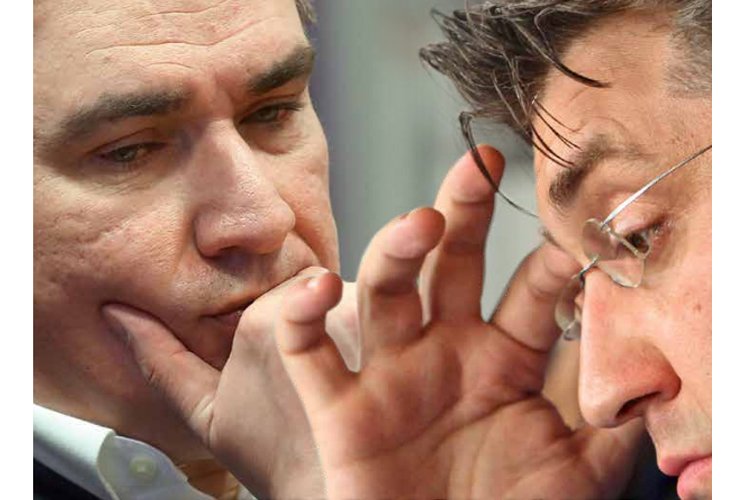
President of the SDP Zoran Milanović and head of the HDZ Andrej Plenković faced off on Friday, the last day of the election campaign, on Nova TV.
The first question they answered was what tax reforms they would undertake when they come to power and how much they would cost.
– What the HDZ will do when it forms a stable government is that we will implement a comprehensive tax reform, primarily corporate tax, income tax. What we are aiming for is to increase the non-taxable part of the salary to 3,750 kuna. In the second year, we plan to reduce the VAT rate, by the end of the mandate it will fall to 23 percent, with the aim of increasing our credit rating and economic growth, said Andrej Plenković.
– Our estimates are 3.5 billion kuna. With the income tax, we have shown that we increased salaries for people at the right time. A tax reform would be if we deeply tilled the system. What we are talking about is adopting the right measures at the right time, said Zoran Milanović to which Plenković replied: – A 1 percent GDP growth means 700 million new kuna, a reduction in interest rates, an improvement in ratings, new funds in the Croatian budget, this is how we will compensate for the shortfall when the VAT rate is reduced.
Should we reduce VAT or increase the non-taxable part of the salary, was the next question.
For the head of the SDP, there is no doubt – “the non-taxable part of the salary because it affects aggregate demand” because, he believes, VAT would jeopardize the system at this moment.
– We have shown that at the right moment by adopting the right measures we can actively influence consumption and demand, said Milanović.
Unlike his colleague, Plenković is for – both.
– It is a combination of measures. In the second year, we will reduce VAT because by then we will generate economic growth, the non-taxable part of the salary will have an immediate and strong effect.
Of course, to this response, Zoran Milanović replied saying that VAT has a marginal or no impact on people’s demand. The key measure is, he claims, the income tax with the note that economic growth is the result of the work of “my government”.
Both the SDP (more precisely the People’s Coalition) and the HDZ communicated in their election promises about increasing the non-taxable part of salaries. Now they clarified whether there is a simulation for how many workers and in what amount.
– People in that category fall into the largest number of employees, our experts have made estimates. We believe that this way they will have more funds left. Our experts will see about the amount later, said Plenković.
Before his answer, Milanović added that “Plenković has no answer to any specific question,” and then offered an answer: – What we did in 2015 affected 200 thousand people. The next step is to raise the rate from 40 percent even higher. What you will hear from Plenković is that he never has a concrete answer to a specific question, “he jabbed” at his colleague Plenković.
Of course, a reply followed.
– When it comes to income tax, we will reduce the currently highest bracket from 40 to 36 percent. This will stimulate professionals, young people, doctors, engineers, those working in the ICT sector to stay in Croatia and form their families here. We are currently at 60 percent employment, the average employment rate among EU member states is 75 percent, we want 180 thousand new jobs, we want 65,000 jobs in industries, 45,000 in small and medium enterprises, and 50,000 jobs in agriculture considering that during Zoran Milanović’s government mandate, the number of employees in agriculture decreased by 100,000 jobs, said Plenković.
When asked whether the Labor Law is good or needs to be changed, Milanović said that the law is not bad but that it is being violated and that the state must be much stricter and protect workers’ rights. “We have achieved the first step, more is being done, prices are higher for us. Now comes the protection of workers,” said the president of the SDP.
– Flexibility, which is a model of Scandinavian countries, is a model that will enable Croatia to achieve economic growth, the best opportunities, and easier employment, but also when we must protect the efficiency of employers, there must be flexibility. The model in Croatia must have a stable legal framework that protects workers but also allows for a stable labor market, believes Plenković and adds: – The HDZ, as a party that takes care of economic and social dialogue, will ensure that the exploitation of workers is avoided, which was present in the outsourcing proposed by Zoran Milanović’s government. This happened the most and according to union information in companies that were in outsourcing.


