
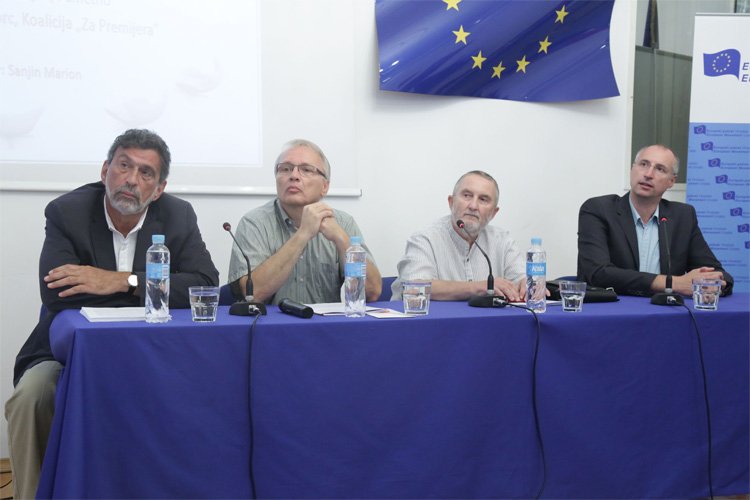
Four political parties presented their ideas related to the accessibility of education, the future of young graduates in Croatia, a better connection between the economy and science, investments in science, education, and projects of science and the economy, as well as their thoughts on higher education as the foundation of an innovative society during a pre-election debate on the topic “Policies of Science and Higher Education: Youth are the Future of the Croatian Economy” today at the European House.
The round table, which included Radovan Fuchs (HDZ), Neven Budak (SDP), Zdravko Žvorc (Coalition for the Prime Minister), and Ivica Puljak (Smart), was organized by the Academy for Political Development and Network of Young Scientists, whose president Sanjin Marion moderated the discussion. The fifth panelist was supposed to be Roman Malarić from MOST NL, but the organizers say he canceled his attendance 45 minutes before the discussion due to family reasons.
This meeting once again showed that each party has its own view on higher education and science, but they generally agree that investment in this area, which is the foundation of society, should be increased, and they all agree that higher education, science, and the economy should be connected. However, how to achieve this remains unclear as specific measures are reluctantly discussed.
The Smart party was the only one to indicate through its budget projection where it would make cuts to secure funding for higher education and science. This would have long-term implications for collaboration because only when Croatian science becomes competitive on a global level will it be in the interest of the economy, said Ivica Puljak. SDP representative Neven Budak offered his opinion on the reasons for the poor collaboration between science and the economy but did not provide a solution to this problem. He believes that employers are insufficiently educated to recognize the importance of scientific research and engage.
– The first thing that needs to be done in the higher education system is to align the production of personnel with the needs of the labor market, emphasized Zdravko Žvorc from the Coalition for the Prime Minister. This approach is unprofitable because personnel are educated who then go to the unemployment office or leave to work abroad. He mentioned that this should be taken on by the chambers of commerce, but he did not specify how this should be carried out.
– Our students have enormous theoretical knowledge, but they lack practical experience. Individual universities need to connect with the economy and create personnel in accordance with what the economy needs at that moment so that students can be employed immediately after graduation, said Radovan Fuchs.


