
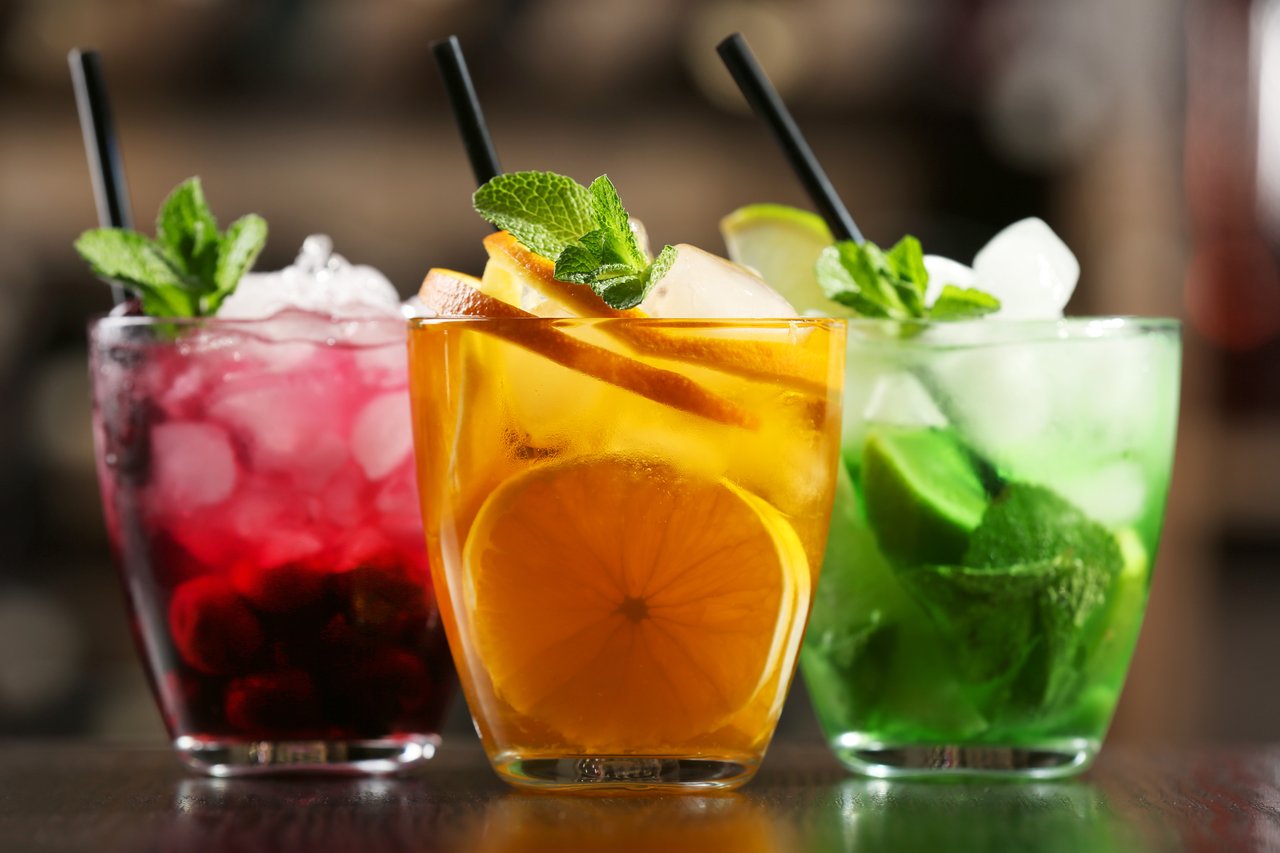
In the United States, 200-300 years ago, the toast of rooster fighters was ‘Let’s drink to the rooster’s tail.’ After a fight, the owner of the defeated rooster would treat the winner to a drink made from beverages whose colors resembled the feathers of the winning rooster’s tail. According to legend, this is how the name cocktail – rooster’s tail – originated, which is still used today to refer to mixed drinks, among which the most popular are rum and cola or gin and tonic, with hundreds of thousands in existence. And every day, a new one is created.
The cocktail, as a drink served in a bar, was first mentioned in the book ‘How to Mix Drinks’ published in 1862 by Jerry P. Thomas from the New York Metropolitan Hotel. His most famous cocktail is the Blue Blazer, a mixture of whiskey, hot water, and sugar, garnished with a slice of lemon. Thomas would ignite the liquid and pour it flaming from one vessel to another.
Shake, don’t stir
His book also mentions ‘martinez’ for the first time, which he referred to as the king of cocktails that we now know as martini. This mixture of gin and vermouth with a few drops of lemon and an olive, under the name The Martine, was described in 1872 by another important American cocktail master, Harry Johnson, in the book ‘The Bartender’s Guide.’ The martini has changed its recipe over the last century.
Initially, the ratio of gin to vermouth started at ‘half and half’ and ended up at 50 to 1 in favor of gin. James Bond popularized the vodka martini and the order ‘shaken, not stirred.’ However, puritans in the cocktail industry argue that a martini should not be shaken but only gently stirred so that the lighter spirit and the denser flavored wine can be seen separately in the glass.
What is the base?
In the history of cocktails, a special place is held by the Catalan emigrant to Cuba, Constantino Ribalaigua Vert. From 1918, he ran the Floridita restaurant in Havana, which Ernest Hemingway also frequented. Constante, as the owner was affectionately called, devised a way to chill cocktails with ice without diluting them with water. He would pour the cocktail ingredients over crushed ice but would strain the finished cocktail before serving so that no ice pieces that could melt remained in the glass. Real cocktails must contain alcohol, and they are categorized, according to the base spirit, into those with rum, gin, vodka, whiskey, and tequila.
Absinthe, the drink enjoyed by Vincent van Gogh, Arthur Rimbaud, Henri de Toulouse-Lautrec, etc., is not often mentioned as a cocktail base because it is still banned in some places, but many use it. In wine countries, cocktails based on wine are common. For example, in Burgundy, they make kir, a mixture of white wine from the local aligote variety and blackcurrant liqueur. In royal kir, or kir royal, there is champagne, in kir petillant some sparkling wine outside of Champagne, in Communard/Cardinal red wine…
And gemišt is a cocktail
Our traditional gemišt is actually a cocktail. It is not a drink in which the bad taste of counterfeit wine is diluted with mineral water. The wine must be carefully selected, and the best are those with low alcohol, pronounced acidity, and delicate aromas, such as kraljevina or moslavac. One must also choose the mineral water. Jamnička has quite large, somewhat aggressive bubbles, so gemišt with it will tingle the mouth a bit, which many enjoy. Others may choose a ‘calmer’ water like Kalnička. Mixing wine with plain water is, after all, a barbarism whose only purpose is to dilute the wine. And there are wines with more and less alcohol, from 9 to over 15 percent alcohol, so there is really no need for dilution. Cocktails are very tasty but very dangerous drinks because they can easily deceive. Therefore, one should enjoy them sober.
The original Croatian cocktail – crocktail
Marin Nekić, the leading Croatian cocktail master, has created the Croatian national cocktail – crocktail. It is a mixture of Croatian products – Zadar cherry liqueur, i.e., maraskino, cherry juice, fresh lemon juice, and candied orange peel (arancina) that gives the crocktail a unique flavor, along with cherries as decoration.


