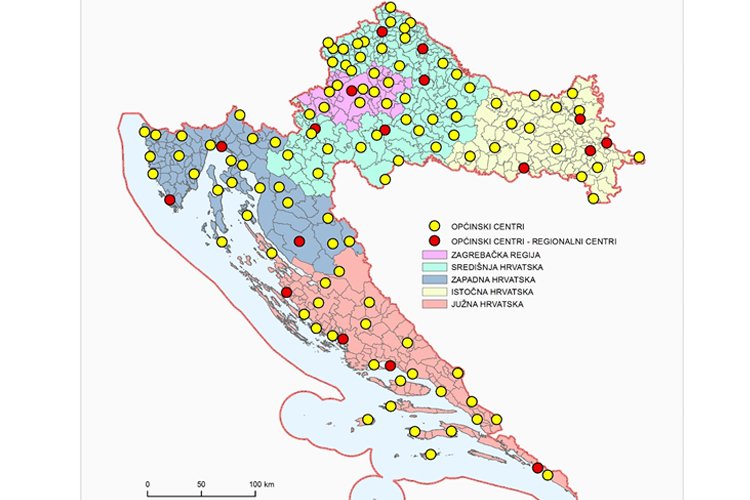
The Smart Party Smart presented a map on Thursday in Osijek, which illustrates a new administrative-territorial organization of the Republic of Croatia with five regions and 123 urban centers, instead of the current 556 cities and municipalities and 20 counties plus the city of Zagreb. They have concretely shown what the reform of public administration and local self-government brings to each region.
– Some of our regions, cities, or municipalities still fear the reform of public administration and local self-government because no one informs them what it really means and how much it will change Croatia – for the better. All parties are aware of the necessity of this reform, but many scare people by stating that they will lose jobs and sovereignty, without telling them that without this reform, the state cannot improve its services, reduce costs, and stop the burdens on the budget, and thus, cannot set the framework for economic growth. Parties look exclusively at their political interests and where they will place their personnel, while we look at the interests of citizens, and that is the key difference between our and other policies, emphasized Ivica Puljak, secretary of the Smart Party.
They believe that simply by reducing the number of local units, money would be secured for a significant improvement in the quality of life and services for citizens.
– Do you know, for example, that today in Croatia there are more than 1000 political leaders and their deputies at the local and regional level? And when we add others who receive income from political mandates, we arrive at a figure of 11,000 people who are paid from local budgets. We want to reduce that number to just a quarter. Why only 123 so-called urban centers? In Baranja, for example, there are currently nine local self-government units, which average 3,350 inhabitants, and despite this, maintaining the ‘cold operation’ of one Baranja municipality requires at least three million kuna annually. The Smart Party will establish two large and strong municipalities in Baranja, centered around the urban centers of Beli Manastir and Darda. A simple calculation shows that by abolishing seven Baranja municipalities, savings of at least 20 million kuna could be achieved, which could finance two schools or two kindergartens, illustrated Mislav Matišić, first on the Smart Party list for the 4th electoral district.