
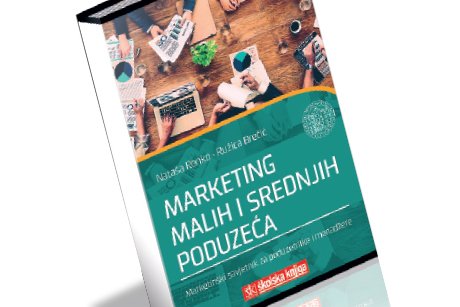
The aim of this book is to offer specific knowledge in marketing that will simultaneously serve as a textbook for students and a guide for small and medium entrepreneurs in their quest for more successful business solutions.
Numerous tips and recommendations are presented, along with many positive examples from business practice, mainly from Croatia, which support the proposed marketing business concept. Thus conceived, it will be useful and inspiring for many managers and small and medium entrepreneurs who wish to operate successfully in accordance with modern principles of marketing business, as well as for those who intend to start a new business or improve an existing one. The book is divided into three parts and 12 chapters, aiming to cover all the knowledge in marketing necessary for the successful operation of small and medium enterprises.
Marketing of Small and Medium Enterprises
Nataša Renko, Ružica Brečić
Školska knjiga, Zagreb, 2016.
Today we witness different sizes of the state and its influence, as well as various measurements of its breadth and results. Jambrač, in his book ‘People, Economy, State’, attempts to measure the strength of the state on a vertical axis, that is, its capacity to assume functions at the subnational level. If we measure that capacity with a typical economic indicator, the share of public expenditure in GDP, then the subnational level of the state has a weak capacity. However, the strength and size of the central level do not necessarily guarantee results. Quality is much more important than size, as demonstrated by Scandinavian countries. They have stimulated economic development through political decentralization, crucial for social development and social mobilization. Therefore, the author concludes, strong political institutions are necessary for economic growth and development.
People, Economy, State
Josip Jambrač
Izvori, Zagreb, 2016.


