
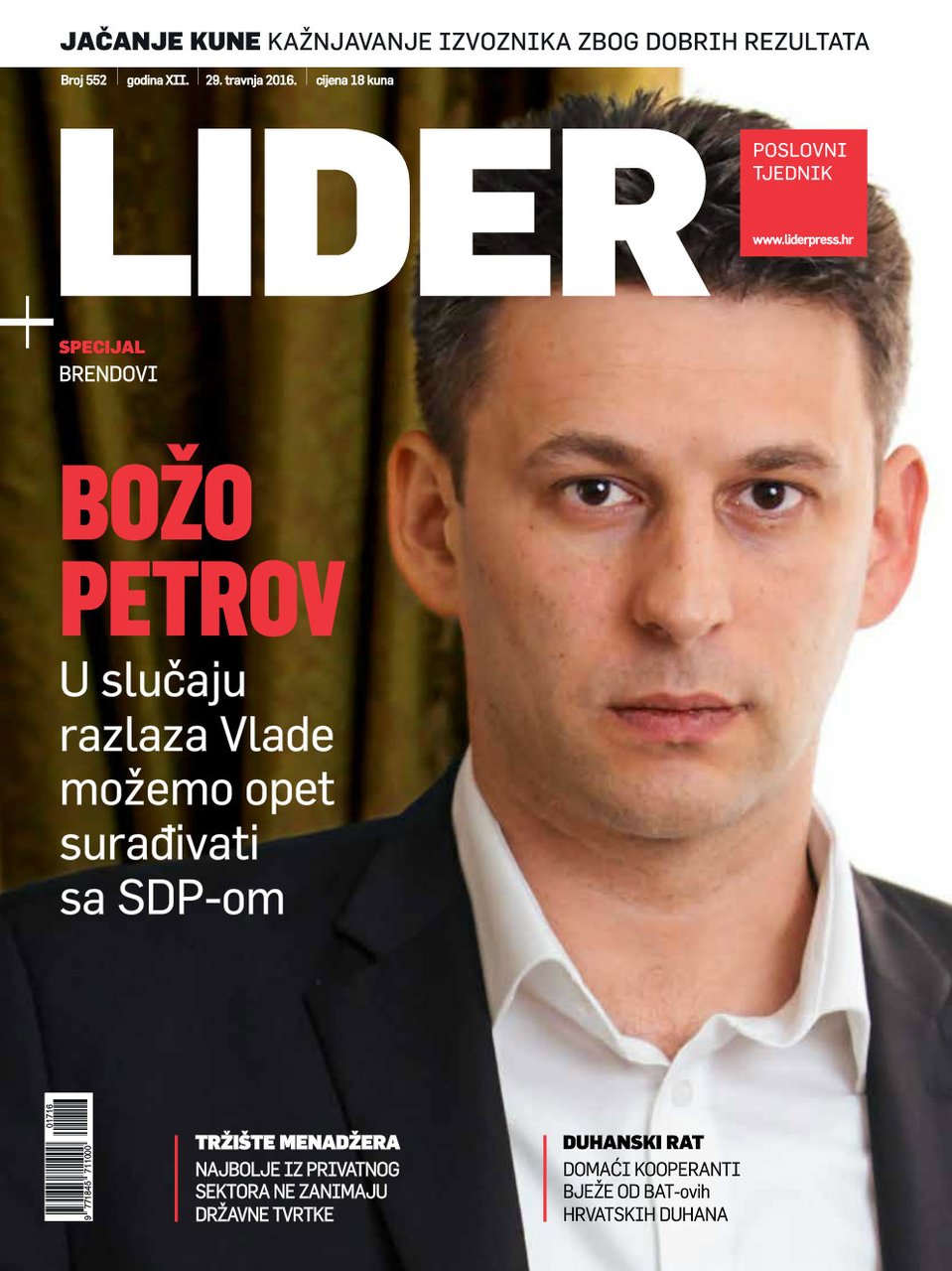
If the Government dissolves, new elections are realistic. But as the spokesperson for Most, Nikola Grmoja, says, the SDP and Milanović can show that they are ready to cooperate in the interest of the state in the Parliament. We have never closed the door to cooperation with anyone in that direction.
The political marriage between Most and the Patriotic Coalition is in its most serious crisis this week, just before the hundredth day of the Government, which falls on Sunday, May 1. But not because of the future of INA, which has proven to be a hot topic in the country, due to the non-implementation of reforms we are still waiting for, nor because of Croatia’s strategic interests that Deputy Prime Minister and Most leader Božo Petrov swears by. Omiš has fundamentally shaken Most’s trust in HDZ, after which, for the first time since the end of negotiations on forming the Government, Most has begun to openly flirt with the SDP. Thus, Petrov states in an interview in the new issue of Lider – In the event of the Government’s dissolution, we can cooperate with the SDP again.
In the poker game for INA, Mol, official Croatia, but with two to three players, some of whom are soloists, arbitrators in Geneva and Washington, Hungary, the European Union, Russia, and the USA are involved. And everyone is bluffing, making it difficult to sift through the real situation from a series of spins. Regardless, in the new issue of Lider, we analyzed the most likely options for resolution.
Political announcements about a major cleanup at the head of state-owned companies have also revived the market for managers. Although there will certainly be plenty of candidates for managing the public sector, few well-known managers will embark on an adventure where they depend on the direction of political winds and do not have free hands. In the new issue of Lider, Matilda Bačelić writes that the best managers from the private sector are not interested in state-owned companies.
Members of the association Krupan list, cooperatives of the Virovitica company Hrvatski duhani, which is part of BAT Adria, could soon take ownership of the competing company Agroduhan from Slatina and also become its cooperatives. The transfer of cooperatives from Hrvatski duhani to Agroduhan would represent a significant turnaround, and the question is what BAT Adria would do with Hrvatski duhani in that case. Namely, if it loses the cooperatives, of which it has by far the most, it would have to procure tobacco from abroad or BAT could decide to lock the doors in Virovitica. Edis Felić writes about the tobacco war in the new issue of Lider.
Many believe that Croatia is like some corrupt poor country. And it is teeming with geniuses, but the system is organizationally set up in favor of imports and local lackeys of foreign bankroids. In the new issue of Lider, in an interview with Kata Pranić, Dr. Davor Pavuna says that the EU, neighboring countries, and corporations have a detailed analysis of all key Croatian experts, resources, and plans.
The shipbuilding company Agena Marin from Biograd is today a leader in the production of vessels for tourist excursions into the underwater world. Its semi-submarine SemiSubmarine is an attraction in the Maldives, and there are interested parties from Australia, Caribbean countries, Spain, the USA… The owner of Agena Marin, Mladen Peharda, discussed the company and business with Kata Pranić.
The latest example of the rise of the radical right in wealthy, developed EU member states is the presidential elections in Austria and the victory of the candidate from the radical right Freedom Party in the first round. In Serbia, however, although Šešelj achieved a good result in the elections, 85 percent of the votes went to pro-European, centrist options. The wealthy seek protection in radical options, while the poor hope for improvement from the center, writes Vanja Figenwald in the new issue of Lider.
The same author writes that penalties and damages for cheating could lead to Mitsubishi’s downfall. Namely, after VW’s scandal last year, all car manufacturers are under special regulatory scrutiny, yet new scandals are emerging. Last week it was revealed that Mitsubishi also cheated on fuel consumption. And not only on its cars but also on those it produced for its partner Nissan. Both scandals show how unbearable the pace of competition has become, as it is clear that no one is hesitating to ensure a market advantage.
Read here.



