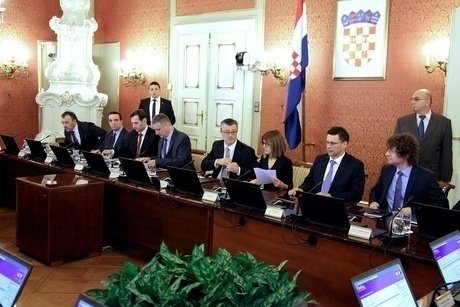
One hundred days is the first transitional period for assessing the government’s work. However, this period has been spent on completing the ministries and aligning between coalition partners and the non-partisan prime minister. Therefore, real measures are only expected – between hopes for a coherent economic program and fears of continued ministerial soloing. If the government does not collapse beforehand.
In the new issue of Lider, we write about the first 100 days of the new government; yesterday we presented the first part, and now we bring you the second part of the overview of what the ministries and individual ministers did.
Ministry of Culture (Zlatko Hasanbegović) – More notable for ideology than for culture

Immediately after taking office, he abolished funding for non-profit media, which caused the most controversy in the public. The public was more entertained by ideological statements than by solutions for the struggling culture, which received less budget funding this year than last year. The strategic project of his ministry this year will be the relocation of the Croatian Historical Museum to a new location.
Ministry of Foreign Affairs (Miro Kovač) – Participated in closing the Balkan route

He immediately tackled the migrant crisis and, with the help of Austrian colleagues, closed the Balkan route insisting on quotas for refugees. He was the first to go to Budapest after the government’s appointment to calm relations with the Hungarians – although without the knowledge of Most – and helped open railway traffic between our two countries. Among his recent moves is the red light for opening EU negotiations with Serbia until conditions are met.
Ministry of Agriculture (Davor Romić) – Secured a little peace with subsidy payments

At the beginning of April, he welcomed the payment of subsidies for farmers, for which a total of 3.4 billion kuna was allocated, thus securing at least some time of peace in the department. At the beginning of his term, he stated that his priorities are land reform and a kind of tax on uncultivated land, which some farmers received with discontent. He also announced the development of strategies for the agricultural and food industry, as well as for forestry and wood processing.
Ministry of Social Policy and Youth (Bernardica Juretić) – Still preparing the law on 1000 euros for newborns

When she is not seeking God’s help in managing the department, she is changing the Family Law, the new version of which will be presented at the end of this or the beginning of next year; the main goal will be to simplify adoption. She is also preparing a law under which every newborn child will be gifted 1000 euros by the state, and a reduction in social transfers has been announced along with alignment with property and income criteria.
Ministry of Health (Dario Nakić) – Author of the most unpopular moves

Every government knows that the most unpopular moves are made at the beginning of the term, and until now, the health minister has been the most responsible for them. The reason for this is the announcement of an increase in supplementary insurance and the reform of the emergency medical service. He is also facing a reform of the hospital system, which is struggling with financial and staffing problems as doctors and nurses are literally fleeing from Croatia.
Ministry of Defense (Josip Buljević) – Welcomed by the MIG affair

The future of the Croatian combat aviation depends on the new Minister of Defense. This requires a lot of patience as it has been shown that the overhaul and procurement of MIGs in Ukraine are under investigation by the State Attorney’s Office due to irregularities and suspicions of corruption, which is why MIGs are not breaking the sound barrier for the time being. Meanwhile, the Ministry of Defense recently signed a contract for the procurement of military equipment for the needs of the Armed Forces with representatives of 27 Croatian companies worth 200 million kuna.
Ministry of Veterans (Tomo Medved) – The rights of veterans are more important than the tent

The tent is still on Savska Street in Zagreb, so Medved has not yet reconciled the veterans’ associations and the government. The tent is not his main goal, but rather resolving all open issues with the veteran population. He announced the drafting of a new law on the rights of Croatian veterans and simultaneously the development of a national strategy for the protection of veterans’ health, and he will also consider ideas related to veterans’ centers and a veterans’ hospital.
Ministry of Justice (Ante Šprlje) – Indicated major reform plans

He plans to introduce the non-expiration of war profiteering, privatization crime, and serious murders into the Constitution, and for 2017 he announces further steps in restructuring the court system initiated by his predecessor. A lot is expected from him, and he himself has big plans for activating the Council for the Implementation of Judicial Reform.
Ministry of the Interior (Vlaho Orepić) – Forced changes and then reorganization

He is currently dealing with the reorganization of police administrations. His chair was most shaken by the robbery of gold and money in Heinzelova, which many interpreted as a message to him from those in the police ranks who are loyal to another, old colleague minister.
Ministry of Science, Education and Sports (Predrag Šustar) – Continues the education reform

There were speculations that the education reform was being abandoned. However, Šustar quickly calmed the passions by announcing that the reform will continue and will begin experimental implementation in September. Although the Law on Sports came into force during his term, the minister is not implementing it. Sports inspectors are still waiting for instructions, and Šustar is already announcing a new, thorough legislative proposal.