
The most common economic crime in Croatia is asset appropriation and cybercrime, with only one in four companies conducting fraud risk assessments.
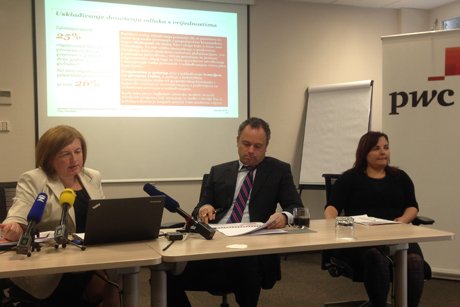
What are the three predominant types of economic crime in Croatia, who are the most common perpetrators of fraud, what are the financial losses due to economic crime, and how effective is Croatia in detecting economic crime? These questions were answered by this year’s PwC Economic Crime Survey. The results of the survey were presented at today’s press conference by Per Sundbye, a partner at PwC and head of forensic services in Southeast Europe, and Martina Butković, a director at PwC responsible for forensic services in Croatia.
The survey included a significant number of Croatian financial directors, treasury and controlling department heads, 19 percent, executive directors, presidents, and general directors, 17 percent, board members 17 percent, and others. Seventy percent of them are from private companies across various sectors: finance, insurance, engineering and construction, manufacturing, and technology. In Croatia, one in four companies has experienced economic crime in the last two years, while globally, the figure is 36 percent.
The most common economic crime in Croatia is asset appropriation in as many as 58 percent of cases, while globally it is 64 percent; bribery and corruption account for 33 percent, which is higher than the global level of 24 percent, and cybercrime is at 25 percent, compared to 32 percent globally. However, this is not the true picture of the situation.
– In Croatia, only 26 percent of respondents have experienced economic crime, which is below the average, but there is a likelihood of lower detection rates. Key tools for monitoring and detection, such as data analytics for identifying unusual activities and irregular transaction patterns, are not very sophisticated and are often not used at all – said Sundbye, emphasizing that there are no effective channels for reporting economic crime, such as hotlines for reporting irregularities, nor protections for those who report them.
The largest share of economic crime in Croatia is in the retail and consumer sector (while globally it is in finance), followed by insurance companies, engineering and construction, financial services, and manufacturing and technology. The highest number of frauds occurs in state-owned companies, followed by private companies and joint-stock companies, and they are discovered during regular internal audits or through corporate security.
Although cybercrime is on the rise, only four out of ten companies in Croatia, as well as globally, have crisis management experts who can deal with it. One in four Croatian companies has experienced cybercrime, with financial losses amounting to 350,000 kuna, but 27 percent of respondents reported losses exceeding seven million kuna. Cybercrime has caused service interruptions and theft of intellectual property, as well as data theft. Despite this, 21 percent of Croatian respondents do not intend to create a protection plan against such types of crime, and 27 percent have no plan at all.


