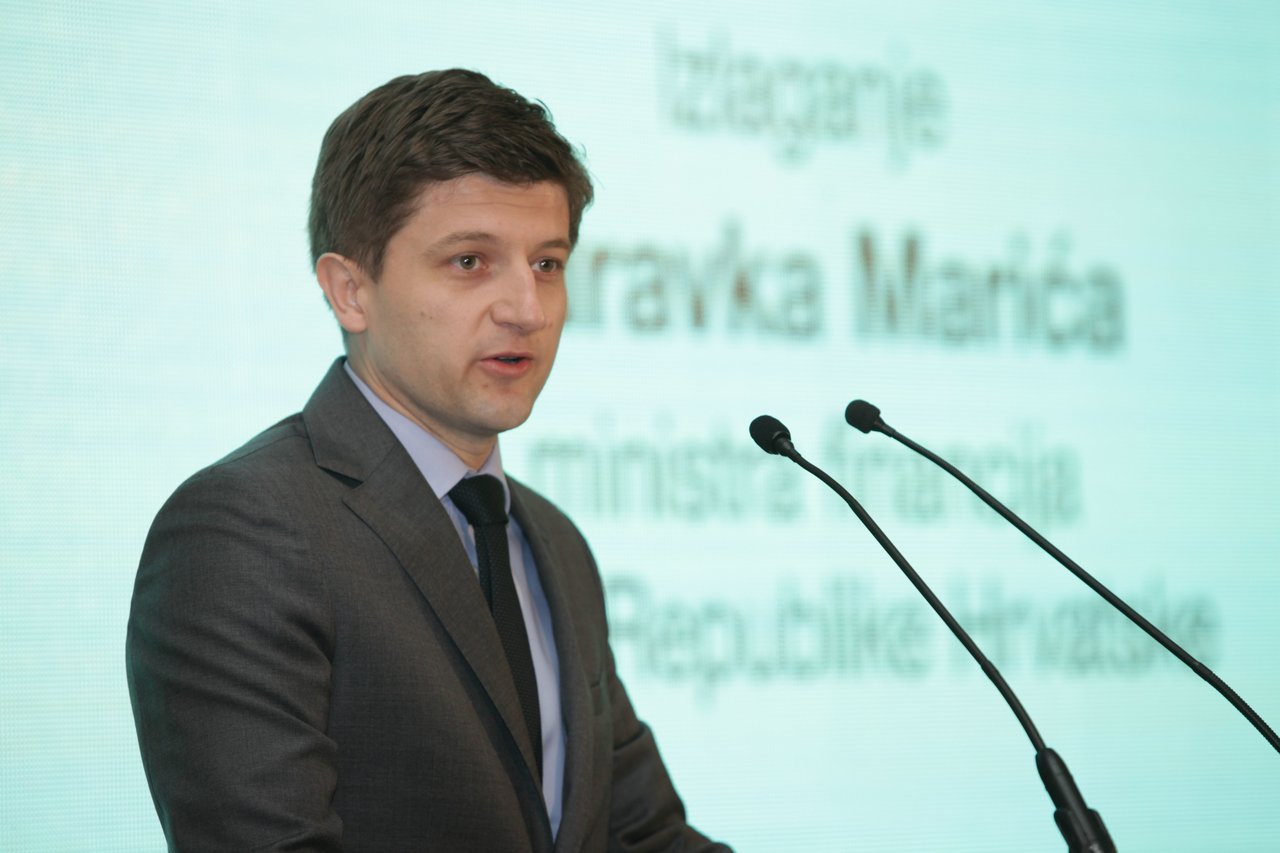
Finance Minister Zdravko marić stated that it is difficult to comment on how much tax is evaded annually in Croatia, but that reports from the Economic Institute and the State Bureau of Statistics on the grey economy can be monitored, which include a portion related to tax evasion.
Finance Minister Zdravko Marić said on Tuesday that Croatian anti-money laundering services are connected with foreign services and are actively involved in resolving the Panama Papers case.
– All our services – state and those in the Ministry of Finance, such as the Office for the Prevention of Money Laundering, as a sort of financial intelligence service, are connected and networked with all other services in the European Union, as well as those in over 150 countries worldwide, said Marić on the sidelines of the conference “Loans and Economic Growth”. He emphasized that Croatia actively participates in this and all other similar cases, but did not wish to disclose which specific foreign services Croatia collaborates with.
– The services act in accordance with all procedures and protocols, that is, according to the orders they receive, but also the orders we request from other countries and perform the analytical part of the work, added Marić, emphasizing that he cannot comment on any specific and concrete elements of the mentioned case.
– I can only say that all our institutions diligently and responsibly do their part of the work. All international relevant bodies that refer to Croatian services, including the Office for the Prevention of Money Laundering, have so far spoken only and exclusively in superlatives.
He added that it is difficult to comment on how much tax is evaded annually in Croatia, but that reports from the Economic Institute and the State Bureau of Statistics on the grey economy can be monitored, which include a portion related to tax evasion. When asked how the state budget is filled, the finance minister said that a slight increase in certain tax revenues has been recorded, highlighting revenues from excise duties and corporate tax, but not from VAT.
Commenting on the banks’ request for arbitration in Washington regarding the conversion of loans linked to the Swiss franc, Marić said that the government has its mechanisms, but that it cannot currently comment on further steps.
– We are aware of the complexity and sensitivity of this topic. The government certainly has its mechanisms and activities, but at this moment cannot comment on potential and possible further steps. The conversion is as such completed, and based on that, further discussions will continue with both the involved banks and the European Commission, he stated.
The finance minister did not want to speculate on what would happen if the Constitutional Court decides in favor of the banks, only stating that the government will act in accordance with the decision.
– When there is a ruling or decision, we will act accordingly. The law has practically been consumed, he said.
When asked by journalists whether the government is discussing a new and better solution for loans in Swiss francs and a compromise with the banks, Marić emphasized that all aspects are taken into account and that the government also has some arguments it uses in discussions with banks and the European Commission, and that it considers the overall effect on debtors and society as a whole. He added that debtors have nothing to fear.
Regarding the protest of civil society organizations due to the drastic reduction in the distribution of revenue from games of chance, Marić said that these funds are distributed according to government regulations and go for a large number of purposes, from sports activities, veterans’ associations, associations in the domain of social policy, demographics, family, as well as civil associations.
– The proposal that will be presented to the government tomorrow is in line with our forecasts for this year and takes into account experiences from previous years, including some unspent, transferred funds. It is understandable that certain groups will not fully agree with certain decisions; however, I believe that this regulation will provide enough money for the financing of civil associations, he stated.