
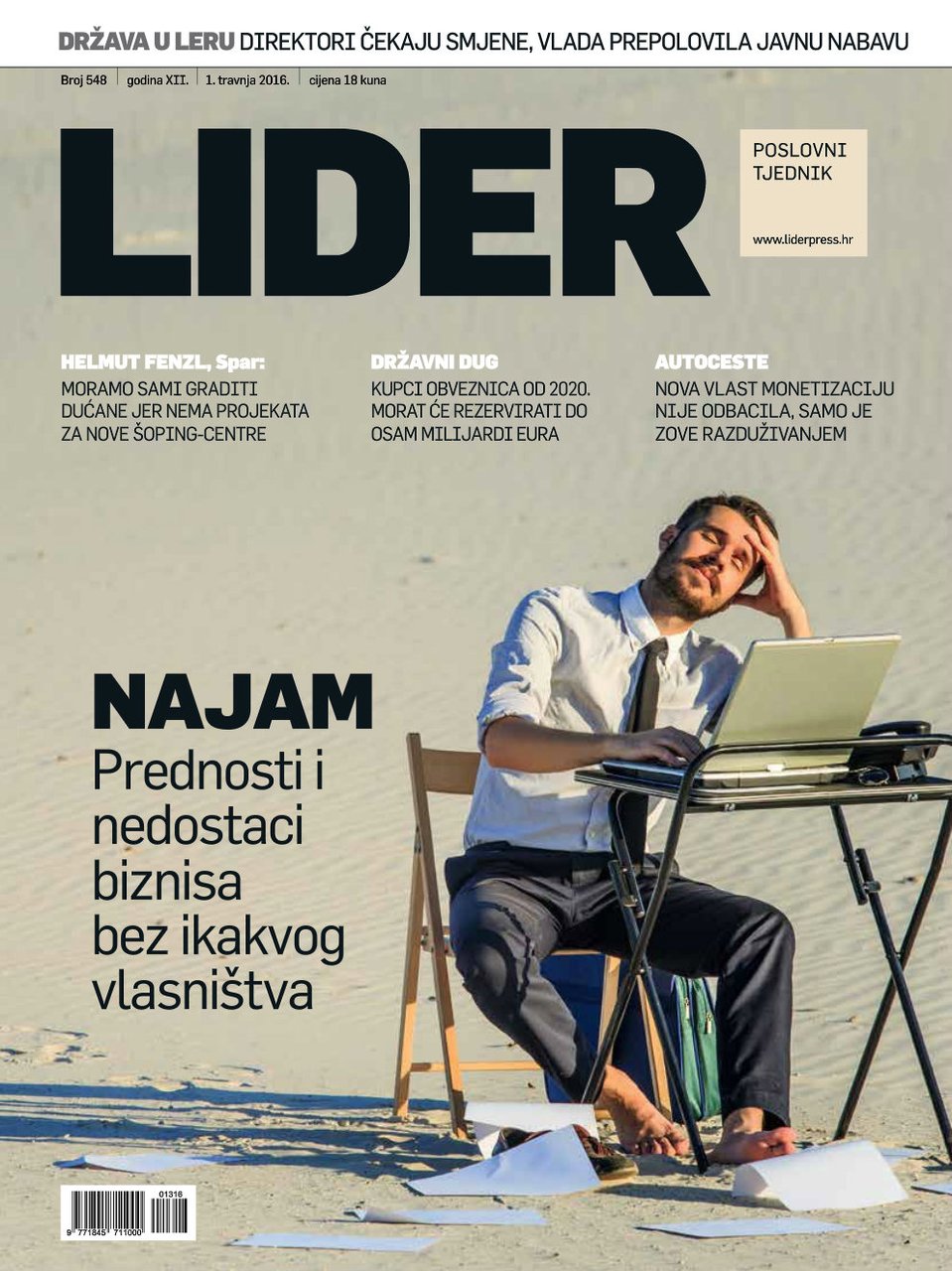
A new business model is slowly taking root in Croatia, primarily in ‘one-man-band’ and small companies. However, larger organizations prefer to hire what they need, at least for seasonal or project-based operations, rather than invest in ownership.
Although Croatia has not moved far from the mentality of ‘what’s mine is mine’, these new models, still relatively unknown, are slowly breaking through. Namely, ownership is not always better than renting, just as renting is not always better than ownership. Miro Soldić and Jasmina Trstenjak write about the advantages and disadvantages of a business without any ownership in the new issue of Lider.
Today, creditors do not have to reserve any money for state financing. This will gradually change. The amount of reservations will depend on credit risk. According to today’s rating, this would be one hundred percent on every foreign currency bond and loan. Bond buyers from 2020 will have to reserve up to eight billion euros, reveals Gordana Gelenčer in the new issue of Lider.
It is no secret that Croatian highways can no longer be financed by the existing toll collection system, and it is increasingly likely that changes will occur, as the state collects 250 million euros annually from tolls, while, for example, Slovenia, with half as many kilometers of highways, earns as much as 300 million euros from vignettes. Whether Croatia will fully switch to a vignette system or whether they will be introduced while retaining the ENC system are questions that the government should answer through a professional study conducted by consultants selected by the European Bank for Reconstruction and Development (EBRD), which should be completed by the end of this year. In parallel with the new analysis of the profitability of vignettes, the Ministry of Transport is refining the document of its predecessors. The government has not completely abandoned the idea of monetizing highways, although it is on the table as a last resort for resolving the debt for highway construction, writes Ksenija Puškarić in the new issue of Lider.
Minister Nakić is desperately trying to save two billion kuna, writes Tin Bašić in the new issue of Lider, adding that with the new regulation that governs a kind of public-private health partnership, allowing doctors from the public sector to work in both hospitals and private practice, the Minister of Health is trying to retain doctors in Croatia with this emergency measure.
The largest Croatian producer of cracklings and lard, Frelimo from Samobor, exports products to the EU market, and will now also target China. It is ready for this as it has more production capacity than is currently in operation. Although it prepares cracklings from imported bacon, the production is traditional. Frelimo is also the first Croatian producer of cracklings to win the Superior Taste Award, writes Kata Pranić in the new issue of Lider.
This government has another 3-6 months of maneuvering space with foreign investors. No, this is not claimed by Vanja Figenwald; it was revealed to him in the new issue of Lider by Timothy Ash, Director of Credit Strategy for the EMEA region at the prestigious Japanese bank Nomura.
The same author also brings the story of the fallen internet giant Yahoo. Namely, Vanja Figenwald reports that Microsoft is ready to invest in the struggling Yahoo to avoid losing the Bing search engine.
Read more here.



