
Citizens of Croatia are open to all the advantages of the digital economy – from online banking to shopping via mobile devices, but they are also aware of all the risks it brings and are ready to protect their personal data.
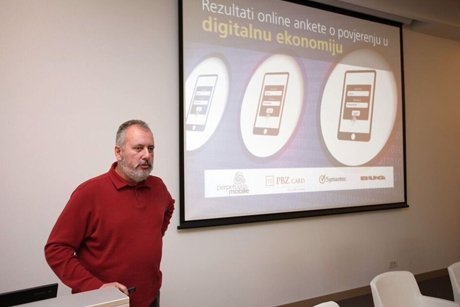
Additionally, citizens are turning to the internet and the digital economy seeking advantages over the traditional economy. They inform themselves about what is offered and ultimately make decisions based on criteria of availability, speed, better offers, and service security. This is the conclusion of a study on trust in the digital economy conducted on nearly 6,800 respondents by Perpetuum Mobile and its partners, PBZCard, Symantec, and the magazine BUG.
The digital economy is a new form of economy based on digital technologies that have long since gone beyond the realm of “informatics.” They have become an indispensable element of life and work in modern times, and for the economy, they represent one of the most attractive growth opportunities.
Croatia and its citizens have been adopting, using, and developing various skills and products that create the digital economy for several years now. With the expansion of digital into all spheres of society, the traditional economy is transforming into a digital economy.
According to the recently published “The Digital Economy & Society Index (DESI),” 47 percent of the population in Croatia uses online banking services. This coincides with data collected in the study on trust in the digital economy, where 46.5 percent of respondents stated that they use online banking services. However, compared to the European Union, where 57 percent of the population uses online banking, we are still below the average. Interestingly, however, even a quarter (26 percent) of Croatian citizens use mobile banking. For comparison, the EU average is 33 percent.
Although according to DESI data, only 44 percent of Croats shop online, this study shows somewhat different data, closer to the European average of 65 percent. Thus, more than three-quarters (78.1 percent) have shopped online more than 5 times in the past year. In most cases (84.3 percent), this involved purchasing various products such as books, white goods, and software. A high proportion (76.6 percent) of citizens have paid bills via the internet or mobile phone, while other activities such as purchasing services (47 percent), tickets for music or cultural events (43.5 percent), and eCitizen and eMail services (38.9 percent) were performed to a somewhat lesser extent. Although during online shopping, the majority of respondents (75.6 percent) use credit cards and (72.7 percent) PayPal, it is interesting to note that just over one percent also use the virtual currency Bitcoin.
Croatian citizens, although they enjoy shopping online, are quite cautious when it comes to their personal data. Thus, 89 percent of respondents leave their credit card information only if sellers have security certificates and other mechanisms to protect their private data. However, it should also be noted that 7.3 percent of respondents do not leave their credit card information with anyone, regardless of certificates and protection mechanisms.
Online and mobile banking is widespread among Croatian citizens primarily due to accessibility (71.8 percent), while one-fifth simply does not want (or does not have time) to go to a bank branch to conduct their transactions.
In this regard, the most commonly used service is bill payment (92.3 percent) and checking account balances (79.7 percent). It should not be overlooked that even a third of respondents purchase mobile phone vouchers via e-banking or m-banking. Interestingly, among the 3.6 percent of respondents who do not use online or mobile banking, the main reason for this is fear. Namely, nearly two-thirds (59.1 percent) indicated that they are not sure that such a way of doing business is safe, while 17.8 percent of respondents see no advantage in using such a service.
That mobile phones have become an indispensable part of everyday life is best demonstrated by the fact that Croatian citizens are willing to use them as a means of shopping. More than half of them (54.7 percent) have some shopping app installed on their smartphones.
Mobile phones are most often used for paying parking or travel tickets (56.8 percent) and products (31.3 percent) and services (14.2 percent) in online stores. In this regard, the most commonly used payment mechanism is the mobile phone bill with the mobile operator (35.6 percent) and manually entering credit card information (29.1 percent).
Given that more and more shopping centers around the world are using the possibility of personalized offers to visitors through specialized apps, we were curious whether citizens would be willing to allow stores or companies to track their movements in order to offer them special services. More than half of the respondents (52 percent) rejected such a possibility, while 40 percent would consider it if the offer were good enough.
On the other hand, personal data for respondents is a category they do not want to put into commercial use. Thus, only a quarter (24.9 percent) of respondents would be willing to share some personal data to receive better offers, while nearly half of them (46.9 percent) would consider it if the offer were attractive enough.
That Croatian citizens take cyber threats seriously is also shown by data on how they protect their data on computers and mobile phones. As many as 85.5 percent of respondents have antivirus software installed on their computers, and half of them (50.4 percent) also use a firewall for additional security. On the other hand, when it comes to their mobile phones, they are somewhat “more relaxed.” Only a third (32 percent) have antivirus software installed on their computers, while half (50.6 percent) protect their data and access to their mobile phones with a PIN.


