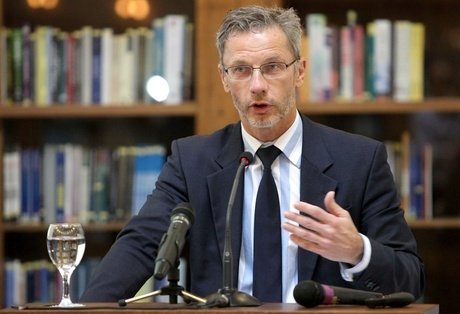
The Governor of the Croatian National Bank, Boris Vujčić, delivered a lecture at the Faculty of Economics in Rijeka on the topic “The Impact of Monetary Policy on the Competitiveness of Croatia,” and in response to a journalist’s question about the proposed state budget, he stated that he would not comment on the budget for now, as he has said more or less everything he had to say about it.
The Governor of the Croatian National Bank, Boris Vujčić, stated on Friday in Rijeka that the proposed state budget for this year is within expected parameters, and that the CNB estimates that GDP growth this year should be around two percent, and he believes that a budget revision should not be expected.
– So, what I said earlier, I think has been confirmed in the presentation of the budget. We are roughly within the parameters we expected, more or less maintaining expenditures at the level of the previous year, which, due to revenue growth and economic growth, leads to budget adjustments and a reduction of the budget deficit to around or below three percent of GDP, said Vujčić.
When asked whether the economic growth of two percent on which the budget is based is realistic, Vujčić said that at this moment, the CNB’s estimates are that GDP growth this year should be around two percent.
– Given our growth projection and this budget, a revision should not be expected, Vujčić said in response to a question about whether he expects a budget revision considering the anticipated decline in consumption.
When asked what he expects, given that we have avoided a corrective procedure from the European Commission and that the credit rating assessment is still pending, the central bank governor said that he does not like to speak about it in advance and that the rating agencies will say what they think themselves.
The European Commission announced on Tuesday afternoon that no corrective procedure will be initiated due to excessive macroeconomic imbalances in which Croatia finds itself. The Commission will reconsider its assessment in May to take into account the level of ambition of national reform programs.
Journalists also asked Vujčić what he expects regarding the report on the work of the CNB in 2014 and the semi-annual information on the financial situation, the degree of achieving price stability, and the implementation of monetary policy, as well as the situation in the Parliament regarding voting or not voting on the CNB’s report. The CNB, by law, informs the Parliament twice a year about the implementation of monetary policy and financial stability, Vujčić reminded, adding that they have done so and that the discussion was very interesting.
Meanwhile, in the Parliament, representatives of the Most party and the opposition, dissatisfied with the interpretation of the Speaker of the Parliament, Željko Reiner, regarding the reasons why there will be no vote on the CNB’s report for 2014 this Friday either, demonstratively left the chamber, making it impossible to continue voting on other items due to a lack of quorum.