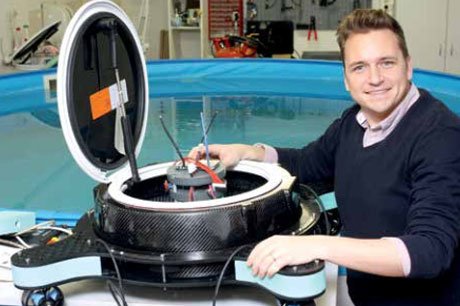
Assistant Professor in the Laboratory for Underwater Systems and Technologies at the Faculty of Electrical Engineering and Computing, University of Zagreb, Dr. Nikola Mišković is the coordinator of a large and important project ‘CADDY’, which aims to finally enable divers to access the deepest marine expanses with the help of robots.
In addition to ‘CADDY’, among the many projects that this young scientist is working on in the laboratory led by Professor Zoran Vukić, it is worth highlighting the multi-robotic system being developed as part of the European project ‘subCULTron’, which is intended to prevent the devastation of Venice, and the ‘MORUS’ project led by Professor Stjepan Bogdan from FER, which is part of NATO’s prestigious ‘Science for Peace’ program.
– It is fascinating how many unexplored areas we have on Earth. We have a map of the Moon, but if we go just a little south of Zagreb, the depths of the Adriatic Sea are still unknown to us.
We may never personally encounter these unexplored underwater places, but if we engage in underwater robotics, we will be the first to learn about them – explains Dr. Mišković, sharing the source of his passion for this field. The expert team in FER’s Laboratory for Underwater Systems and Technologies is engaged in all types of research related to marine robotics. This includes robotics on the sea surface and underwater. Underwater research is very demanding and challenging because there is neither GPS nor wireless communication, yet on a planet that is 70 percent underwater, detailed maps of the seabed do not yet exist. The expansion of underwater robotics has only occurred in the last twenty years. The reason for this, as Mišković reveals, is not a sudden desire to explore new species of animals or plants, but rather that we have exhausted the ores on the Earth’s surface, which is why we now need to turn to the exploitation of underwater ores.
The ‘CADDY’ project is therefore very important. It is the largest project in the Laboratory for Underwater Systems and Technologies, funded by the Seventh Framework Programme of the European Commission (FP7). It is the first such project coordinated by an institution from Croatia. The project involves seven partners across Europe, and the European Union is funding it with a total of 3.7 million euros. It focuses on researching the possibilities of interaction between autonomous underwater vehicles and divers during complicated underwater missions.
– Our goal is to create a successful system that will enable interaction between the robot underwater and the diver. It should independently assess what information to provide to the diver who, in our envisioned scenario, has an underwater tablet, but we want to create a robot that will be a ‘buddy’ to the diver, performing tasks for him and guiding him through the difficult underwater world and ultimately bringing him to the desired point. It must also predict in time whether a problem will arise, such as nitrogen poisoning, and alert the crew on the surface – explains the project coordinator. The ‘CADDY’ project started in January 2014 and is expected to last three years. How the robot functions in real conditions was proven by last year’s validation experiment in Biograd na Moru. Now they are left with polishing and the final validation project in October, says Dr. Mišković.