Lider is not against high fines for serious offenses, such as tax evasion, falsification of books, etc. However, there are also unjustifiably high fines for minor offenses. The biggest victims of such budget filling are small entrepreneurs and craftsmen, who are not even warned about minor mistakes before being punished.
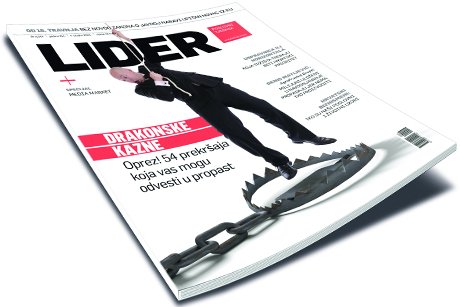
Apartment owners who do not install heating dividers will be fined from 10,000 to 50,000 kuna. These are indeed unjustifiably high fines, especially considering that many retirees live in these apartments and find it difficult to allocate money for dividers. The seriousness of the situation is highlighted by the fact that the Ministry of Economy misinterpreted the EU directive and legally obligated apartment owners to install dividers, prompting the new minister Tomislav Panenić to establish a working group to consider the effects of introducing dividers. Regardless of the effects, the blunder with the inappropriately high fines has prompted us to seek examples of draconian fines that entrepreneurs must pay for minor offenses. We found 54, which means there are almost certainly more, limiting ourselves only to legal regulations related to the economy. Therefore, in the new issue of Lider, Edis Felić warns: Caution! 54 Offenses That Can Lead You to Ruin.
When discussing the budget, Gordana Gelenčer states that this Government is neither cautious, nor realistic, nor brave. Not only has no government had the political courage to delve into the essence of things, but it also does not know where we want to be, where we want to go, and on what basis we will grow sustainably. Appeasing creditors and investors is not enough. Everyone who feared major cuts can breathe a sigh of relief. There will be none. It is not that the recent statements from the Marić-Orešković tandem could lead to any other conclusion. The emphasis this year, as it became clear even before Orešković’s ‘good, good, good’ performance, is on revenues, less on expenditures.
Which markets should be Croatian priorities, asks Matilda Bačelić in the new issue of Lider. Croatia achieves a foreign trade surplus with horizontal countries and a deficit with vertical ones. Supplementing the traditionally close horizontal with a more potent vertical would be more than welcome, but on the export side of commodity exchange. It seems that after the change of government, the region is no longer what it used to be. Namely, what has so far been generally implied by the term ‘region’ was more or less the territory of former Yugoslavia, plus-minus a few other countries in Southeast Europe. Now, in political efforts to distance ourselves from the orientation and associations with the former state, ‘vertical’ and ‘horizontal’ are being promoted, which is, in fact, the previous ‘region’.